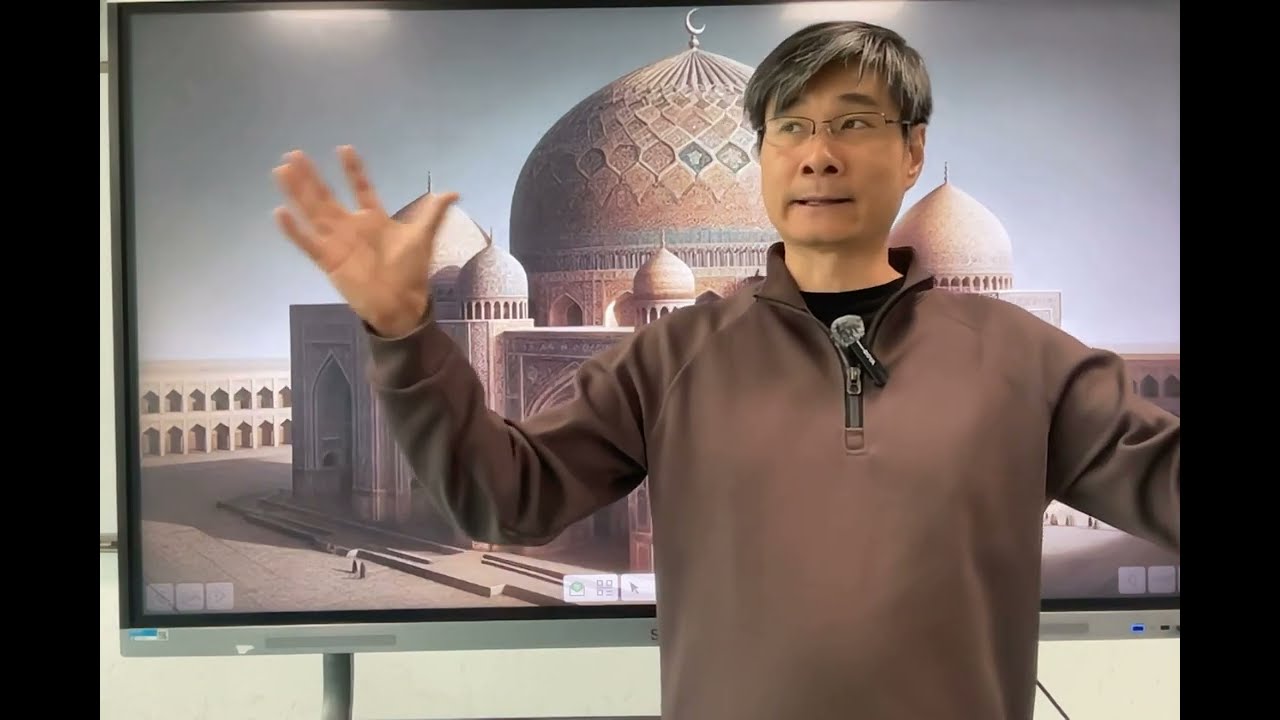
While medieval Europe entered its “Dark Ages,” the Islamic world experienced a Golden Age of intellectual, scientific, and cultural flourishing that lasted roughly from the 8th to the 13th century. This episode explores three central puzzles: why this divergence happened, what eventually ended the Golden Age, and how Christian Europe later overtook the Muslim world. The core argument is that Islam’s unique theological synthesis, combined with its embrace of Aristotelian empirical thinking, created the conditions for a civilization that became the true portal to modernity, even though Europe ultimately built on and surpassed those foundations.
The Foundations of Islam
Islam is the world’s second-largest religion with about 1 billion adherents, divided primarily into Sunni (the majority) and Shia (concentrated in Iran), the key difference being whether leadership must descend from Muhammad’s grandson Ali.
Founded by Muhammad, a merchant who at age 40 received visions from the Archangel Gabriel in a cave near Mecca; these revelations became the Quran.
Muhammad was forced out of Mecca and migrated to Medina (the Hijra), where he brokered peace among warring pagan, Muslim, and Jewish factions through the Constitution of Medina, which guaranteed religious freedom to all.
From the start, Islam was designed as an open, tolerant, and inclusive tradition, a monotheistic coalition that saw itself as the culmination of the Abrahamic line: Abraham, Moses, Jesus, and finally Muhammad as the last prophet.
The religion is built on five simple pillars: belief in one God (Allah), five daily prayers facing Mecca, charitable giving, fasting during holidays, and the Hajj pilgrimage to Mecca at least once in a lifetime.
Muslims are described as among the most devout people, with even the poorest saving their entire lives to make the Hajj.
The Rapid Expansion and the Three Mysteries
In less than 100 years, Islam spread from the Arabian desert to conquer the Sasanian Persian Empire and half the Byzantine Empire, including Syria, Egypt, and Jerusalem. The Umayyad Caliphate became the largest and wealthiest empire in the world at the time.
The speed of expansion is puzzling because the Arabs were militarily outmatched on paper, and the episode argues this was less a conquest than a revolution: people disgusted with existing leadership simply switched allegiance.
Three mysteries frame the episode:
Why are there no written records from the first 100 years of Islam, despite literate Jews and Christians being part of the early movement?
Why didn’t Muhammad name a successor, given that this omission led to devastating civil wars between Sunni and Shia?
Why was the Al-Aqsa Mosque built on top of the Jewish Temple Mount, the holiest site in Judaism, if Islam was truly tolerant?
Solving the Three Mysteries
The missing records: The early period was revolutionary and tumultuous, involving civil wars and purges of Muhammad’s original companions, including Jews and Christians who held legitimate claims to authority. The victors had strong incentives to erase or disguise this history. Additionally, unlike Greeks and Romans, the Arabs simply did not have a strong tradition of written historiography.
No named successor: If you genuinely believe you are living in the end times, there is no point naming a successor because God himself is about to return and establish peace. Muhammad saw himself as the final prophet; after him, no human leadership structure would be needed.
Al-Aqsa on the Temple Mount: The episode proposes a controversial theory. During the Byzantine-Persian war, Jews allied with the Persians on the condition they could return to Jerusalem and rebuild their temple (just as Cyrus the Great had permitted centuries earlier). The Al-Aqsa site may have originally been intended as the third Jewish temple, promised in exchange for Jewish support. Over roughly 200 years of construction and shifting political dynamics, Arab leaders converted it into a mosque to prevent Jews from becoming too powerful within the Islamic world.
The Islamic Golden Age
The Abbasid Caliphate, centered on the new round city of Baghdad, launched the Golden Age. Baghdad became the center of the world, connected by trade routes spanning from China to Europe.
The Abbasids created the Maritime Silk Road, dramatically expanding global trade and bringing China into deeper contact with the rest of the world.
The House of Wisdom in Baghdad was modeled on the Library of Alexandria: its mission was to collect, translate, systematize, and disseminate all known knowledge from Greek, Persian, Indian, Chinese, and Jewish traditions.
Major contributions and figures:
Mathematics: Hindu numerals (0–9) were standardized and spread; Musa al-Khwarizmi founded algebra (the word “algebra” is Arabic, and “algorithm” derives from his Latinized name).
Philosophy and medicine: Ibn Sina (Avicenna) and Ibn Rushd (Averroes) were so influential that Dante placed them in limbo in the Divine Comedy alongside Socrates and Plato, acknowledging Europe’s intellectual debt to Islam.
Optics and physics: Alhazen essentially invented the field of optics.
Surgery: Al-Zahrawi is considered the father of modern surgery.
Hospitals: Baghdad had the world’s first 24-hour hospitals, and the poor were treated for free as a religious obligation.
Education: The University of al-Qarawiyyin in Fez, Morocco, founded in 859 by a woman, is the oldest degree-granting university in the world.
Literature: The Arabian Nights, likely of Indian origin, was considered low art in the Islamic world but was later embraced by Europeans.
Social science: Ibn Khaldun, writing after the Golden Age, is considered the father of social science, economics, and the philosophy of history, famous for his concept of asabiyyah (social cohesion) to explain why borderland peoples conquer empires.
Leonardo Fibonacci traveled to Baghdad to study mathematics and brought these ideas back to Europe, where they became foundational.
Why Islam Flourished While Europe Declined: A Theological Comparison
The episode compares Judaism, Christianity, and Islam to explain why Islam surged ahead during this period:
Judaism’s strengths: Rich literary tradition, emphasis on literacy and learning, which explains Jewish dominance in academia, law, and media. Weaknesses: The Bible is contradictory and difficult to interpret; Yahweh is a violent and inconsistent God; the “chosen people” theology creates a painful paradox when Jews are perpetually persecuted and homeless.
Christianity’s strengths: Jesus personifies and perfects divinity, providing a clear, consistent moral message; the idea of historical progress toward the Second Coming gives meaning to suffering. Weaknesses: The story of God becoming human and sacrificing himself is deeply confusing; the Holy Trinity is counterintuitive; God is distant and inaccessible to ordinary people.
Islam’s strengths: It synthesizes and perfects the Jewish and Christian traditions; God is absolutely one, everywhere, and knowable through direct experience; the five pillars give clarity of purpose; God can be felt inside you through devotion, giving believers strength and confidence. This combination of pagan-like concreteness (you can feel God in everything) with monotheistic clarity and simplicity was an intellectual revolution.
Islam’s weaknesses: Its very clarity and simplicity make it inflexible over time. The Quran claims to be the eternal word, which makes it difficult to reinterpret or innovate. Contradiction and conflict, paradoxically, are what drive innovation in Judaism and Christianity (eventually producing Protestantism), but Islam’s coherence resists such internal challenges.
Plato vs. Aristotle: The Philosophical Divergence
The episode argues that the real reason for the divergence between Islamic and European civilization comes down to philosophy:
Christian Europe followed Plato (as adapted by Augustine): God is the “Form of the good,” perfect and unchanging; the material world is a flawed shadow of heaven; the goal is to return to God through faith and by avoiding sin. This produces a passive orientation: do nothing, don’t make mistakes, and you’ll reach heaven.
The Islamic world followed Aristotle: God is the “prime mover” who set everything in motion; everything has a purpose (telos) that is fulfilled through action; truth is discovered through empirical observation and analysis. This produces an active, scientific orientation: go out, observe, discover, and fulfill your purpose.
Both civilizations had access to the same texts and wealth, but the choice of philosophical orientation made the difference. The Muslims’ Aristotelian empiricism drove the Golden Age; the Europeans’ Platonic passivity contributed to the Dark Ages.
How Europe Overtook the Islamic World
Europe eventually emulated the Islamic Golden Age through three major movements:
The Renaissance: Europeans rediscovered Aristotle and the empirical tradition through Arabic translations and scholarship.
The Protestant Reformation: Brought God closer to the individual, mirroring Islam’s idea that God is within you and that personal devotion matters more than institutional mediation.
The Scientific Revolution: Built on empirical observation but added a crucial innovation: institutions designed to destroy dogma through debate, experimentation, and falsification.
Europe’s key advantage was its ability to institutionalize the destruction of dogma. The Islamic world’s strengths, over time, became rigid orthodoxy that prevented further innovation. Europe’s internal contradictions and conflicts, by contrast, continued to generate new ideas and institutions.
The episode’s central thesis: the Islamic Golden Age is the true portal to modernity. Without Islam’s preservation, systematization, and advancement of knowledge, Europe could not have modernized. But Europe improved on the Islamic model by building mechanisms to continuously challenge and overturn established truths.
The Mongol End and the Gunpowder Empires
The Islamic Golden Age is traditionally said to have ended in 1258 when the Mongols sacked Baghdad and burned its books, destroying the thriving bookstore culture and intellectual infrastructure.
However, creativity did not stop entirely. The period from 1300 to 1700 saw three great Islamic empires, the Ottomans, Safavids, and Mughals, collectively known as the gunpowder empires, which continued to dominate much of the world.
Islam dominated global civilization from its founding in 622 until roughly 1700, a span of over a thousand years.