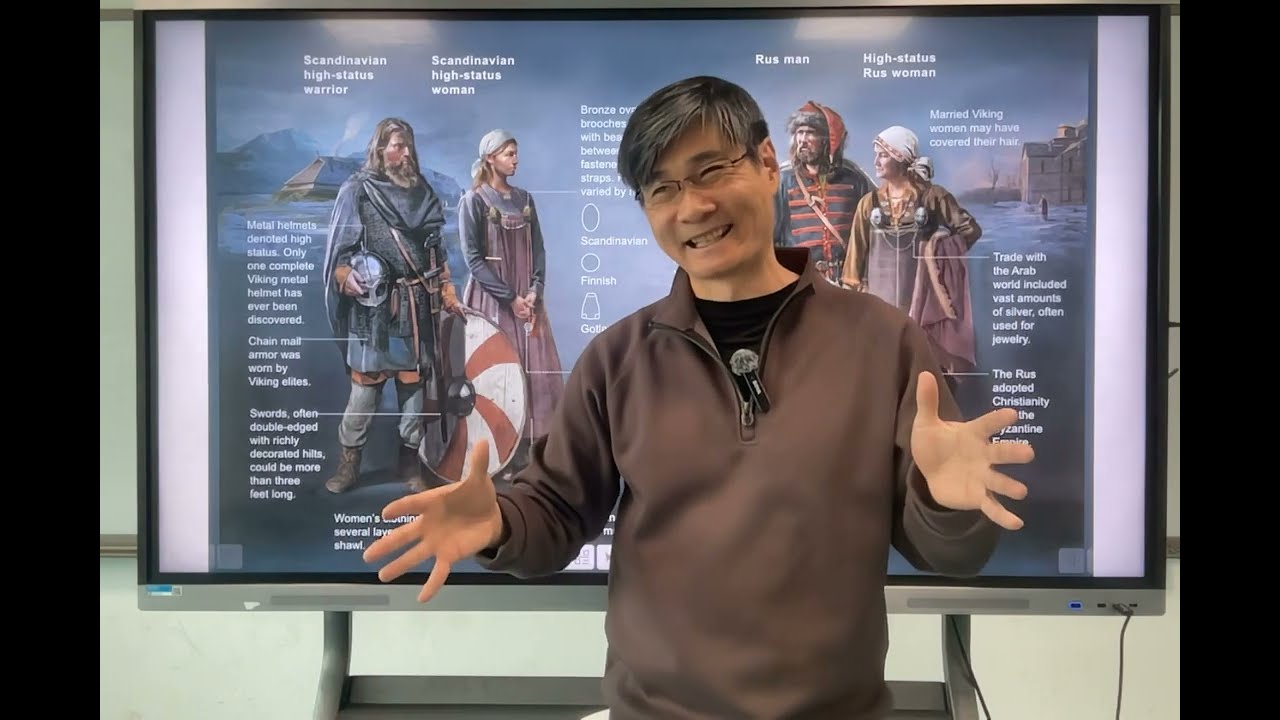
The Vikings are one of the most underappreciated and misunderstood cultures in Western civilization, and over two classes the professor argues they deserve to be recognized as a fifth foundational pillar alongside the Greeks, Romans, Jews, and Christians. This first class provides a historical overview of the Viking Age and situates the Vikings within the broader framework of the semester’s thesis about “oceanic currents of history” — the recurring pattern by which isolated Borderland cultures interact with, challenge, and eventually transform or merge with Empires.
The Viking Age: 793–1066
The Viking Age is conventionally dated from 793 to 1066.
793 marks the first recorded Viking raid on a monastery in Europe (Lindisfarne), which is one of the earliest written records of Viking activity, though Vikings had existed and interacted with Europe long before — some even served as mercenaries in the Roman Empire.
1066 marks the Battle of Hastings, when the Normans (descendants of Vikings settled in Normandy, France) conquered England. This event symbolizes the assimilation of Viking culture into mainstream Europe and the end of the Viking Age.
The Vikings originated from what are today Denmark, Norway, and Sweden — collectively Scandinavia.
The region’s geography is extremely diverse and rugged, historically making it poor, isolated, and culturally fragmented, with a mix of kings, tribal chieftains, and varied political systems.
Viking Expansion and Geographic Reach
During the Viking Age, Europe was under pressure from three main groups:
Vikings from the north (attacking by sea and rivers)
Magyars (Hungarians) from the east (land-based cavalry, the latest iteration of Proto-Indo-European steppe nomads)
Arabs from the south
The Vikings were unique as a maritime people — they attacked and traded via sea and rivers, not by land with cavalry.
Their expansion was vast:
East: Founded settlements at Kyiv (modern Ukraine) and Novgorod, giving them access to the Byzantine Empire, the Abbasid Caliphate in Baghdad, and the Silk Road to China.
West: Settled Iceland, Greenland, and reached North America (Vinland, in modern Newfoundland) — roughly 500 years before Columbus.
British Isles: Founded Dublin in Ireland; had major encounters with the British and Irish.
France: Settled in Normandy (“land of the Norse”), granted land by Charles the Simple after being defeated; from there they later conquered England in 1066.
The Vikings either founded or profoundly influenced four major European civilizations: Germany, France, Britain, and Russia. These four nations dominated global military and cultural life for the past 500 years, producing the greatest literature, philosophy, and art — a connection the professor argues is not coincidental.
Iceland: A Cornerstone of Viking Legacy
Iceland is particularly significant for three reasons:
Its population (~330,000) is remarkably homogeneous, descended from a small founding group that remained isolated for centuries.
It developed the Althing, considered the world’s first parliament — an annual gathering of all citizens to discuss political affairs, a cornerstone of modern European democracy.
Most Viking mythology and stories were preserved and written down in Iceland as sagas, which became the foundation of modern European literature.
Viking Activity: Trade, Mercenary Work, and Raiding
The popular image of Vikings as raiders is misleading:
Most Vikings engaged with Europe primarily through trade.
Some served as mercenaries in European armies.
Only a small minority were raiders and pillagers, but their extreme violence captured the European imagination and shaped the historical record.
The yellow-marked areas on maps of Viking expansion show documented raids — concentrated along coasts and rivers, made possible by their longships.
The Monastery Raids
Vikings primarily raided monasteries, which were the medieval equivalent of universities:
Monasteries were centers of learning where monks spent decades producing illuminated religious texts (especially the Bible), developing bookmaking techniques, fonts, ink, and binding systems still used today.
Books were adorned with covers of gold, jewels, diamonds, sapphires, and rubies — making them extraordinarily valuable.
Vikings, as a pagan and non-literate people, had no use for the books themselves. They would rip out the pages and take the gold and silver.
For the monks, this was traumatic — equivalent to having a child killed — and they recorded the Vikings as agents of Satan, creating the overwhelmingly negative historical perception of Viking culture.
The raids began as opportunistic strikes on unprotected concentrations of wealth and grew into a cycle: raids generated wealth, which fueled population growth in Scandinavia, which drove further expansion, eventually enabling the sacking of heavily fortified cities like Paris.
Viking Material Culture and Social Structure
Helmets: Vikings did not have horned helmets — this is a modern myth. Horns would be impractical in combat and on ships. Vikings were practical and economical people.
East-West cultural differences: Vikings who went east (the Rus, from whom Russia takes its name) intermarried with local populations and adopted local languages and customs, while western Vikings did the same in their regions. History is a continuous process of cultural integration.
Egalitarianism: Despite depictions of high-status warriors, Viking society was remarkably egalitarian. Most Vikings were independent farmers. Even on longships, there was little visible hierarchy — the captain was not markedly different from the crew.
Longhouses: Due to Scandinavia’s harsh climate, Vikings lived communally in longhouses, spending most of their time together, drinking, and telling stories — emphasizing their strong oral tradition.
Viking Longships
The longship was the dominant maritime technology of its era:
Deliberately small for flexibility and maneuverability, especially on rivers.
Designed to be light enough to be carried over rocks when navigating shallow or obstructed waterways.
Extremely lean and efficient, the product of constant innovation — Vikings were always refining ship design.
Europeans had no effective counter to this technology.
Vikings traded extensively with Arabs, Byzantines, and Chinese, trading slaves in exchange for silver, which held high status in Viking culture.
Viking Funerals
The cultural spectacle that mattered most to Vikings was the funeral (not a military triumph or theatrical achievement, as in Rome or Greece).
Only chieftains and great warriors received elaborate funerals.
These funerals lasted 10 days, were extremely expensive (consuming the warrior’s entire savings), and involved animal and sometimes human sacrifice.
The deceased was buried with a ship.
The professor emphasizes that the funeral process — not the burial itself — is where Viking culture expressed itself, serving to memorialize the dead and send them into the afterlife while ensuring their eternal contribution to the community.
The Slave Trade
Slavery was an integral part of European life at the time due to limited population, scarce agricultural surplus, and constant warfare.
The primary drivers of the slave trade were the Byzantines (Christians) and Arabs (Muslims), both of whom had a religious prohibition against enslaving fellow believers.
Vikings, as pagans, could enslave other pagans and sell them to either market, making the slave trade highly profitable for them.
The professor notes that slavery has been a persistent feature of human civilization and was only formally abolished during the British Empire era — and still exists today in hidden forms.
Archaeological Evidence: Viking Graves
Many Viking ship burials and graves have been discovered and studied. Key findings:
No standardized burial system: Graves vary enormously — one woman buried with a horse, another with a ship — suggesting individualized rather than systematic practices.
Lineage records: People were buried on top of ancestors, suggesting a narrative of family lineage.
Careful attention: Great thought went into how the dead were remembered, though the professor stresses the funeral process (not yet excavated) is where the real cultural meaning lies.
The Oceanic Currents of History: Empire vs. Borderlands
The semester’s central thesis: history follows a recurring pattern where Borderland cultures (isolated, peripheral) interact with Empires (large, centralized civilizations). Energy transfers from Empire to Borderland, the Borderland expands, conflicts with the Empire, and is either assimilated, destroyed, or becomes the Empire itself.
Examples: Greeks vs. Persians, Romans vs. Carthaginians, Arabs vs. Persians.
Three Advantages of Empires: Mass, Organization, Strategic Depth
Mass: Large populations.
Organization: Hierarchical systems enabling large armies and coordinated action.
Strategic Depth: The ability to lose battles and continue fighting.
Example: Darius could raise new armies after defeats by Alexander; Chiang Kai-shek could retreat inland after losing China’s coast to Japan; Rome lost every battle to Hannibal but won the one that mattered at Zama.
Three Advantages of Borderlands: Energy, Openness, Opportunism
Energy: Fewer people but more ambitious, aggressive, and resilient.
Openness: No central authority means freedom to innovate through open cooperative competition — separate groups learning from each other while trying to outdo each other. This drove Viking ship innovation.
Opportunism: Strategic and shameless — befriending the strong, exploiting the weak. Borderlands cannot afford to fight unwinnable wars.
The Viking Teenager: A Thought Experiment
A 16-year-old Viking around 800 AD would have been remarkably capable:
Skilled at farming, animal care, food preparation, woodworking, boatbuilding, and celestial navigation.
Proficient with axe, sword, and bow.
Able to survive alone in the wilderness, fight wolves, and navigate home from anywhere in Scandinavia or Europe.
The professor contrasts this with modern mass education systems (using China as an example), which he argues reduce individual energy by training students only to memorize facts and pass tests.
He states that if given the choice between Yale and “Viking school” for his own children, he would choose Viking school — he wants his children to be worldly, strong, and resilient.
Why the Viking Age Began: The Opportunity Theory
Scholars debate why the Viking Age started. Popular theories include Charlemagne’s expansion threatening Scandinavia, population growth, or internal conflict.
The professor’s theory: the Vikings were opportunistic — an opportunity arose that hadn’t existed before.
After Rome’s collapse, wealth in Europe became more distributed among farmers.
As Charlemagne’s kingdoms consolidated, wealth became concentrated in monasteries, which functioned as:
Banks: Nobles stored gold and silver there, trusting divine protection.
Landowners: Controlling up to 20% of local land, leased to farmers.
Businesses: Breweries, religious donations from locals.
Monasteries were unprotected (considered sacred and thus safe) and full of concentrated wealth — perfect targets.
Additional opportunity: European military relied on armored knights (heavy cavalry, essentially medieval tanks), which were ineffective in water. Rivers were completely undefended, and Viking longships were ideal for river navigation.
The rise of feudalism (knights becoming landowning nobles who exploited farmers) made European society increasingly hierarchical and resistant to change. Adapting to the Viking threat would have required restructuring their military and political systems, which they were unwilling to do.
How the Viking Age Ended
The Viking Age ended when Vikings amassed enough wealth to join the European nobility:
They intermarried with European aristocrats, converted to Christianity (a top-down process — elites converted first, then gradually their followers), and provided military protection to European powers.
Once wealthy Vikings became aristocrats, their wealth was legitimized, and they were co-opted into the European system.
Viking Worldview: Community as Story
The professor introduces a key conceptual framework for understanding Viking culture, contrasting modern and premodern worldviews:
Modern: The individual is distinct from and often in conflict with the community. The nation-state exists to protect individual rights against communal oppression (e.g., women, homosexuals, minorities).
Premodern: The individual can only exist within the community, which provides history, tradition, religion, and identity. The worst punishment was banishment (not execution), because removal from the community meant ceasing to be a person.
Three Premodern Conceptions of Community and Individual
Greeks: Community = the polis (political gathering). Individual = someone who stands out through excellence in speech and debate. Goal: achieve eudaimonia (human flourishing) and arete (human excellence).
Romans: Community = tradition, history, and place (Rome). Individual = a pious person loyal to Roman traditions and extending them through conquest. Goal: bring glory to Rome as a general.
Vikings: Community = a collection of stories told and retold by its members. Individual = someone who adds to the story through exploration, adventure, and personal courage. Goal: be remembered by the community through deeds.
This is why Vikings raided, traded, settled Iceland and Greenland, and founded Kyiv and Novgorod — all to contribute to the larger narrative of Viking culture.
Cultural Fluidity and Identity
Premodern concepts of race, ethnicity, borders, and nation-states did not exist. Identity was fluid:
Vikings identified with their village or tribe, not with a national identity.
Tribal confederations were temporary and fluid — tribes could switch alliances freely.
Intermarriage was a key political strategy for building alliances. Viking rulers in Kyiv married Byzantine princesses, converted to Orthodox Christianity, and gained legitimacy, while the Byzantines gained proven soldiers.
Kings had multiple wives representing different political alliances — not for personal pleasure but for strategic alliance-building.
Converting to a spouse’s faith was a precondition for intermarriage; conversion was a slow, generational process.
Tolerance in Premodern Cultures
Premodern pagan cultures were in many ways more tolerant than modern societies:
There was no concept of homosexuality as a category — men had sex with each other without stigma.
Women had fewer rights in some areas, but Viking women held status, especially through the practice of magic (reserved for women in Viking culture).
People could freely move with their families to new communities.
The professor argues that the idea of community oppressing the individual is a modern myth used to justify the nation-state. Race and racism are modern concepts, emerging only in the past 200 years to justify imperialism.
Banishment as the Worst Punishment
For Vikings (and Greeks), the worst punishment was banishment or exile, not death:
In Athens, the maximum banishment was 10 years for the most grievous crimes.
The logic: the individual is constituted by the community. Without it, you are a “ghost” or “nobody.”
Banished people almost always tried to return, because the individual cannot exist outside a community.
In the ancient world, the first question asked of a stranger was not “what is your name?” but “where are you from?” — your community defined how others interacted with you.
Preview of Next Class
The next class will explore the Viking cultural system in depth — their beliefs, mythology, and how their understanding of community as story shaped every aspect of their culture, including the elaborate funeral rituals.