-
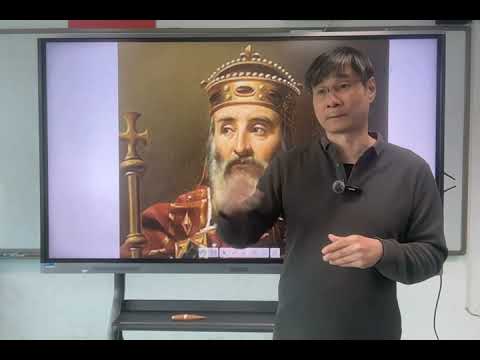
The Holy Roman Empire (founded 800 CE) was a political arrangement in which the Frankish king Charlemagne was crowned emperor by Pope Leo III, creating a system in which the Catholic Church conferred legitimacy on secular rulers in exchange for military protection and political support. Voltaire’s famous quip that it was “in no way holy, nor Roman, nor an empire” turns out to be largely accurate: it was a useful fiction that papered over constant conflict between popes, emperors, and local princes.
-
Why Europe needed a new source of legitimacy
- Unlike Egypt, Mesopotamia, the Indus Valley, or China, Europe lacked the three features that made those civilizations wealthy and unified:
- A temperate climate at the right latitude for year-round agriculture
- A major river system enabling surplus production and internal trade
- Natural boundaries (mountains, deserts, oceans) that protected against invaders
- Europe was mountainous, divided, poor, and constantly exposed to migrations from the steppe (Huns, Goths, Vikings, etc.)
- Rome was a Mediterranean empire, not a European one; after its collapse, Europe fragmented into competing fiefdoms whose local lords could not be conquered easily because they held castles in mountainous terrain
- Conclusion: Europe could not be unified by military force alone. Unity required an idea of legitimacy that made rulers seem rightful in the eyes of other kings and their subjects.
- Unlike Egypt, Mesopotamia, the Indus Valley, or China, Europe lacked the three features that made those civilizations wealthy and unified:
-
Charlemagne’s motivations for accepting the Pope’s crown
- Legitimacy: Being crowned by the Pope gave Charlemagne authority that his army alone could not provide. Many European kings were Catholic, so papal endorsement carried real weight.
- Unity: The coronation created a shared Christian identity across diverse kingdoms.
- Differentiation: It distinguished Charlemagne’s realm from the Byzantine Empire in Constantinople, which also claimed to be the heir of Rome.
- Charlemagne is also celebrated for the Carolingian Renaissance, including the building of 14 cathedrals (most famously Aachen Cathedral), whose acoustics were designed to make worshippers feel surrounded by the voice of God.
-
Why the Catholic Church could confer legitimacy
- The official church history: Jesus (a god in human form) sacrificed himself to redeem humanity; his disciples spread the gospel; despite persecution, Christianity triumphed over pagan Rome and converted the empire.
- The instructor’s alternative account:
- Jews made up roughly 10% of the Roman Empire’s population and were in persistent conflict with Rome because they refused to worship the emperor and believed a Messiah would lead them to victory over Rome.
- Paul of Tarsus, a Roman citizen and well-established Jew, saw in Jesus (a prophet of peace, mercy, and forgiveness) a way for Jews to practice their faith without threatening Rome.
- The early Catholic Church functioned as an elite social club where pro-assimilation Jews and Romans could cooperate.
- Because it was backed by the Roman state and was well-organized and wealthy, it outcompeted other Christian sects.
- The church as an assimilation machine for barbarians
- The migrations into the Roman Empire were not invasions but economic migrations: newcomers wanted better lives and were willing to conform.
- The Catholic Church absorbed these converts by offering community, social mobility, and—crucially—by converting temporary barbarian leaders into hereditary elites whose status would pass to their children.
- New converts, having sacrificed their old community and identity, tended to be the most fanatical believers (a sunk-cost-fallacy dynamic).
- The church as a proto-imperial bureaucracy
- Local priests collected information, shaped thought, and extended central influence in the absence of a functioning imperial state.
- The church thus became the mechanism through which Europe could be culturally unified even when it was politically fragmented.
-
The five major churches and the road to the Holy Roman Empire
- After the fall of Rome, five major churches (Rome, Constantinople, Antioch, Alexandria, Jerusalem) operated largely independently, each developing its own doctrines within a Christian framework.
- When the imperial capital moved to Constantinople in 330, the Constantinople church tried to impose orthodoxy (notably the Nicene Creed and the Holy Trinity) on the others, using military force.
- As Byzantine military power declined, Rome reasserted its independence—most visibly during the iconoclasm controversy, in which Constantinople banned religious images and Rome pushed back.
- Rome saw Charlemagne as the perfect partner to reassert papal authority against Constantinople, leading to the coronation in 800 and eventually to the Great Schism (c. 1054), which permanently split Western Catholicism from Eastern Orthodoxy.
-
Pope Leo III’s motivations
- Asserting authority: The coronation established the Pope as the true representative of God on Earth, with the power to make or unmake emperors.
- Self-protection: Leo had nearly been assassinated by rival factions within the church; he needed a powerful military ally.
- Competition with Byzantium: Both Rome and Constantinople claimed to be the legitimate heir of the Roman Empire; creating a rival “Roman” empire in the West strengthened Rome’s case.
-
The intellectual blueprint: Augustine’s City of God
- Augustine wrote City of God after Rome was sacked in 410 by pagan Goths, an event that led many to believe the pagan gods were punishing Rome for abandoning them.
- He argued for two cities:
- The City of Man (Rome): temporal, earthly, driven by power struggles.
- The City of God (Jerusalem): spiritual, eternal, devoted to faith and salvation.
- The Catholic Church cast itself as the City of God on Earth—the new Jerusalem—giving people a way to “step out of history” and pursue spiritual redemption.
- Charlemagne reportedly had the City of God read to him daily and made it a foundational text of his empire.
- Key point: The Holy Roman Empire could not have been imagined without Augustine’s idea; ideas, not just economics or military power, move history.
-
Why Voltaire was right: the Holy Roman Empire was not holy, Roman, or an empire
- Not holy: The church’s supremacy was pageantry. Popes and emperors repeatedly clashed over who held real power, and local princes pursued their own ambitions beneath a veneer of Christian unity. The period was marked by constant underground conflict, assassinations, and wars—a “Game of Thrones” situation.
- Not Roman: The church used Latin and modeled itself on the Roman Senate (as the body that conferred legitimacy), but Roman culture had effectively died long before, especially after 212 when citizenship was extended to everyone in the empire.
- Not an empire: Unlike Byzantium, the Holy Roman Empire had no imperial bureaucracy or standing military to enforce the emperor’s will. The emperor was elected by prince electors (local kings and lords), who guarded their autonomy and rebelled whenever the emperor tried to centralize power. This dynamic gave rise to feudalism.
-
The delicate balance of the system
- Local princes benefited from the Holy Roman Empire because it conferred legitimacy on them too, helping them keep their thrones and control their people through the shared framework of Catholicism.
- But they still demanded autonomy, while the church and emperor tried to assert central authority—a tension that persisted for centuries.
- The empire was formally dissolved in 1806, but its legacy of fragmented sovereignty and church-mediated legitimacy shaped European history well into the modern era.
Civilization #34: The Useful Fiction of the Holy Roman Empire
Predictive History • • 1h4 → 5 min • #47