-
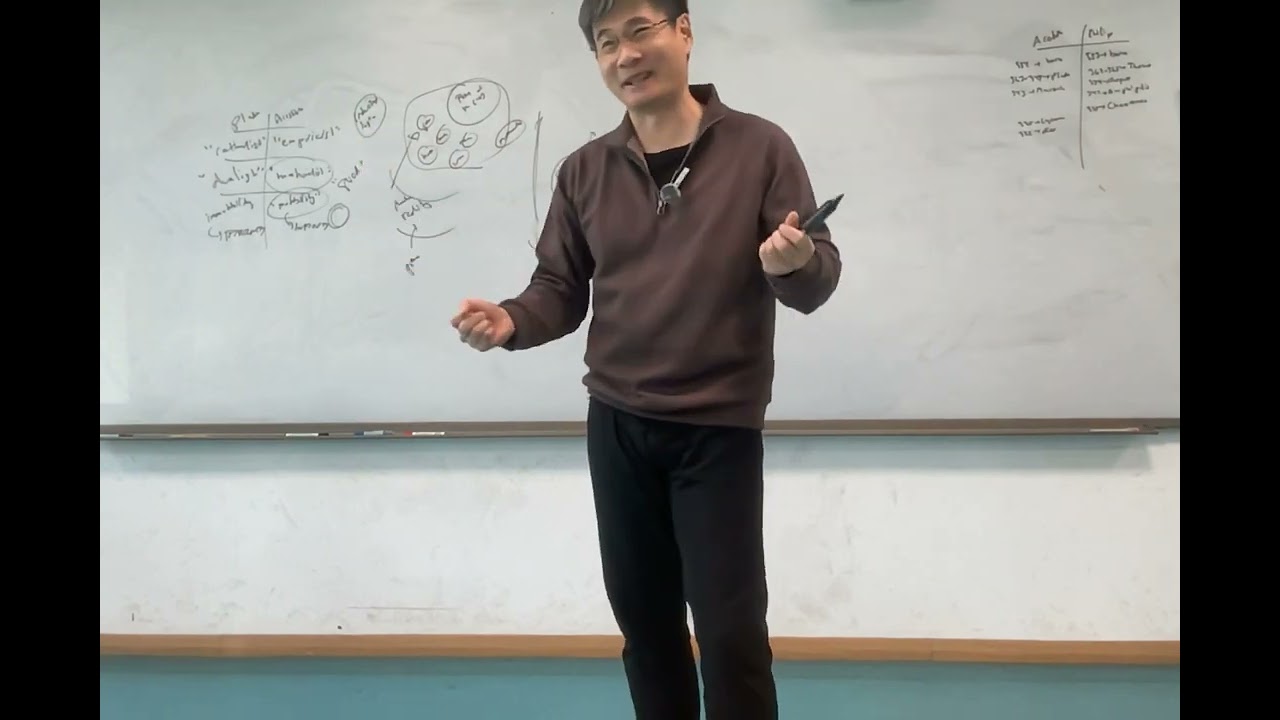
The episode presents a controversial reinterpretation of Aristotle—not as an original philosopher, but as a political “censor” or systematizer working for Macedonian kings Philip II and Alexander the Great to construct a unified Greek cultural identity (the “panhellenic project”) that could legitimize and stabilize their empire.
- This framing is used to resolve three paradoxes about Aristotle:
- No surviving original writings: We have no texts confirmed to be written by Aristotle himself—unlike other great thinkers like Plato or Shakespeare, whose works bear their unique voice.
- Unparalleled breadth of work: Around 200 works are attributed to him, spanning politics, ethics, rhetoric, physics, biology, and more—a range unmatched in human history.
- Radical divergence from Plato: Despite studying under Plato for 20 years, Aristotle developed a worldview fundamentally opposed to Plato’s, which is historically unusual for a star pupil.
- The speaker argues these paradoxes dissolve if we see Aristotle not as an independent thinker but as a curator or editor who compiled, standardized, and repackaged Greek knowledge to serve Macedonian imperial goals.
- This framing is used to resolve three paradoxes about Aristotle:
-
Plato vs. Aristotle: Two incompatible worldviews
- Plato’s idealism:
- Reality is a shadow of eternal, perfect “Forms” (e.g., the Form of the Good, Justice, Beauty).
- True knowledge comes through pure reason and mathematics—not sensory experience.
- The physical world is transient and less real; art and action are imitations of imitations.
- Goal: Return the soul to the Form of the Good through philosophy.
- Aristotle’s empiricism and teleology:
- God is a “prime mover” that set everything in motion.
- Good = fulfilling one’s purpose (telos); evil = failing to do so.
- Truth comes from observation and inductive logic, not pure thought.
- Focus is on the material body and practical excellence (arete), leading to human flourishing (eudaimonia).
- These views are mutually exclusive: Plato dismisses the physical world as illusion; Aristotle sees purpose and value within it.
- Plato’s idealism:
-
Historical context: Macedon’s rise and the need for cultural legitimacy
- Aristotle and Philip II were nearly the same age; Aristotle’s father was Philip’s court physician—suggesting they grew up together.
- While Philip studied military innovation in Thebes, Aristotle studied at Plato’s Academy in Athens—both likely preparing to serve Macedon.
- When Philip conquered Greece, Athenian resistance was weak—possibly because Aristotle, with elite Athenian connections, acted as a middleman, bribing or persuading aristocrats.
- After Philip united Greece (338 BCE), Aristotle founded the Lyceum in Athens (335 BCE)—a school aimed at systematizing Greek knowledge.
-
The panhellenic project becomes panhellenistic
- Philip’s original goal: unite the Greek world against Persia.
- After Philip’s assassination (336 BCE), Alexander the Great exceeded this vision, conquering most of the known world in a decade.
- The unintended result: a vast, multicultural empire needing a unifying culture.
- Aristotle’s systematized Greek knowledge—textbooks, encyclopedias, standardized curricula—became the tool to create a shared “Greek” identity across diverse regions.
- This was especially useful for Macedonian rulers, long seen as “barbarians” by other Greeks—elevating Aristotle (a Macedonian) helped legitimize their rule.
-
The Library of Alexandria and the spread of Greek culture
- After Alexander’s death, his empire split; Ptolemy I took Egypt and founded the Museion (the world’s first research university) and the Library of Alexandria.
- The Ptolemies stole Alexander’s body to claim divine legitimacy and built Alexandria as a Greek intellectual capital.
- They collected original manuscripts (e.g., from Athens) under the guise of copying them—but kept the originals, offering huge deposits as compensation.
- The Library standardized Greek texts (e.g., Homer), created commentaries, indexes, and teaching tools—making Greek education accessible globally.
- This infrastructure enabled non-Greeks (e.g., in China) to study Greek thought, fulfilling the panhellenistic mission.
-
Three possible origins of Aristotle’s works
- Aristotle personally supervised students in compiling an encyclopedia of Greek knowledge.
- After his death, students reconstructed his lectures from memory—explaining the fragmentary nature of surviving texts.
- Aristotle may be a fictional construct: scholars at the Library of Alexandria synthesized various works and attributed them to a single legendary figure named “Aristotle” to lend authority to their curriculum.
-
The Greek Legacy: Three enduring contributions
- A new way of being human:
- Homer cultivated empathy and imagination through oral epic.
- Tragedians (Aeschylus, Euripides) fostered perspective-taking and inner debate through dramatic dialogue.
- Philosophers (Plato, Aristotle) enabled reason and reflection by putting dialogue on the page.
- Together, these formed the foundation of the liberal arts—a model that shaped Western intellectual life for millennia.
- Standardized, universal education:
- The Library of Alexandria made Greek knowledge portable and teachable across cultures.
- Standardized texts, commentaries, and pedagogical tools allowed anyone, anywhere, to access Greek thought.
- Global innovation through cultural fusion:
- As Greek knowledge spread, it merged with local traditions (e.g., Indian philosophy, Egyptian religion, Jewish theology).
- The most transformative fusion: Greek philosophy + Judaism = Christianity—a religion that reshaped world history.
- This cross-pollination sparked a global revolution in ideas, science, and governance.
- A new way of being human:
-
The episode concludes that regardless of Aristotle’s true authorship, the Greek legacy—especially through the systematization and global spread of their ideas—makes ancient Greece the most creative and consequential civilization in human history.
Civilization #13: Aristotle and the Greek Legacy
Predictive History • • 54min → 3 min • #26