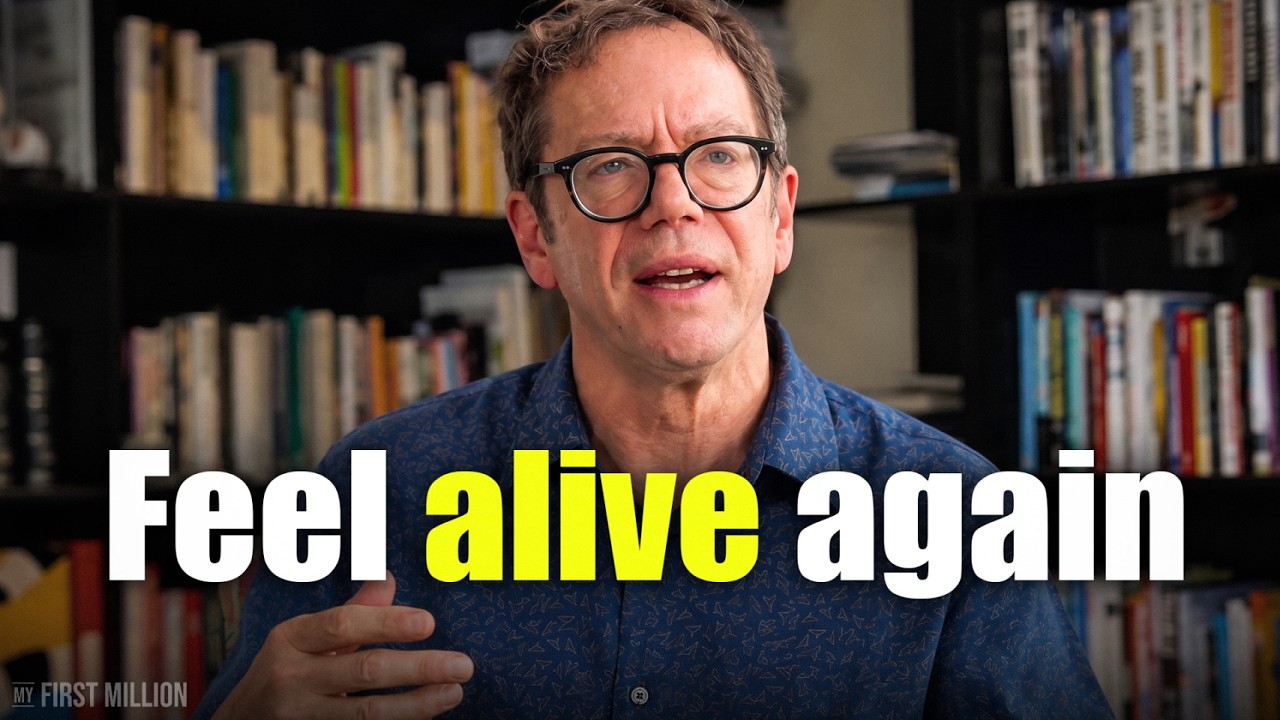
Robert Greene discusses his new book The Sublime, which emerged from his near-death experience (a stroke eight years prior) and explores how to access profound, awe-inspiring experiences in daily life without needing to nearly die; the book is a practical guide to reconnecting with the world, others, and oneself amid modern disconnection driven by technology.
The Sublime: concept and origin
The sublime is the opposite of Greene’s earlier themes (power, control, mastery) — it is about letting go, being small, and feeling connected to something larger than the daily struggle.
Greene’s stroke left him physically limited (unable to hike, type, or travel), forcing him to find sublime moments in his immediate surroundings: the sky, his pets, his wife, simply being alive.
The book argues that humans are “sleepwalking through life” — disconnected from environment, others, and self — largely because technology (especially smartphones) shrinks our perceptual circle to a small screen.
Each chapter ends with exercises to practice slowing down, withdrawing from technology, and reawakening childlike wonder and bodily awareness.
Technology’s rewiring of the human brain
Smartphones affect 90%+ of adults; of those, 90%+ use them more than they want, often 7+ hours/day — a historically unprecedented “dosage” of programmed, algorithmic experience.
The brain evolved to be restless, energy-hungry, and driven to learn, conquer, and develop skills; instant, effortless stimulation atrophies patience, discipline, and the ability to read deeply or write original thoughts.
External stimulation (social media, streaming, even travel with phone in hand) creates an addictive cycle of emptiness; fulfillment comes only from internally generated experience — climbing a mountain, loving another person, connecting with an animal — where no one programs what you feel or think.
Greene’s remedy: leave the phone behind, go into nature, force cold-turkey outward attention; the mind then engages with sounds, body movement, non-human reality, producing genuine awe.
Key stories illustrating the dynamical sublime
Andes plane crash (1972): Uruguayan rugby team crashes at 14,000 ft in the Andes with spring clothing, no equipment, no climbing experience. Nando Parrado, driven by love for his father, leads a climb over “impossible” peaks using makeshift tools, survives nights at altitude, finds a gap to Chile, and secures rescue for 16 survivors. Experienced climbers later said the ascent was impossible — demonstrating that humans discover latent powers when purpose meets extremity.
Viktor Frankl / Holocaust survivors: Those with a purpose (a book to write, a family member to save) survived Auschwitz; purpose transmutes suffering into meaning.
Greene’s own stroke: His girlfriend (now wife) called 911 seconds in time; he survived with one functional hand. He interpreted survival as a mandate to write The Sublime — handwriting 120 notebooks, rewriting each 4–5 times, then dictating and one-handed editing over seven years.
Near-death experiences (NDEs) and the death sublime
Since the 1960s, millions of NDEs provide data: ~85% are positive (peace, beauty, life review, loss of death fear, sense of connection to something greater); ~15% are hellish.
Hardcore atheists sometimes emerge believing in God/an afterlife; skeptics like neuroscientist Susan Blackmore (Dying to Live) explain visions (tunnel, light, life review) as the dying brain scrambling perception of time and reality.
Greene’s take: NDEs reveal that the brain constructs our reality; when it dies, the filter lifts, and we perceive the world more directly — e.g., the sky appearing “incandescent, on fire” after his coma.
The effect wears off but returns in waves; it softens death fear but does not eliminate it (the life instinct remains). Greene compares it to psychedelics but distinguishes it: on LSD you hallucinate; in NDE aftermath you believe you are seeing what is actually there without the brain’s familiarizing overlay.
Charisma, leadership, and the “mythic” quality
Charisma = non-verbal intensity (aura) + outer-directed attention + deep confidence. It often stems from troubled childhoods (abandonment, abuse, orphanhood) creating a hunger for public love/attention (Marilyn Monroe, Churchill, Malcolm X, JFK).
Confidence is the core teachable component: it cannot be faked (bravado reads as empty); it arises from inner security and/or a cause that ignites genuine conviction (Churchill’s depression and political wilderness years; Malcolm X’s prison conversion; 50 Cent’s shooting).
The “mythic” leader articulates a vision larger than policy laundry lists — e.g., America’s builder/pioneer spirit, JFK’s televised cool, Reagan’s folksy backward glance. Sports offers clear examples: Conor McGregor’s self-belief (“Mystic Mac”), Jaylen Brown’s “the energy is about to shift” tweet preceding a championship run.
Greene admires leaders who combine strategic brilliance with empathy and character: his mentee Ryan Holiday (empire builder, good father), OKC Thunder coach Mark Daigneault (young, intellectual strategist, high empathy, innovative rebound-heavy system, championship winner).
Power dynamics and the 48 Laws in practice
Law 4: “Say less than necessary” — presence/absence dialectic; withdraw to create mystery (Beyoncé disappears 1.5 years, then drops an album).
Law 1: “Never outshine the master” — navigate egos carefully.
Case study: Josh Kushner (Instagram early investor, Thrive Capital founder, Lakers owner at 41) — minimal social media, mystery, bold moves, liberal politics in a polarizing family — exemplifies strategic silence and mystique.
Greene’s social media: only posts substantive podcast clips; withholds private life (no breakfast photos, travel shots, cats) to maintain mystery per his own laws.
AI: pessimism and the dark side of human nature
Deep public resentment/fear of AI may drive political regulation (capping data centers, etc.).
Technology amplifies human nature’s dark side (irrationality, grandiosity, envy, shortsightedness — 18 laws in The Laws of Human Nature): phishing/scams escalate, biological weapon knowledge accessible to bad actors, apocalypse risk alongside cancer/climate cures.
Cognitive atrophy: youth lose patience for essays, 400-page books, editing their own thoughts; dependence on AI for answers erodes independent thinking.
Professional disruption: law, coding, etc., face decimation; mass career resentment looms.
Greene used AI minimally for The Sublime (occasional fact-checks only); his process: handwrite → rewrite → dictate → print → hand-edit → one-handed type.
Writing philosophy and personal purpose
Two paths: write for marketability or write what you must express. Greene chooses the latter — “I make what’s cool to me and sometimes the whole world agrees” (Mike Posner).
Purpose fuels the grind: 60 miserable jobs in his 20s/30s felt retroactively meaningful when they fed The 48 Laws of Power; stroke survival felt like a mandate for The Sublime.
Mastery requires aligning technical/analytic skill with social intelligence and character — social ineptitude neutralizes brilliance.
Greene does not seek a “course” on his books (colleges teach useless theory; business schools might teach power pragmatics), but sees value in bridging knowledge-to-practice gaps.
Closing reflections
The conversation itself models the sublime: slower pace, full presence, “life wisdom” beyond surface-level success tactics.
Greene’s artistic courage — writing a book on a near-unsearchable topic (“sublime” has near-zero TAM) because it called to him — is the ultimate demonstration of his philosophy: create from necessity, not guarantee.