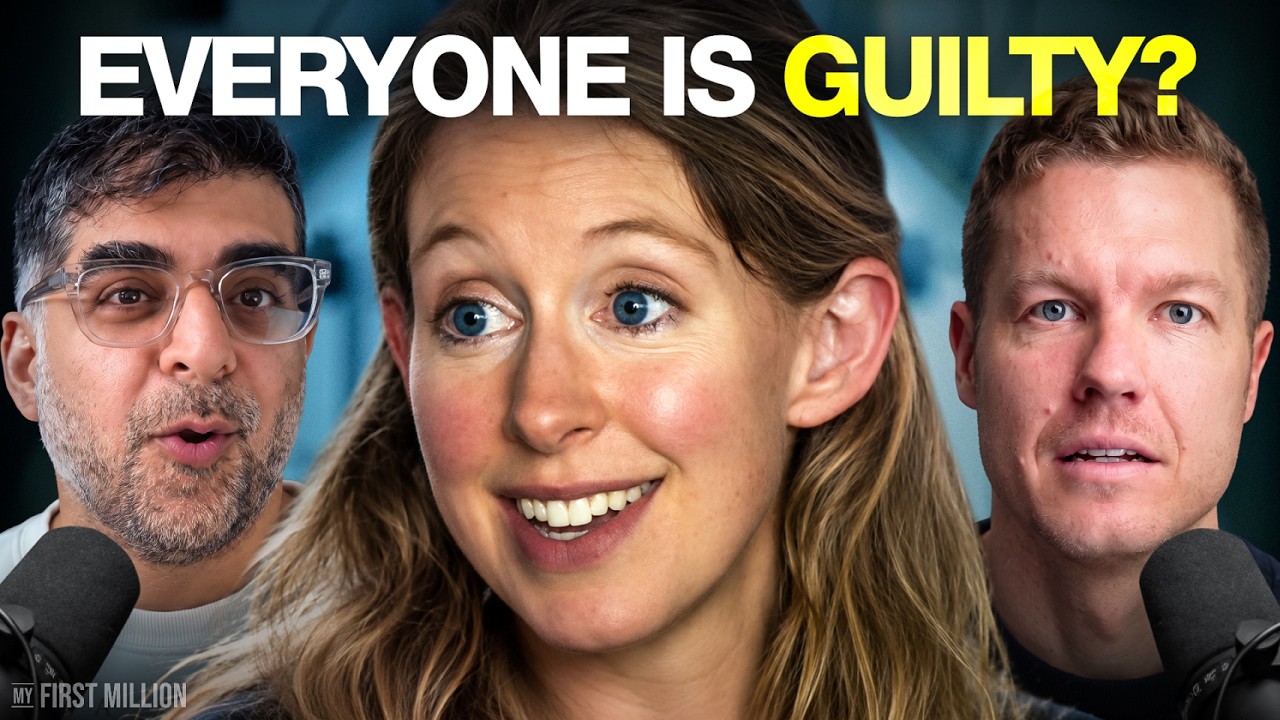
This podcast episode is a detailed, spoiler-filled discussion of Nathan Fielder’s three-hour documentary You Can See Everything, which follows Elizabeth Holmes in the 34 days before she reported to prison and for three years afterward, premiering secretly at Telluride to critical acclaim and becoming the highest-rated film on Letterboxd, Rotten Tomatoes, and Metacritic.
The documentary’s premise and production
Nathan Fielder moved into Elizabeth Holmes’s small Del Mar beach house 34 days before her prison surrender date, initially staying behind the camera as a fly-on-the-wall observer before becoming a central character himself.
Filming continued in total secrecy for three years — only about 30 people knew the project existed — until its surprise debut at Telluride, where it received extraordinary reviews and immediate awards buzz.
The film had a modest $5–7 million budget but achieved a massive box-office opening for a documentary, with critics calling Fielder a Best Actor contender and Christopher Nolan having praised his directorial craft years earlier.
Fielder’s signature hyperrealistic reenactments — built to the inch, populated with studied actors — become the primary tool once Holmes enters prison and can no longer be filmed, including a full recreation of the prison visiting room, vending machines and all.
Elizabeth Holmes’s portrayal: disarming, opaque, and persistently unrepentant
Holmes appears completely disarming: no makeup, intense unblinking eye contact, soft-spoken, never performing charm or defensiveness — she simply says “I don’t know” when asked why she’s going to prison or whether she did anything wrong.
She claims never to have lied since childhood; when pressed on everyday white lies, she redefines the question to mean “the types of things I’m accused of,” then the film cuts away.
On the Edison machine’s capabilities, she insists “it could” run any test because the architecture allowed it (cartridge → cloud → any assay), even though only 12 of 300+ assays ever ran on Theranos hardware; she refuses to concede the gap between “could” and “did.”
She admits under oath to adding Pfizer logos to validation reports shown to Walgreens — a fact the documentary does not confront her with — while maintaining she believes everything she said was true.
The film shows her and Billy actively pitching a new Theranos-like venture with AI while she awaits incarceration, framing it as continuing the mission rather than acknowledging fraud.
Billy Evans: the controlling partner who mirrors the Sunny Balwani dynamic
Billy Evans, Holmes’s partner and father of their two children (they are not legally married to avoid combining finances due to her restitution debt), emerges as a manipulative, controlling figure who dominates decisions and speaks for her.
He negotiated a profit-participation deal with A24 behind Holmes’s back — “Harry and Meghan got $100 million” — which the filmmakers flagged as ethically compromising for a documentary about someone claiming she wasn’t motivated by money.
In a revealing kitchen scene, Billy interrupts a serious conversation to take a whisk from Holmes and scramble eggs faster, then insists “nothing was wrong, I just wanted to help” while Holmes reads the moment as him thinking she’s incompetent.
After Holmes enters prison, Billy creates an AI avatar of her, posts tweets as her without disclosure (“I know her so well, we’re one”), keeps a three-foot komodo dragon on the dining table, and threatens vengeance against everyone who “did this to her,” including the Dropout showrunners.
The hosts identify Billy as the film’s biggest loser: exposed as petty, controlling, and performatively loyal while undermining Holmes’s defense that she was a passive victim of male manipulation.
Key scenes that structure the film’s psychological puzzle
The “Who’s on First” routine: Fielder plays the Abbott and Costello bit to test Holmes’s literal-mindedness; she fails to grasp the wordplay, saying “I don’t know” when asked the name of the player on first base, then “I didn’t get that” when told “Who’s on first” — a moment that shifts the viewer from seeing her as evasive to possibly cognitively unusual.
Watching The Dropout together: Fielder screens the Hulu series for Holmes and Amanda Seyfried (who played her); Holmes is pained by the caricature, Seyfried is initially judgmental, then feels guilty seeing Holmes’s reaction, then defends her craft as “fiction” — prompting Fielder to note fiction is also a lie that shapes perception.
The prison reenactments: Fielder rebuilds the federal prison visiting room down to the vending machines, hires actors as guards and inmates, and stages visits with Holmes (played by an actor) to continue the visual language after camera access ends.
The shower scene: Within the first ten minutes, the camera follows Billy into the shower and lingers on his naked body — a shocking transparency that immediately signals his comfort with exposure and raises the question of why he agreed to it.
The ocean callback: A late swim scene mirrors an early one, but the shifted power dynamic and unspoken tension make it feel damning — suggesting Fielder himself may have fallen under Holmes’s spell.
Themes: truth, performance, and the limits of seeing everything
The title You Can See Everything is ironic: unprecedented access (extreme close-ups, 34 days cohabitation, three years of follow-up) yields more confusion, not clarity — “you see everything and know less than when you started.”
The film refuses to adjudicate the legal case (which is settled) and instead investigates who Holmes is — her reality-distortion field, her ability to make smart people doubt their own judgment, the parallel between her and Fielder (both creators of constructed realities).
Media complicity is implicated: The Dropout fictionalized her, the New York Times stood by a disputed quote (“that’s a character I created”) without a recording, and the documentary itself becomes part of the same ecosystem it critiques.
The “fake it till you make it” defense is tested: Holmes frames Theranos as entrepreneurial hustle (like Musk’s self-driving promises), not fraud — she believed the mission justified the means, and the hosts largely agree she knew what was happening but didn’t categorize it as criminal.
Hosts’ reactions and verdicts
Ben: Calls it possibly the best movie he’s ever seen for entertainment value; Holmes is incredibly persuasive and engaging; wants more intellectual post-game analysis; believes Holmes knew the machines didn’t work but framed it as necessary hustle.
Diego: Highlights the reenactments and storytelling as A+; notes the $5–7M budget; praises Fielder’s “weaponized awkwardness” — his willingness to sit in uncomfortable silence longer than anyone else.
Sean: Sees Holmes as a “smart dumb person” or a nine-dimensional chess player; identifies the Roy Cohn/Trump playbook (never apologize, counterattack, weaponize media, build loyalty fortress) in her behavior; thinks the film makes everyone guilty — Holmes, Billy, the media, the actress, Fielder himself.
Sam (unseen): Convinced to watch despite the 3-hour runtime; notes the trailer alone was “electric” and pattern-interrupting.
Consensus: Nathan Fielder is the biggest winner (breakout from niche to mainstream acclaim); Holmes gains rehabilitation potential (speaker circuit, future funding); Billy is the clear loser; the film is a 10/10 — not the most enjoyable or satisfying, but “astonishing” and on a different axis of achievement.