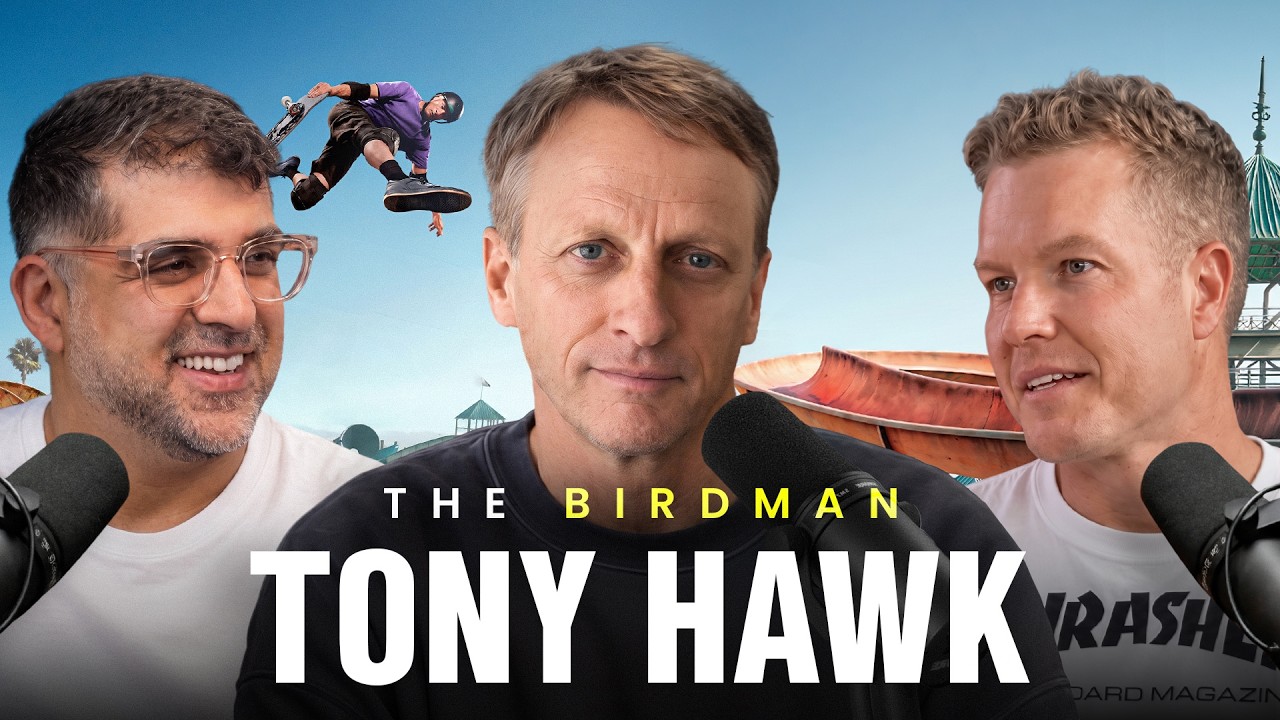
Tony Hawk, the most recognizable figure in skateboarding history, joins My First Million to discuss his journey from obsessed kid to cultural icon, the business of the Tony Hawk’s Pro Skater franchise, his philanthropic skatepark foundation, and what drives him at nearly 60.
The episode’s central arc: from outcast to icon, and the business behind the brand
Hawk’s career spans the rise of skateboarding from fringe activity to Olympic sport, with his name becoming synonymous with the sport itself through video games, competitions, and a business empire built on authenticity.
The conversation covers his early struggles, the 900 at X Games 1999, the video game franchise that made his first million, his investment wins (Nest, Blue Bottle, DocuSign), and his current focus on skating for joy rather than accolades.
A chance meeting in Ethiopia reveals the power of visible impact
Sean recognized Hawk on a remote mountainside in Ethiopia during a Charity Water trip — the only celebrity the locals knew, despite the group including founders of Spotify and other tech companies.
Hawk had sponsored a well in his daughter’s name; visiting it showed him the concrete proof of impact that Charity Water’s model (GPS tracking, flow meters, site visits) pioneered for nonprofit transparency.
He applies the same logic to his Skatepark Project: “when we do skate parks, you have literal concrete proof of where your money goes. And here it is and you can go skate it.”
The Skatepark Project: 20 years, nearly 1,000 parks, and a model of leverage
Started in 2002 after Hawk’s own skatepark (Del Mar Skate Ranch) gave him community, identity, and safety as a misfit kid in the early ’80s.
Early grants were small ($5K–$10K) but served as validation to push projects through hostile city councils and skeptical communities.
Hawk mandated 10–20% of his endorsement deals flow to the foundation; corporate partners followed.
Parks shifted from temporary modular ramps to permanent concrete, embedding skateboarding into municipal infrastructure.
He views the work as self-sustaining: “skateboarding is very cyclical… but it doesn’t feel like it’s down… they’re more here to stay than ever.”
The price of greatness: obsession disguised as play
From the moment school ended, Hawk went to the skatepark until dark, often forgetting to eat. His mother called him a “nightmare” who wouldn’t give up; she reframed it as determination.
At 14, he was still “flailing” with no style — only trick obsession. Recognition came around year three via contest rankings.
Stacy Peralta (Bones Brigade) saw his frustration and tenacity, not just talent: “he saw that I was determined and that I had the tenacity to keep at something until I get it. And against, you know, even against my own safety.”
Unlike pro athletes chasing contracts, Hawk’s early goal was free gear; first-place prize money was $100. He thought he’d be a math teacher.
The 900: a decade-long obsession, finally cracked on live TV
No one had ever landed a 900 (two-and-a-half rotations) in practice or competition. Hawk had tried for 10 years, breaking ribs in 1994.
At X Games 1999, a best-trick format gave him 20 minutes. His “best trick” (varial 720) landed once in his life; he did it halfway through the session.
The on-site announcer goaded him: “Let’s see one of those 900 attempts, Tony.” Early attempts were crowd-pleasers; around attempt five, his speed and spin became consistent.
He committed fully knowing: “I’m either going to make this trick or you’re going to carry me unconscious out of this arena.”
On the make, his first thought: “I never have to do this again. I’m free.” The crowd and competitors swarmed him — a moment of collective progression, not individual glory.
Afterward, 900s remained inconsistent; today kids do back-to-back 900s and kickflip-body-varial-900s. “That’s the through line of skateboarding. We keep building upon what we saw.”
Tony Hawk’s Pro Skater: the $4.5M check that changed everything
1997: a coder pitched Hawk a skateboard engine; they got rejected by Nintendo and publishers (“skateboarding isn’t even popular”).
A year later, Activision (then a small company, post-Pitfall, pre-Call of Duty) called. Their prototype: Bruce Willis on a skateboard with a gun, doing ollies in a desert. Controls felt intuitive.
Hawk insisted on final creative approval — a daring demand at the time — and Activision agreed. He burned beta copies for pro skaters to get honest feedback; buzz built in the core community.
Pre-launch, Activision offered a $500K royalty buyout. Hawk had just bought a house he could afford; he bet on himself.
THPS1 launched 1999; by THPS4, four of the top 10 selling games were Tony Hawk titles. At lunch, his Activision contact slid a $4.5M royalty check across the table: “This is what it means.”
The game introduced millions to skate culture (music, spots, pros like Andrew Reynolds, Elissa Steamer) and created a reverence for pioneers like Rodney Mullen.
Business empire: Birdhouse, 900 Films, licensing, and angel investing
Birdhouse Skateboards (founded 1992) nearly died in the mid-’90s; partner Per Welinder’s business degree kept it alive. X Games and THPS drove peak sales 1999–2005. Decks still wholesale at $60 (unchanged for decades); Hawk keeps it running via licensing and passion, not profit.
900 Films produces branded content (Liquid Death, Qualcomm, Red Bull) and skate media.
Hawk Shoes and Hawk Clothing revived via licensing.
Angel investments: Nest, Blue Bottle, DocuSign, Liquid Death, Events.com — often via Silicon Valley connections. He invests where he can add value beyond capital or trusts the “dream team” operators.
Restaurants are his riskiest category (Counter Burger failed); Chicken Hawk (Nashville hot chicken in Encinitas) works because it reflects his authentic aesthetic.
Aging, injury, and the “find your kickflip” mindset
At 57, Hawk still skates daily. Warm-ups take longer; hips don’t always cooperate. He shares a 30-second kneeling hip/glute activation stretch (chin down, palms out, twist and push) that helps.
Broke his femur in 2022; bone shifted after early return. Eight months later, a second surgery with a reset. Relearning a kickflip was “ugly, sloppy, scary, painful” — but he landed it. His tweet: “Find your kickflip. It doesn’t have to be perfect… get to that stage cuz then there’s more to offer.”
He schedules skate time around family; the ramp in his office warehouse is the “pinnacle of the office” — he skates after this interview.
No lofty goals: “just trying to keep it moving,” learn a new low-impact trick, be present for his first grandchild, and provide for family.
Miscellaneous legends: tickets, shakedowns, and the “face of sports” club
Trespassing ticket for skating Oceanside boardwalk ($150, 1990); paid to avoid court.
Speeding in a Geo Metro in rural Georgia (70 in a 55): deputy couldn’t “process” a California license, took him to a holding cell, demanded cash bail. Teammate drove to ATM, paid $200 — “felt like a shakedown.”
He hangs with Gretzky, Jordan, Woods, Armstrong, Slater at an annual “Face of Sports” dinner. “You put your hands in the middle like your rings touch.”