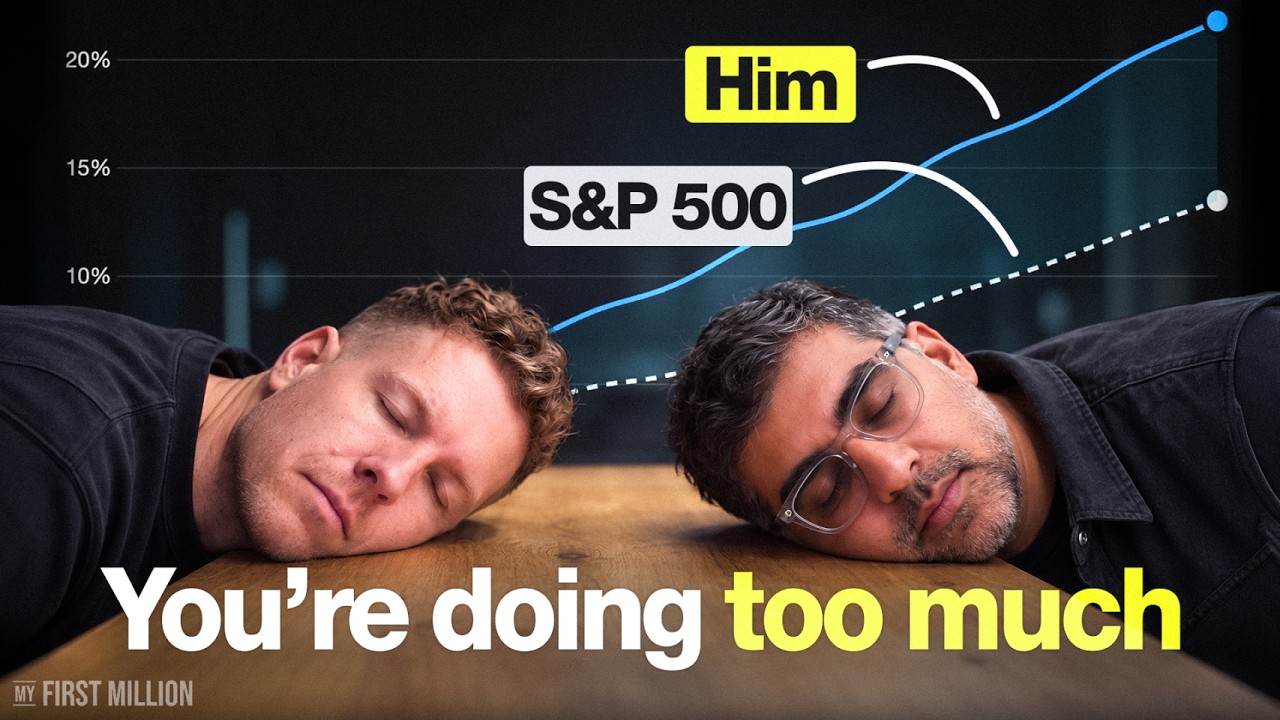
This episode of My First Million features hosts Sam Parr and Shaan Puri discussing a remarkable retail investor who beat the S&P 500 for 11 of 12 years while making only 2.9 trades per year, then expanding into broader themes of decision-making, leadership, life strategy, and fear management.
The “Almost Nothing” Investor
A Hampton member sold his company for eight figures and achieved a 21.8% annual return over 12 years (vs. 13.5% S&P 500) while holding roughly 15 stocks and averaging just 2.9 buy/sell decisions per year.
Three of the last 10 years involved zero trades; the longest inactive stretch was 2022–2025; he only underperformed the market in 2022.
His process: study a few understandable businesses deeply for months, keep detailed notes, then wait for a price opportunity — e.g., he researched a large travel stock for six months pre-COVID and bought the day it became cheap.
The hosts connect this to Warren Buffett’s “lethargy bordering on sloth” and Kevin Ryan’s “one good idea a year” — high performers make few, high-conviction decisions.
Patterns Among Elite Decision-Makers
Reversible vs. irreversible decisions: don’t agonize over reversible ones; Shaan’s default is “I don’t care” unless something forces attention, while Sam’s neurotic default treats everything as critical.
Circle of competence: top investors say no to good opportunities outside their realm of understanding, not because the opportunity is bad but because it’s not their game.
Writing as thinking: they use pre-mortems (listing everything that can go wrong), journals, and written arguments to avoid “resulting” (judging decisions by outcomes rather than process).
Jack Dorsey’s Square pre-mortem: before launching, he wrote 140 reasons Square would fail — a Charlie Munger “know where you’ll die so you don’t go there” approach that let him design around failure modes.
Zuck, Alex Wang, and the Meta AI Pivot
Mark Zuckerberg acquired Scale AI (and effectively Alex Wang) for ~$15B; Wang, 29, was described by Zuck as “the guy” — combining strategic clarity, communication, and execution beliefs (e.g., talent density > headcount, flat small teams).
Zuck’s leadership style: constantly texts smart outsiders (not just board members) asking “what should we do about X?” — gathering signal and assessing talent simultaneously.
Contrast with Cornelius Vanderbilt/Elon Musk secrecy: many top leaders operate by consensus and wide input, not dictatorship.
Zuck’s framing: “You don’t get judged by your mistakes, only by the things you got right and how right you got them” — entrepreneurial asymmetric upside (Bezos: baseball max 4 runs, business can yield 1,000+ runs per swing).
Humility, Dunning-Kruger, and the Comparison Trap
Dunning-Kruger: novices overestimate competence; true experts (black belts, top investors) emphasize how little they know and how large a role luck played.
Sam admits the podcast induces comparison anxiety — “hanging out with the 30th richest person on Earth” makes his own efforts feel small; an executive coach flagged his self-criticism.
Coping mechanism: define your game. Most people don’t know what game they’re playing (LeBron: beat Father Time/catch Jordan; Jaylen Brown: prove himself; role player: get paid/have fun).
Games dictate what you want and who you must become (charades → expressive/collaborative; Mafia → deceptive). Few people consciously choose their game.
Resilience Fables and Mental Models
Elon Musk (2008/09): asked what he’d do if SpaceX and Tesla both failed and he lost everything — “move to cheapest apartment, buy a computer, start building the next thing within 24 hours. The loss of money wouldn’t bother me; the loss of the companies would devastate me for one night. Then build.”
Napoleon: “I act and the plan emerges from my action.”
Scott Galloway: “Keep your sails up” — stay ready when the wind comes; don’t drop sails when you’re down.
Sam’s downward spiral (early startup days): living in squalor (garbage bag nailed to wall), letting business failure poison life. Turned it around not by fixing the business but by stacking small life wins — hike, clean room, wear good outfit — to reset attitude and belief.
Fear, Panic, and the DARE Method
Sam used the DARE protocol (from a panic-attack book) to fly sober for the first time in 15 years (previously required Xanax):
Dismiss: “Yeah, I’ll get panicky. So what?”
Allow: “Let’s go, I’m open to it.”
Run toward: “I want this panic attack to come faster.”
Engage: once peak passes, shift to a new activity (read, listen, talk).
Worked even when his flight aborted landing (brakes failed), diverted to Salt Lake City, and landed amid fire trucks — he stayed drug-free.
Georges St-Pierre’s coach: months before fights, replicated fight-day conditions exactly — same meal, UFC gloves, walkout music, bright lights — so the nervous system habituated. Sam applies this to tough conversations: rehearse in the actual room.
Anticipation vs. reality: peak enjoyment often occurs in anticipation (car shopping, coat buying); for feared events, vivid anticipation blunts the actual experience (skydiving: acceptance — “it’s happening, I’m hooked to the instructor, let’s feel the rush” — neutralized 50% of fear instantly).