-
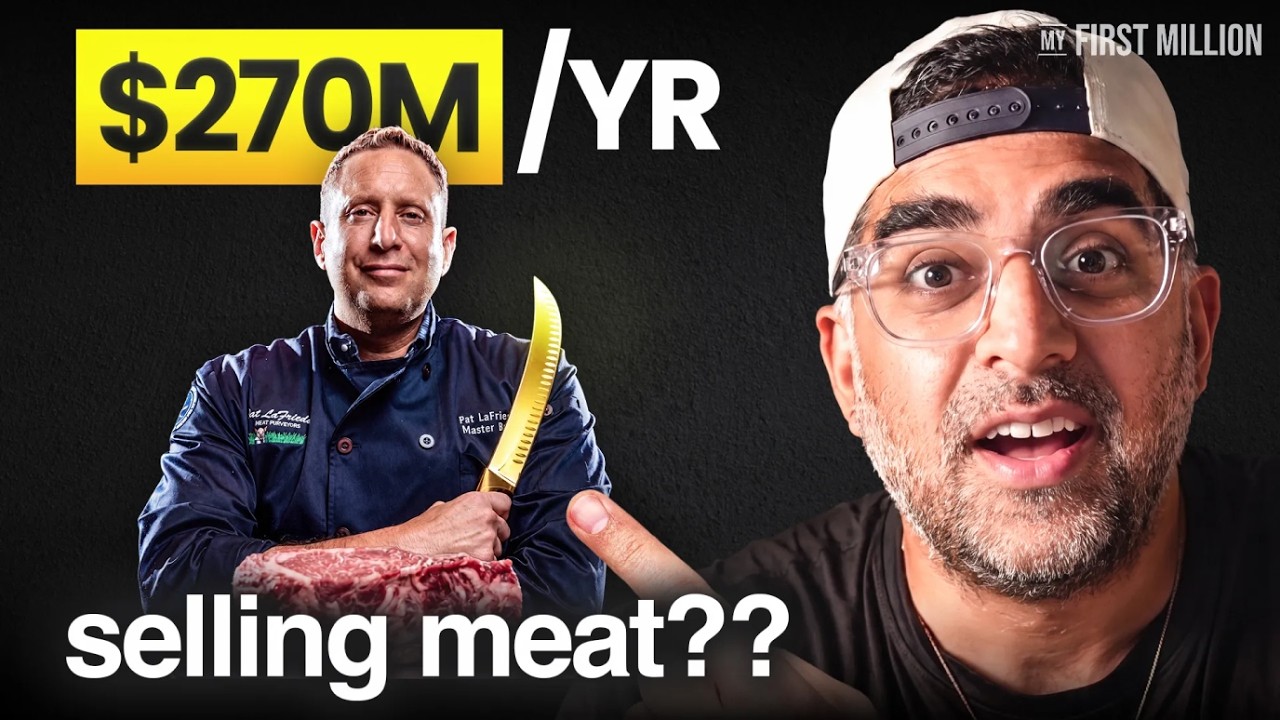
Pat LaFrieda Jr. turned a dying family butcher shop into a $270M/year meat empire by rejecting commodity meat, building custom branded blends for top chefs, and making bold counterintuitive bets — proving that being the best at anything, no matter how unsexy, can generate enormous wealth.
- The business started in 1909 when Anthony LaFrieda migrated from Italy to Brooklyn and opened a butcher shop that refused to use scrap meat in hamburgers, insisting on whole-muscle cuts only — his philosophy: “You can’t hide your sins in the hamburger.”
- By the late 1980s, the company was dying — restaurants were switching to Sysco for delivery, and the father actively discouraged Pat Jr. from joining, telling him he’d be “rubbing together pennies for the rest of your life.”
- Pat Jr. joined in 1994 when the company had only 44 customers and 5 employees. He reinvested aggressively, hit the streets signing up restaurants door to door, and created custom exclusive blends for individual chefs — 50 restaurants got their own proprietary blend under NDA.
- His first big bet was selling meat on credit to an unknown chef named Mario Batali, who later became a celebrity and exclusively used LaFrieda meats, lending the brand enormous credibility.
- He secretly developed preformed patties for Danny Meyer’s Shake Shack against his father’s wishes — when they saw 200 people in line at the first location, his father finally understood the vision.
- During the 2008 financial crash, he launched a $28 “Black Label Burger” made with 30% dry-aged New York strip steak at Minetta Tavern — it outsold the cheaper burger 2x, moving 15,000 units.
- Today the company does $270M/year, feeds roughly 100,000 people daily, operates the world’s largest dry-aging room, holds $10 million of meat nightly, and was designated essential infrastructure by presidential mandate.
-
The “idiot index” is Elon Musk’s mental model for identifying massive inefficiency — it measures the markup between raw material costs (from the London Metals Exchange) and the final price of a part, revealing how much “idiot tax” an industry pays by not making things in-house.
- Musk found the space industry had the worst idiot index he’d ever seen — markups of 100x or more on nearly every part — which is how he realized SpaceX could operate without NASA-level funding.
- Palmer Lucky of Anduril applied similar logic to defense contracting: the “cost-plus” model used by Lockheed Martin and others means contractors make a percentage on top of costs, so their incentive is to make everything more expensive and slower, not better and cheaper.
- Anduril instead operates like Amazon or Costco — best product, lowest price, fastest delivery — and reinvests 100% of revenue into R&D every year versus ~1% at traditional defense primes.
- Nick Sleep, a legendary value investor in the Buffett-Munger lineage, ran a concentrated portfolio of just four stocks (Costco, Amazon, Berkshire Hathaway, and one other) and crushed the market for years. He noted that most of his portfolio companies shared a “quiet attitude” — they shunned advertising and earnings guidance, yet were no less successful. Bezos’s version: “Advertising is the price you pay for having an unremarkable product.”
-
Three traits that define exceptional founders: sensitivity, audacity, and first-principles logic.
- Sensitivity means noticing things others overlook — like Palmer Lucky seeing that Silicon Valley’s best minds were all working on advertising and entertainment while defense was considered taboo, or Elon Musk seeing that space parts were marked up 100x.
- Audacity means believing you can actually fix the problem when virtually everyone else thinks it’s impossible.
- First-principles logic means breaking a problem down to its fundamental truths and reasoning up from there — the math is often simple, but most people can’t or won’t follow it.
- Palmer Lucky was homeschooled, which may have insulated him from herd thinking. His first job was using VR therapy for veterans with PTSD — a detail that foreshadowed his later work at Oculus and Anduril.
- He left Facebook because he saw the smartest people in the world focused on getting users addicted to mindless entertainment, and he asked: “Is it a bad thing for America if all our smartest technologists refuse to work on defense?”
-
Travel and “frame-breaking” moments are essential for entrepreneurial insight — seeing how things work differently elsewhere reveals assumptions you didn’t know you had.
- Brian Armstrong was inspired to start Coinbase after working in Argentina, where hyperinflation made the local currency nearly worthless and the “blue dollar” exchange rate was 2x the official rate — making the value of an inflation-proof currency like Bitcoin immediately obvious.
- A cross-country motorcycle trip or time in another country breaks routines and forces you to ask “why am I living this way?” — these moments of perspective are where new business ideas often originate.
-
The “kingmaker move” — creating an award, list, or ranking to insert yourself at the center of any industry or network.
- The Webby Awards started in 1994 as “Cool Site of the Day” and became the Oscars of the internet. It’s now a pay-to-play business with 13,000 entries at $600-$700 each, owned by a private equity firm headquartered in Kentucky despite its Brooklyn hipster image. Famous early moments included Larry and Sergey in foil capes and rollerblades, and the five-word speech rule.
- Jason Calacanis created the “Silicon Alley 100” to break into New York’s tech scene — he deliberately ranked controversial figures (like putting Ariana Huffington at #4 instead of #1) to generate buzz, and both winners and losers called him wanting to know more.
- JD Power started in 1969 when James David Power (the name was real) surveyed car buyers and sold the research to automakers. He later created the JD Power Award and trophy, which became so influential that companies paid for consulting to improve their rankings. The company sold for $500M and later for over $1B.
- The model works in any niche where buyers need research to make expensive decisions — senior living facilities ($10K-$20K/month), accountants, financial planners, etc.
- “Sam’s List” is a ranking site for accountants started from a tweet asking for recommendations — it now does ~$500K/year and has a TikTok following of nerdy accountants, but the real opportunity is expanding to financial planners who are better salespeople and more aggressive at following up on leads.
-
A proposal: create an award and gathering for teenage “hacker misfits” — brilliant kids who are world-class at low-status, nerdy things and are invisible to traditional recognition systems.
- These kids aren’t honor roll class presidents — they’re the ones running sneaker-flipping empires, selling GTA skins, owning valuable Instagram handles, publishing papers in Nature, or being the #1 Starcraft player who dominates Korean servers.
- Finding them in the 11-19 window and giving them a network of similar weirdos plus mentorship from founders they admire could be a massive trajectory shifter for their lives.
- Companies like Ernst & Young would sponsor it, but rejecting big corporate sponsors would increase the brand’s credibility. The idea needs a name, a brand, and someone with energy to build it.
The "Idiot Index": the simple math that made Elon Musk billions
My First Million • • 1h1 → 5 min • #17