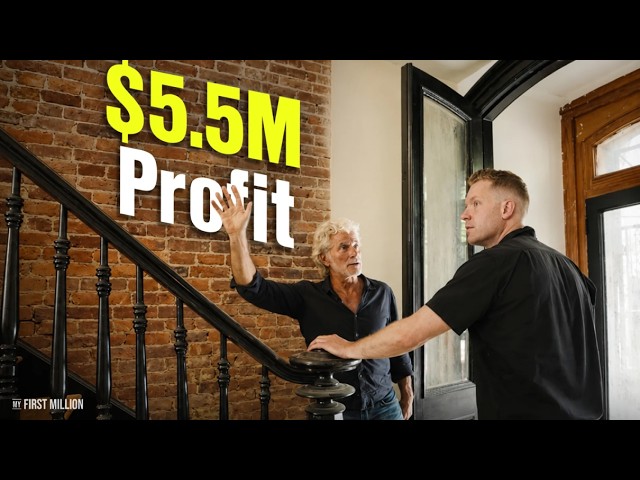
Sam Parr spends a day with Mark O’Brien, a 63-year-old developer who buys, restores, and sells historic brownstone townhouses in New York City, to evaluate the business economics and lifestyle of this “blue-collar millionaire” path.
Mark O’Brien’s Background and Entry into Real Estate
Mark got into real estate out of desperation in his 30s: he had two-and-a-half kids, lived in a fixer-upper in Greenwich, Connecticut he couldn’t afford to hire out, and borrowed against his house to buy his first project.
First deal: bought for ~$800K, put in ~$800K, sold for ~$2.3M in under a year — a near-double that hooked him.
He then scaled to running four projects at once, sourcing deals by knocking on doors and leaving notes in mailboxes (“numbers game”).
Before this, he started a vodka brand (Broken Shed, 100% New Zealand ingredients) which he still owns.
Philosophy: heavy leverage (bank money) accelerates returns but is “a great way to go broke”; he has seen peers fail from overleveraging.
Property 1: 94 Bank Street, West Village (Manhattan)
Purchased for $5.5M; estimated $6M+ renovation; target sale $17M.
180-year-old house (c. 1840s); Mark lives in it during the multi-year permit process.
Landmark status means 2.5 years (and counting) just for permits — soil tests, foundation exposure, neighbor footing comparisons, architect/engineer coordination.
Carrying costs during permitting are the silent killer: “time will kill every deal.”
Mark’s signature moves: widen the central staircase for light, add a roof bulkhead, finish the cellar (free FAR — floor area ratio — since below grade), expose original 140-year-old brick and horsehair-plaster rubble foundation walls.
Bedroom/office currently set up in what will become demolition zone; original fireplace mantels, wide-plank floors preserved.
Property 2: Fort Greene Brownstone (Brooklyn)
Purchased ~2 years ago for $2.8M; renovation budget grew from $1.8M to ~$2M; target sale $6.2M.
~4,500 sq ft after expansion (roof build-out, cellar finish, widened stair).
Discovered 140-year-old original pine floorboards under vinyl; chose to grind and restore rather than cover.
Exposed original brick interior walls (c. 1880s) and rubble-stone foundation (rock, horsehair, mud).
Garden-level rental/in-law suite with separate entrance (~$5K/mo potential).
Target: photos in 2 weeks, market by summer, close by September.
Subcontractors only — no full-time crew; Mark acts as owner/GC, fronting all capital.
Business Model & Economics
Typical vintage formula: buy for $1M, build for $1M, sell for $3M (early deals); recent deals tighter — this Brooklyn project: $4.8M all-in for $6.2M exit = $1.4M gross over 2.5–3 years ($500K/year).
High variance: “boom and bust” — good years ~$500K–$1M income, bad years can lose money.
Capital intensive: Mark puts up the money, carries the risk, manages the subs.
Moat is low: “anyone with enough money could do it”; primary barrier is tolerance for regulatory pain and multi-year timelines.
Machine score low: Mark is the catalyst — projects stall without his daily pushing on permits, subs, design decisions.
Regulatory & Operational Reality
NYC landmark approvals dominate the timeline: 2.5 years for permits on Bank Street before a shovel hits dirt.
Carrying cost (taxes, insurance, interest) during permitting is the hidden profit eroder.
Subcontractor model means no payroll but zero control over scheduling/quality; Mark is on-site daily, weekends included.
Physical work demo: Sam tries cutting brick with a grinder — Mark’s crew works fast, OSHA would hate it.
Lifestyle Assessment
Pride: 9/10 — Mark visibly loves the craft (restoring 140-year-old floors, exposing original brick, widening stairs for light); Sam felt proud watching him.
People: 7/10 — subs/crew are “cool and lovely”; buyers (wealthy creatives, media types) less relatable.
Freedom: 5/10 — projects have end dates allowing breaks, but in the thick of it it’s 7-day weeks, constant calls on regulations, no true detachment.
Overall lifestyle score: 21/30.
Sam’s Scoring & Final Verdict
Business (Money/Machine/Moat): 3 + 3 + 2 = 8/30 — low returns for high risk/capital/effort; not scalable; moat is only “crazy enough to endure it.”
Lifestyle (Pride/People/Freedom): 9 + 7 + 5 = 21/30 — high craft satisfaction, good crew, moderate freedom.
Total Sam Score: 29/60 — “Mark O’Brien buying, restoring, selling brownstones: SAM score 29.”
Sam’s take: he likes Mark personally, but the business is a “pain in the butt” that doesn’t make enough money for the grief; lifestyle is the real product.