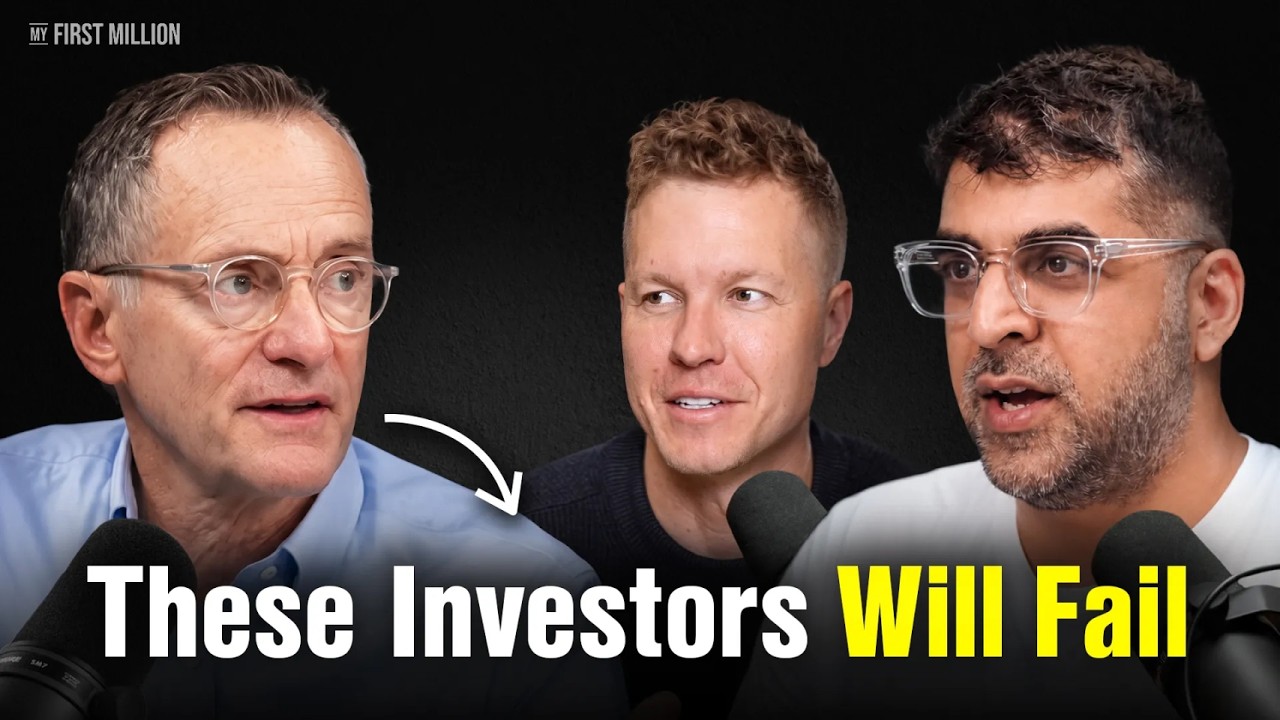
Howard Marks, co-founder of Oaktree Capital, reflects on how his thinking has evolved across AI, investing through crises, long-term partnership, parenting, and career decisions — emphasizing humility, second-level thinking, and the role of luck alongside skill.
Changing his mind on AI
Marks initially wrote a memo in December 2024 warning of a possible AI bubble, but after his son Andrew (a VC working daily with AI companies) urged him to reassess, he rewrote the memo entirely in February 2025.
The shift came from seeing AI’s unprecedented autonomy: unlike prior technologies (railroads, computers, internet) which were tools to speed up human work, AI can be given a job without instructions and figure out how to do it.
He also highlights AI’s unpredictability — “I don’t think anybody knows the shape of the future” — a feeling he never had about the internet.
On whether AI can replace investors: it will “defrock” those whose skills are overstated, but Marks believes experienced investors retain an edge in situations with no historical data to train on, where judgment and “hair on the back of the neck” intuition matter.
He frames every AI opinion with “I’m no expert” and notes the core question: is the list of what AI can do unlimited or limited? He doesn’t know the answer.
Second-level thinking as the core of investing
The most important thing in investing is second-level thinking: seeing something different from the consensus (a variant perception) and being right about it.
Marks believes this cannot be taught — “you can’t coach height” — because it requires insight that some people simply have and others don’t.
He doesn’t know if AI can ever develop this kind of insight, calling it one of the “mysteries of AI” alongside whether AGI will truly replicate all human capabilities.
Investing through the end of the world (Lehman, 2008)
In 2007–08, Oaktree raised an $11B distressed debt fund (largest in history at the time) because they foresaw a crisis; when Lehman collapsed in September 2008, they deployed $7B in 15 weeks ($450M/week).
They had no data or prior experience for a financial meltdown — only supposition — but reasoned: if the world melts down, investing doesn’t matter; if it doesn’t, not investing means failing their job. They also had quantitative downside protection (buying debt at prices that would break even even if assets fell to 20–25% of prior valuations).
Marks emphasizes they were “absolutely not confident” — they felt the same fear as everyone else reading the terrible news, but acted despite trepidation. “A battle hero is not somebody who’s unafraid. It’s somebody who’s afraid but does it anyway.”
Key principle: “If you wait until you have nothing to be afraid about, probably the opportunity has passed.”
Raising $11B before the crisis
The raise succeeded because of: (1) 20-year track record and reservoir of goodwill from prior crises (1991, 2001–02); (2) a strategy explicitly suited for crisis as a hedge against prosperity-oriented portfolios; (3) ability to articulate specific flaws in the pre-crisis environment (market failing its disciplinarian role, dumb ideas getting funded); (4) credibility from consistently sizing funds down after good vintages rather than up, proving they weren’t just asset-gathering.
Marks notes the “Noah built the ark before the flood” principle — you must raise capital when things look calm, not during panic.
39-year partnership with Bruce Karsh
Marks and Bruce Karsh have worked together for 39 years with no fights, which Marks attributes to: shared values (neither is a financial maximizer; both ethical, neither cowboy nor chicken), complementary skills (Marks does external-facing work, Bruce manages portfolios), and mutual appreciation for what the other does.
“If you don’t share values, I don’t think you can have a successful partnership” — mismatched risk appetites or ethics lead to resentment in good times and bad.
Complementary skills create synergy: each does things the other can’t or doesn’t want to do, and both are grateful for it.
Marks sees the same dynamic in Buffett/Munger: mutual respect, love, humor, complementary IQs (Munger the classicist/humanist, Buffett the computing machine), with Munger moving Buffett from “cigar butt” investing (cheap, bad businesses) to “great companies at good prices.”
Relationship with Warren Buffett
Connection began after Oaktree restructured Enron’s Osprey entity (Buffett was second-largest holder, gave them his proxy); Buffett later invited them to lunch in Omaha.
In 2009, Buffett encouraged Marks to write a book and offered a blurb — which led to The Most Important Thing.
What people miss about Buffett: the depth of his love for Charlie Munger. Buffett’s 2024 Thanksgiving letter describing their relationship (big brother/little brother, suffused with humor) is worth reading as a model of partnership.
Parenting: support over superiority
Marks observes many successful men feel compelled to assert superiority over their sons; he deliberately avoided this, letting his son Andrew “be smarter than me in some things” and giving full support to his children’s choices (provided they weren’t injurious).
When his daughter chose between two good high schools, they let her decide — even though they had a preference — because neither was a bad choice, and making choices (including wrong ones) builds judgment.
He references a Forbes article: patients’ problems were inversely proportional to the support they got from their fathers.
Career path: luck, not intention
Marks admits he made terrible, unconscious decisions for his first ~25 years (until ~age 50 when he founded Oaktree): took jobs because of a good summer, moved departments after failure, moved to California for sunshine, got into high-yield bonds because a boss randomly asked him to research “Milken or something.”
He cites Gladwell’s Outliers: right time, right place. “If that call came at lunchtime and I’d been out at lunch, maybe somebody else would get the call and they’d be me.”
His advice to young people (which he didn’t follow): find something that plays to your strengths, avoids weaknesses, and makes you happy — and decide for yourself, not based on friends, society, or parents. “There is only one success: to live your life your own way” (Christopher Morley).
Humility as risk management
Marks’ humility is operational: “No sentence that starts with ‘I could be wrong’ or ‘I don’t know’ ever got anybody into trouble. The sentences that get people into trouble are ‘I’m 100% convinced that.’”
Betting as if you’re 100% right when you’re only 80% right is how you get ruined when the 20% occurs.
He cites Mark Twain: “It ain’t what you don’t know that gets you into trouble. It’s what you know for certain that just ain’t true.”
Book recommendations
A Short History of Financial Euphoria by John Kenneth Galbraith — shaped Marks’ understanding of the mental weaknesses driving booms/busts and the importance of an objective view of cycles.
Fooled by Randomness by Nassim Taleb — reinforced that short-term outcomes are heavily driven by luck, which should inform attitudes toward risk, portfolio construction, and evaluating track records (great return ≠ great investor).