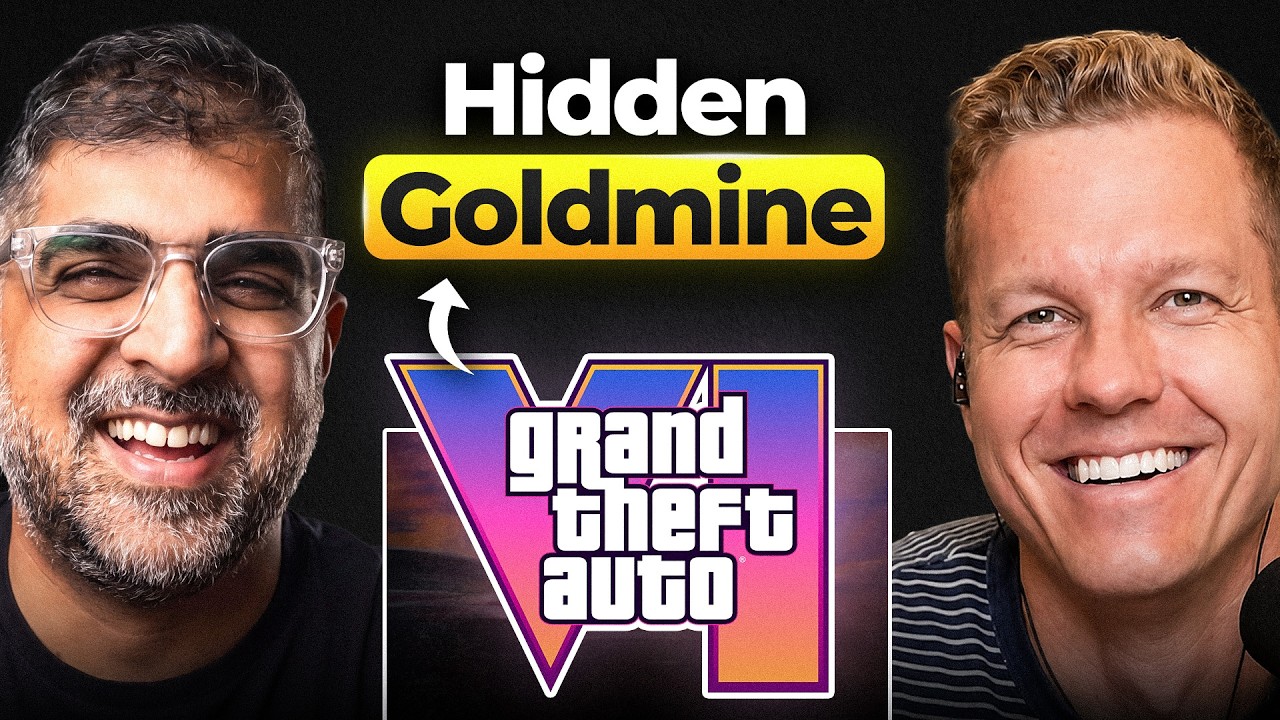
The episode covers a wide range of topics centered on where the biggest opportunities are right now, the TBPN acquisition by OpenAI, the GTA 6 economy, and the story of media mogul William Randolph Hearst as a case study in building a lasting company and managing creative talent.
Where is the opportunity right now?
The hosts argue that most entrepreneurs chase “last wave” opportunities — things that have already been proven — rather than identifying what’s emerging.
Sean gives his own example: in 2012–2014 he was building social media and messaging apps, a category that had already been won by companies like Snapchat and WhatsApp between 2004 and 2012.
He was playing the “venture tech” game but doing so 10 years too late, in winner-take-all markets where network effects give incumbents runaway advantages.
The real opportunities during that period (2012–2018) were crypto, machine learning/big data, and new mobile apps — all of which were visible but underappreciated.
Today, the obvious big opportunities are in AI, energy (GPUs and power plants), and biology/peptides powered by AI.
But the hosts are more interested in discussing a specific emerging micro-economy: the world around Grand Theft Auto 6.
The GTA 6 economy
A friend of Sean’s — someone with a track record of being early on big calls like crypto — proposed a hostile takeover of Take-Two Interactive, the publisher of Grand Theft Auto and NBA 2K.
The takeover didn’t happen because the stock price rose too much, killing the arbitrage opportunity.
The investment case for GTA as an asset:
GTA V did $1 billion in sales in 3 days at launch, bigger than any movie or video game ever.
12 years later, it still generates ~$500 million per year, mostly through GTA Online (recurring revenue).
Nearly 500 million copies sold, ~$20 billion lifetime revenue.
It’s one of the top-grossing entertainment franchises of all media, alongside Pokémon and Harry Potter.
No real substitute exists — it’s a “Coke with no Pepsi” situation.
The new game is expected to do ~$3 billion in year-one sales, with ~$1 billion in pre-orders.
The hosts see opportunity in the ecosystem forming around GTA 6:
Content creators, modders, tool builders, data scrapers, and guide makers.
In-game item trading (skins, outfits, etc.) could create real wealth, as happened with No Pixel, a GTA V mod that became more popular than the official game on Twitch before being sold back to the company.
The economy around the game could be in the hundreds of millions.
Nobody has a head start yet — whoever moves fast and builds interesting things will benefit.
This is especially relevant for 13–25 year olds who are “funemployed” and already deeply embedded in gaming culture.
Accessory businesses in gaming
G-Fuel: an energy drink brand that grew to $100 million in sales by partnering exclusively with Twitch streamers using the Nike athlete endorsement playbook — custom flavors, custom shaker bottles, affiliate revenue shares. Traditional brands hadn’t discovered streamers yet, so the cost of partnership was low and the depth of trust with audiences was enormous.
Elgato: sells streaming accessories (lights, capture cards, etc.) that rode both the gaming streaming wave and the podcasting wave.
Twitch viewing habits vary: some watch on their phone as a primary screen, some use it as a background/second screen while working, some put it on a TV while relaxing. The top category on Twitch is now “Just Chatting” (not gaming), followed by IRL streaming.
The TBPN acquisition by OpenAI
TBPN (This Betcha Podcast Network), a tech live show run by John Coogan and Jordy, was acquired by OpenAI for a rumored $100–200 million, just 12–18 months after launch.
The flagship show itself had relatively small live viewership (~3,000 concurrent), but clips distributed across social media reached far more.
The hosts think it’s an incredible deal for John and Jordy, and predict OpenAI will eventually spin it back out (a “Bar Stool Sports” style second deal) when the board looks to cut costs.
Why it’s puzzling for OpenAI:
ChatGPT already has ~900 million monthly active users; TBPN’s audience is tiny by comparison.
HubSpot’s acquisition of The Hustle made sense because there was direct attribution from content to $20,000/year software sales. OpenAI doesn’t have that problem.
OpenAI claimed TBPN would help with marketing and communications (citing Apple’s acquisition of an ad agency as precedent), but also promised full editorial independence — the hosts see a contradiction there.
The best case for the acquisition: even at $200 million, it’s ~0.01% of OpenAI’s ~$800 billion valuation. Having a uniquely talented media/communications team in-house could be worth that through one great ad campaign or one strategic insight, especially given OpenAI’s current brand problems.
America is deeply skeptical of AI — polling shows AI is more unpopular than Trump. Reasons include fear of job loss, rising electricity costs from data centers, and resentment over billion-dollar funding rounds while ordinary people struggle financially.
Sam Altman specifically draws hatred because he’s seen as inauthentic — he’s admitted he’s bad at confrontation and sometimes says what he thinks people want to hear. There have also been violent incidents: someone threw a Molotov cocktail at his house and later attempted the same at OpenAI’s office.
How TBPN broke the rules of podcasting
The hosts argue John and Jordy inverted the standard podcast model:
Normal model: the long-form show is the product; clips exist to promote the show.
TBPN model: the clips are the product; the 4-hour live stream is a “farming exercise” to produce 20 great clips per day.
The show is designed to be distributed across feeds where people already browse, delivering 10–40 second bursts of entertainment or insight.
They also went all-in on Twitter at a time when most creators weren’t focused there.
Sean highlights two examples of John’s extreme commitment (“lock-in”):
John walked away from a YouTube channel with ~450,000 subscribers and videos getting nearly 1 million views because it wasn’t what he wanted to do long-term. He then started TBPN, where live viewership was only ~2,000–3,000 — a massive psychological drop that would discourage most creators.
John turned down an invitation to a high-profile basketball camp (with founders of Airbnb, Reddit, MrBeast, etc.) because he didn’t want to lose 48 hours of momentum on TBPN, even though at that point it was just a Twitter account replying to tweets — not even a live show yet.
Platform drama: X and TBPN visibility
After the acquisition, users noticed TBPN content appearing less frequently on X (Twitter).
The hosts speculate this isn’t a conspiracy theory — Elon Musk has a history of this: when Substack refused to sell to him, traffic from X to Substack dropped to essentially zero the next day.
With OpenAI as a competitor and an active lawsuit between Musk and Altman, it wouldn’t be surprising if X reduced TBPN’s visibility.
William Randolph Hearst: media mogul case study
Hearst (born ~1863) built one of the largest media empires in history and is the basis for the character in Citizen Kane.
His father was a mining magnate who went from rags to riches to rags to riches again, eventually becoming a California senator with young William running the newspaper that promoted his campaign.
Hearst bought the San Francisco Examiner at a young age and transformed it using what became known as “yellow journalism” — oversized headlines, photos, emotional narratives, and sensationalism over dry facts.
He and Joseph Pulitzer competed fiercely; Hearst’s sensational coverage of the USS Maine bombing helped spark the Spanish-American War.
At his peak, ~20% of Americans got their news from Hearst papers.
Hearst was an extravagant spender:
Equivalent of $20 million/month in personal spending; some years $2–4 billion on projects like Hearst Castle.
Hearst Castle was a 40,000-acre estate with a private zoo (zebras, camels, polar bears), the most expensive art collection in the world, and dozens of mansions.
He told his accountants: “Just find out where the money is from.”
The government repeatedly put his empire into receivership because he couldn’t stop spending.
He was also anti-Semitic and published Hitler as a columnist before the Holocaust was known — the hosts don’t give him a pass on this.
Hearst today is still family-owned, does ~$15 billion/year in revenue, owns Cosmopolitan, GQ, 20% of ESPN, half of A&E, Fitch Ratings, and many local news stations. It’s run by a trust with six family and six non-family members.
Hearst’s approach to managing and collecting creative talent
Hearst was famous for personally recruiting the best writers and journalists — Mark Twain, Jack London, and many others.
He would read a pamphlet or article by an unknown writer, track them down personally, and show up at their door to recruit them.
He paid significantly above market rate.
His philosophy: get the best people under one roof, even if it means profits are thin or the company breaks even. This tends to work out over time.
He gave creatives freedom and covered for them when they said controversial things (e.g., criticizing sitting presidents).
The key insight for managing creatives: the A+ talent is worth 10–100x what an average person produces, but they never cost 10–100x more (with the recent exception of AI researchers). The asymmetric arbitrage is in identifying and paying a premium for truly exceptional people.
Sean’s broader framework: every business has one main thing that determines success or failure. Either the founder must be world-class at figuring out that thing, or they must be world-class at recruiting someone who is. There are only two ways to win.
Building a multi-generational company
Sean is interested in building something that lasts 200+ years, inspired by Hearst’s empire.
His approach is to hold the goal with deep desire but also complete detachment from the outcome.
His plan for involving his kids is unconventional: rather than having them inherit his empire, he wants to work for them — he’ll be their unpaid (or $10-paid) intern when he retires, whatever they end up doing.
He follows the Warren Buffett philosophy on inheritance: give kids enough to do anything, not enough to do nothing.