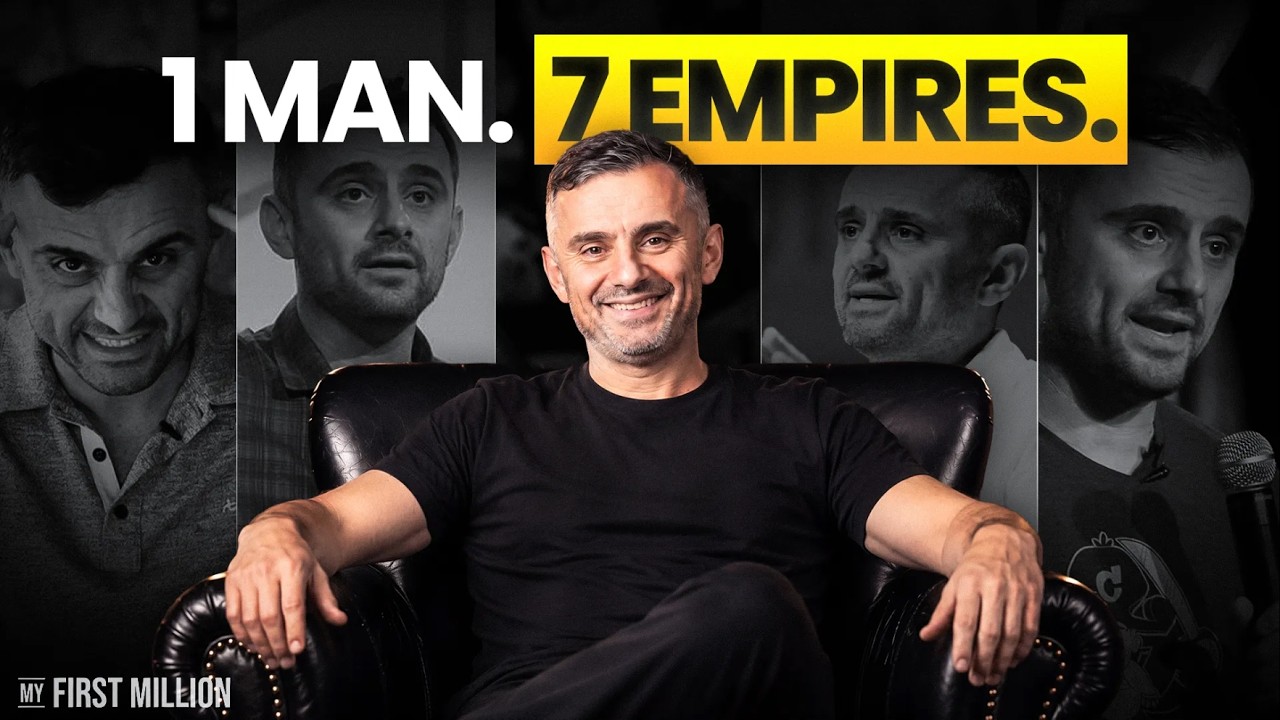
Gary Vee runs seven businesses each doing eight- or nine-figure annual revenue, all built on a philosophy of long-term greed, deep human relationships, and intuition over conventional business logic. He operates as either the primary or secondary leader in each, relying on a small circle of trusted long-tenured partners to run day-to-day operations while he context-switches across all of them through an unusually disciplined 15-minute meeting format.
The relationship engine: Nick Dio and VP of Friendships
Gary employs Nick Dio as a “VP of relationships,” a role with no direct revenue mandate — his job is to host dinners, connect people, and identify opportunities to help others purely for karma.
Nick has been with Gary for 12 years, starting as an intern at Vayner Media, and now represents Gary at events worldwide, hosting gatherings of 50+ high-caliber people in wealthy executives’ homes.
One concrete example: Nick identified a DTC brand founder who had lost his head of marketing, and connected him with a senior Vayner Media employee who wanted to leave the agency — a match that helped both parties with zero financial involvement from Gary.
Gary also has three full-time employees at Vayner X whose sole job is to host emerging influencers touring the office and connecting them to brand deal teams, again on pure karma with no ROI expectation.
He estimates he has spent $5–10 million on relationship-building infrastructure, framing it as his equivalent of LeBron James spending $1 million a year on his body — an investment in himself as a human rather than a financial asset.
Short-term greedy vs. long-term greedy
Gary credits Alexis Ohanian with crystallizing his philosophy: the difference between short-term greedy and long-term greedy. Silicon Valley’s best founders play long-term greedy, and Gary takes it further by being “rainy day human greedy” — building relational equity for scenarios that may never materialize financially, like his daughter needing help 19 years from now from someone he helped today.
He acknowledges this approach was not possible in the first 30 years of his career when margins were tighter. It requires a financial foundation before you can afford to invest in people without expecting returns.
Candor as a leadership breakthrough
Gary was historically terrible at firing people — not because he avoided conflict, but because he genuinely believed he could fix anyone through love and encouragement. He would praise someone on Friday and fire them on Monday without having given any prior signal, then blame the employee for being “delusional.”
A watershed moment came when a Facebook group of former Vayner employees was criticizing him, and he realized all eight people in the group had experienced sloppy, drawn-out exits. His lack of candor had been a hidden weakness masked as a strength.
He wrote about this in his book 12 and a Half, where the 13th principle (a “half”) is candor. He now practices “kind candor” — being direct and honest while not using candor as an excuse to be harsh.
He says becoming a dramatically better CEO over the last 3–4 years, specifically on candor, has directly improved business results.
The seven businesses
Vayner Media / Vayner X: $400 million in revenue. Gary is day-to-day CEO. Full-service agency doing brand deals, influencer marketing, and client services.
Vayner Sports: Sports representation for pros (Kirk Cousins, Sauce Gardner, Aiden Hutchinson, Bo Bichette) plus NIL representation of roughly 300 college athletes. Doing tens of millions in revenue.
ECR Group (restaurant group): Includes Flyfish Club (the NFT restaurant that became a real, thriving NYC private dining club), Kons, and other concepts. Doing tens of millions. Gary is actively involved, texting with co-founder David Rodolitz daily.
V Friends: Gary’s most personally exciting venture. A true IP brand built from the ashes of the NFT era — comic books, coins, trading cards, licensing. Projected to do at least $20 million this year. Gary believes it has a chance to become a Marvel- or Pokemon-level intellectual property over 15 years, especially valuable in an AI-driven world.
Wine Library: Gary’s original family wine business. His best friend Brandon Warick runs it as 1A; Gary is 1B but works on it every day.
Vayner Watt: A TV production company that has quietly sold shows to Hulu, ABC, and Netflix. Still under the radar but scaling.
Gary Vee brand (NIL): Speaking, books, content, and selective seven- and eight-figure brand deals (Stan Store, Masterclass). He is writing a new book called The Individual Empire about creator-entrepreneurs becoming the next Fortune 500 companies.
How he actually runs seven companies: the 15-minute meeting
Gary works roughly 8:00/8:30 AM to 8:00–10:00 PM with no breaks. About 60% of his meetings are 15 minutes. He estimates he gets three days of work done in one day.
Roughly 70% of meetings are him making decisions; 30% are him being informed.
The system works because of what he calls “family business” dynamics — every company is run by people who have worked for him for 7–15 years and know each other deeply. He names Ryan Harwood, Kalin, Claude, JT, AJ, Greg Gensky, David Rodolitz, Connor Heyland, Andy Kay, John Troutman, May, Rips, Brandon Warick, and Eric Watenberg as the core operators.
He points to two proof points: Resy (co-founded with Ben Leventhal, nine-figure exit) and Empathy Wines (founded with two former interns after 11 years at Vayner, sold to Constellation Brands in 18 months for a hefty eight-figure deal). Both succeeded because the co-founders were long-tenured insiders, not new hires.
He is about to announce an eighth standalone business next year with someone who has worked for him for 11 years as co-founder.
Missed investment opportunities
Whatnot: Gary talked about live shopping extensively and the deal crossed his desk, but he was not actively investing at the time. He never took a meaningful meeting with founder Grant Yun, though he now wishes he had. He notes that when he is an investor, he signals it early by making a lot of content about the company — so the absence of early content is the tell.
Airbnb: He had an email from Joe Bedandrea (Airbnb’s Andre) in his inbox but never saw it. The round had closed and he didn’t chase it.
Pinterest: A former Campbell Soup CSO told him about “a startup from Pennsylvania” through a cousin connection. Gary didn’t take it seriously — comparing it to getting a Hollywood script pitch in Chicago. He later invested through Scott Belsky, who had invested in both Uber and Pinterest at a $3.5 million valuation with $25,000 checks from $75,000 in personal savings.
Liquid Death: His biggest win he says he doesn’t deserve. Mike Cessario, a creative who worked at Vayner Media, emailed Gary the day before leaving to say he was starting a water company called Liquid Death and asked if Gary wanted to invest. Gary invested purely to support an employee’s venture, not because he believed in the brand. It was the first check in.
Vetting people and protecting reputation
Gary is aware that his name and image are exploited — people with four followers selling $4,000 courses will take a selfie with him at the airport and claim they had a strategic meeting. He is increasingly conscious of this, especially with deepfakes.
He does not let political beliefs disqualify associations, but he does avoid people whose work he doesn’t consider honorable.
He credits his mother and his upbringing for keeping him grounded — he says he has never said anything in writing that could be used against him, which he attributes to being raised to be the bigger person.
Mimetic rivalry and the psychology of winners
Gary observes that many extremely successful people — those with wealth, relationships, and status — still spend disproportionate time envying or criticizing other winners. He finds this baffling and has called out friends for it, telling them to spend that energy building instead.
He references René Girard’s mimetic theory: most people want things because other people want them. Gary believes his own drive is non-mimetic — he pursues projects because they genuinely excite him, not because others value them.
He pushes back on the idea that insecurity drives success, arguing instead that most people who reach the top do so from a place of extreme security.
What he is betting on for the next 5 years
Advanced AI: He is interested in people building agencies of virtual AI people, knowing the stigma around AI-generated personas will fade in 3–5 years, and owning that IP will be enormously valuable.
Live shopping: He believes live shopping will capture 10–15% of all commerce in 6–10 years, the same way e-commerce disrupted retail. This is a core thesis he has been vocal about for years.
Creator-entrepreneur as Fortune 500: His upcoming book argues that individuals like MrBeast, Alex Cooper, and himself represent a new model where a single human (or human + partner) builds a company as valuable as traditional corporations, enabled by AI, blockchain, decentralized media, and the collapse of traditional gatekeepers in Hollywood, Madison Avenue, and Wall Street.
The restaurant expansion play
Capon’s Chop House, a steakhouse opened in Bergen County, New Jersey, is the prototype for a planned rollout of 50 locations in high-net-worth neighborhoods across the world’s seven most important cities.
The model is positioned as “Ruth’s Chris 2.0” — 20% less nightlife sizzle, 20% more food quality, with a membership structure. The thesis is that food quality drives retention (LTV) more than atmosphere.
The Vayner X marketing machine is a strategic advantage across all of Gary’s businesses, providing built-in brand amplification that most operators lack.