Barry Ritholtz is a veteran investor, blogger, and podcaster who runs an $8 billion AUM advisory firm built on the philosophy that most people should simply own low-cost index funds and stop trying to outsmart the market. He argues that the vast majority of financial media, active managers, and self-proclaimed gurus are either wrong, self-interested, or both—and that the single biggest edge an investor can have is managing their own behavior, not picking stocks.
The Christmas Tree Portfolio
Ritholtz’s core framework is the “Christmas tree” analogy for portfolio construction:
The trunk and base (50–70% of the portfolio) is a broad, low-cost index fund like Vanguard’s VOO, which recently became the first ETF to surpass $1 trillion in assets.
Historically, fewer than half of active managers beat their index in any given year; over 10 years, fewer than 10% do; over 20 years, only a handful of names like Peter Lynch and Warren Buffett.
The decorations on the tree are whatever individual bets or tilts an investor wants—momentum, tech, international ETFs like EWJ for Japan or India funds.
The point of the decorations is psychological, not financial: they give investors something to tinker with so they don’t mess up the core. Ritholtz calls his personal speculative allocation the “cowboy account.”
Even the best speculative bets are hard to hold: he sold Apple at $15 after tripling his money, only to watch it gain another 9,000%. The CEO of Peloton was worth billions on paper but leveraged himself so heavily that when the stock crashed post-vaccine, he had to liquidate everything including a $60 million East Hampton home.
Research by Henrik Bessembinder at Arizona State found that 1–2% of all stocks account for the entire net value created in the market, meaning the odds of picking a long-term winner are extremely low.
Why Most Selling Decisions Are Bad
Ritholtz highlights two key findings about selling:
Panic selling: During the 2008–09 financial crisis, the market dropped 57%. Roughly one-third of investors who sold never returned to equities. A $1 million portfolio sold at the bottom would have been worth ~$4.5 million today if held; instead, those who stayed in cash earned 1–4% annually while missing a 10x recovery.
Hedge fund sells are worse than random: A study by University of Chicago professor Alex Edmans found that hedge fund managers’ buy decisions were thoughtful and logical, but their sell decisions were emotional and impatient. When researchers randomly sold other holdings in the portfolio instead of the ones the manager chose to sell, the random sells outperformed the manager-selected sells by 150–200 basis points. The lesson: make fewer decisions.
The Case for Humility in Investing
Ritholtz’s book How Not to Invest is organized around the principle that “nobody knows anything”—a theme he returns to repeatedly:
He famously passed on Robinhood in 2014 at an $80 million valuation, calling it “the dumbest idea I’ve ever heard.” His colleague Howard Linden made $100 million on it.
He spent 2007 being “the dumbest guy on Wall Street” for predicting the Dow would fall to 6,800 based on research by Reinhart and Rogoff showing that credit-driven real estate bubbles lead to ~32% declines. He was right, but early—the trend line didn’t break until 2008, and CNBC guests literally laughed at him on air.
He argues that even the most successful people, like former Goldman Sachs CEO Lloyd Blankfein (who day-trades 70% of his net worth), are not immune to behavioral mistakes. His advice: “Put the phone down. Stop trading.”
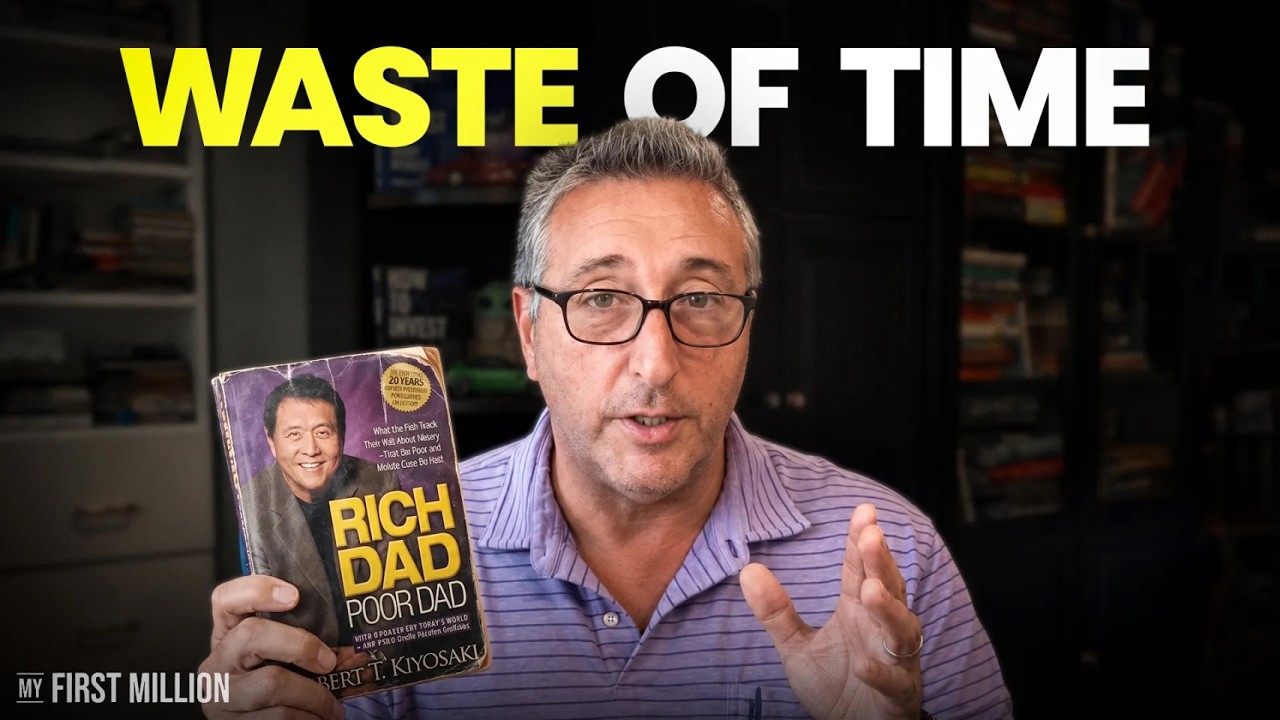
Robert Kiyosaki (Rich Dad Poor Dad) is singled out as a source of consistently bad advice—bearish throughout the 2010s, telling people to sell housing in 2018 right before a historic boom. Ritholtz’s point: you can’t know the future, so stop making forecasts.
Why Pay a Fee for Index Funds?
Ritholtz addresses the obvious objection: if index investing is the answer, why pay an advisor?
His firm’s message has always been “you can do this yourself”—and 99.99% of readers should.
The 0.01% who become clients typically have complexity: tax issues, estate planning, concentrated positions from selling a business or founder stock.
One key service is direct indexing: instead of buying an index fund, the firm buys the individual stocks in the index, allowing them to harvest tax losses by selling the bottom decile of performers (e.g., a small-cap biotech down 40%) and replacing them with similar companies. This can add 75–400+ basis points of tax alpha per year without changing the portfolio’s exposure.
For someone with a $10 million portfolio that’s 90% Apple, direct indexing provides a way to diversify out of the concentration without triggering a massive capital gains tax bill.
The 10% Worth Reading
Ritholtz invokes Sturgeon’s Law (“90% of everything is crap”) to describe financial media. His recommended 10%:
Ed Yardeni: 40 years of data-driven economic analysis, started at Deutsche Bank.
Sam Ro: Market dynamics and structure (free and paid versions).
Morgan Housel: Behavioral finance and storytelling.
Jonathan Miller: Residential real estate data and pricing.
Jim Chanos: Short-selling and fraud analysis.
Michael Lewis: Wall Street culture and psychology (new book on DOGE coming).
Richard Thaler: Academic behavioral finance research at Chicago.
He also notes emerging research suggesting neuroatypical individuals may do better at market timing because they’re less subject to social pressure and emotional trading.
Bubbles Are a Feature, Not a Bug
Ritholtz references the book Pop! Why Bubbles Are Good for the Economy:
The dot-com bubble laid billions of dollars in fiber optic cable at $1,000+ per mile. When the companies went bankrupt, cable and phone companies bought it for pennies per mile, enabling YouTube, Facebook, and all bandwidth-intensive tech that followed.
The same pattern played out with railroads, televisions, radio, semiconductors, mobile phones, and cars—every major technology goes through a boom-bust cycle where most early companies die (of ~2,000 car companies launched in the 1920s, only three survived; HP, Gateway, Nokia, Motorola, and Ericsson all fell).
The takeaway for AI: the technology will transform the economy, but most of the current companies riding the hype probably won’t survive. The winners will be the ones unburdened by sunk costs and legacy platforms.
Elon Musk’s Brief Finance Career
A story from Walter Isaacson’s biography illustrates why even brilliant people struggle in institutional finance:
As a student in Canada, Musk cold-called a bank CEO and landed an internship. He identified mispriced Latin American debt (Brady bonds) trading at 20 cents on the dollar despite being backed by the U.S. government—a Buffett-style no-brainer.
He called the trading desk and confirmed he could place a $50 million trade. He pitched the CEO, who rejected it because the bank “already had too much Latin American debt.”
Musk concluded that big banks make decisions for illogical, risk-averse reasons, decided he’d never work for other people, and went to build things instead. The experience gave him what he called “a healthy disrespect for the financial industry” and the audacity to eventually start what became PayPal.
The Firm’s Growth
Ritholtz’s firm launched in 2013 at the start of the third-best 15-year run in market history.
As of December 31, AUM was $7.6 billion, growing roughly 30% per year since launch.
Fees average around 70 basis points.
When the firm hit $1 billion, it had 35 people—nearly 10x the staff of a typical billion-dollar advisory team at a large brokerage (which would have 4 people). The firm was built to scale from day one.