Lloyd Blankfein, former CEO and senior chairman of Goldman Sachs, discusses his personal investing philosophy, career lessons, and views on risk, luck, and American resilience. Despite decades at the top of global finance, he emphasizes that nobody truly knows anything about investing, that most successful people are more normal and insecure than they appear, and that luck plays an enormous role in outcomes. He also shares how his upbringing in poverty in Brooklyn shaped his relationship with money, his anxiety, and his drive.
His personal portfolio and investing approach
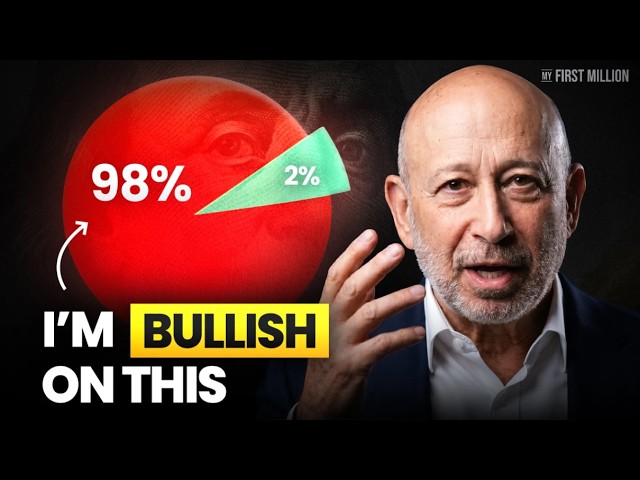
Blankfein invests almost entirely in equities — roughly 98% of his portfolio — because he finds risky assets fun, and because nothing hugely positive or negative will affect his life at this point.
About 75–90% is in individual stocks, mostly big tech and hyperscalers (Google, Microsoft, Nvidia) plus second-tier names like Oracle, with the remainder in ETFs.
He day trades daily from an iPad and phone, calling and texting people for information, treating market activity like background noise — similar to how most people listen to music while doing other things.
He has outperformed the market, which he attributes to his concentrated focus on three sectors: tech, energy (his original trading background), and financial services (where he has deep expertise).
He still holds Goldman Sachs stock out of affection for the firm where he spent nearly 40 years.
For young investors, he recommends a diversified equity portfolio like the S&P 500 (via ETFs such as VOO or SPY), possibly supplemented with tech-focused ETFs, because young people have time to outlive their mistakes.
As people get older, they should become more conservative — focused on not losing what they have rather than maximizing gains.
On democratized investing and day trading
He supports platforms like Robinhood that make investing accessible, but warns that when trading is gamified with confetti and high-fives, it can mask real danger — especially for people who can’t afford to lose.
For some, that gamification is a disservice; for others, it’s exactly what’s needed to spark interest.
Biggest investment mistakes
He passed on SpaceX when it was valued at $100 billion; it’s now being discussed at roughly $1 trillion.
He also missed early cellular opportunities, reasoning that cell phones were bulky and there were plenty of telephone booths — a reminder that nobody is great at predicting the future.
Meeting Elon Musk and the myth of genius
Blankfein has known Elon Musk for years, having underwritten much of his financing, and considers him one of the very few people he’s met whose thinking he genuinely cannot reconstruct — a true outlier.
But he pushes back on the casual use of the word “genius,” noting that most successful people, including world leaders, are far more normal, insecure, and flawed than people assume. Even the most powerful people seek affirmation after speaking.
What separates good traders from bad ones
The margin between the best and the rest is razor-thin — like a golf tournament won by one stroke with six people tied for second.
The worst traders lack resilience; the best bounce back, look at new information rather than the past, and adapt quickly.
Sometimes a good risk manager must encourage risk-taking rather than suppress it, because without risk there is no growth or progress.
After the 2008 financial crisis, Goldman partners became so gun-shy they were talking themselves out of every opportunity — a cautionary tale about how fear can paralyze an organization.
Luck, timing, and the role of fortune
Blankfein became CEO of Goldman Sachs only because his predecessor was nominated to be Treasury Secretary. Had that not happened, he might have been too old by the time the role opened up.
He emphasizes that you could be the fastest runner in the world but peak in the wrong Olympic year and never medal — luck and timing are inseparable from success.
Only about 2% of minor league baseball players ever make a living professionally, illustrating how the market only rewards those in the top 0.001% of a field.
Warren Buffett’s handshake deal during the financial crisis
During the 2008 crisis, Warren Buffett called and offered $5 billion in preferred stock to Goldman Sachs — based on a phone call and a handshake, with no due diligence.
When Blankfein offered to walk Buffett through everything he was worried about, Buffett replied: “Lloyd, I know you well enough to know that you worry enough for the both of us.”
Buffett also noted that if the $5 billion went completely bad, “that’s not even a bad hurricane on the East Coast” — a reminder of the scale of Berkshire Hathaway’s insurance operations.
The money itself was less important than the signal it sent: Buffett’s confidence restored market trust in Goldman at a moment when similar institutions were failing.
Buffett asked for a verbal commitment that Blankfein wouldn’t sell his shares before Buffett sold his — no written contract, just a handshake. Blankfein agreed.
Blankfein notes that most of the transactional world works on reputation and verbal agreements; written documentation is ideal but often unnecessary when performance happens quickly.
Anxiety as a superpower
Blankfein describes himself as wired for anxiety, inherited from his father, and says this trait served him well in a risky business where you need to constantly look around corners for what could go wrong.
He is generally upbeat that things will work out, but knows that before they do, many things go wrong.
He acknowledges this anxiety isn’t ideal for all parts of life, but it was well-suited to presiding over a firm with a large balance sheet taking on risk.
Family, partnership, and money
Blankfein credits his wife Laura as essential to his career — she managed everything at home, especially when he moved overseas, allowing him to focus on work.
He hasn’t paid a bill in over 40 years; his wife manages all household finances through a bill-paying service.
When he was a new partner in his 30s, he and his wife bought a vacation home for around $300,000 — more than all their savings. They drove to the closing with his wife frantically trying to make the numbers work, only to realize she’d forgotten to count the 10% down payment they’d already made.
He reflects on the tension between wanting to give to his kids and then feeling ambivalent when they enjoy things he never had — recognizing the irony that their comfort exists only because he provided it.
He also notes the burden on children of prominent figures: his kids worked briefly at Goldman but found it too oppressive, worrying that people would assume they hadn’t earned their positions on merit.
Scarcity and the lasting imprint of poverty
Growing up in East New York, Brooklyn, as the son of a postal worker, Blankfein was shaped by financial scarcity. He didn’t visit Manhattan three times as a child and didn’t fly on a plane until after college.
As a college freshman in 1971 on full financial aid, he had $11 left after buying books and a sweater. When he went to the financial aid office, they gave him a $500 check on the spot after he filled out a simple form — the first time in his life he wasn’t nickeled and dimed.
That experience of dignified generosity profoundly influenced him and shaped his approach to philanthropy: it’s not enough to give, you must give in a way that preserves dignity.
He now co-chairs financial aid campaigns and believes in “giving with a warm hand, not a cold hand” — giving while alive to experience the joy of it.
The Goldman Sachs obituary test
When Blankfein made partner, a senior partner advised him: if your obituary is nine paragraphs long, make sure no more than three are about Goldman Sachs — the rest should reflect a full life beyond the firm.
He acknowledges he didn’t follow this advice; his memoir even has Goldman Sachs in the subtitle. But he understands the wisdom behind it.
Since retiring, he has tried teaching but prefers learning — taking online courses in cosmology, physics, linguistics, anthropology, and history.
Lessons from history
Blankfein is an avid history reader who believes history doesn’t repeat but it rhymes — patterns recur, and understanding them provides perspective on current challenges.
He recommends Barbara Tuchman’s A Distant Mirror, a 14th-century history that served as a mirror to Cold War anxieties, and Robert Caro’s The Power Broker about Robert Moses, which he reread decades later and appreciated more after experiencing the difficulty of getting things done in business.
He argues against revisionist history that dismisses achievements because of flaws in the people who accomplished them — citing the founding fathers, Columbus, and Robert Moses as examples of complex figures whose accomplishments deserve admiration even alongside their serious failings.
He sees America as “mostly good and we can improve” — a country where you can express contempt for the nation while living comfortably within it, and where every generation faces challenges that feel unprecedented but are in fact rhymes of past eras.
He pushes back against defeatist phrases like “in this economy,” arguing that the words people use shape how they think, and that every generation has faced hardship — from Vietnam-era body counts to the McCarthy era to Japanese internment camps — and overcome them.
He loves the immigrant journey and believes the American dream should be about starting a small business, not just buying a home — pointing to the bodegas named “American Cowboy” or “American Inc.” run by families who may not speak English fluently but understand what America represents.