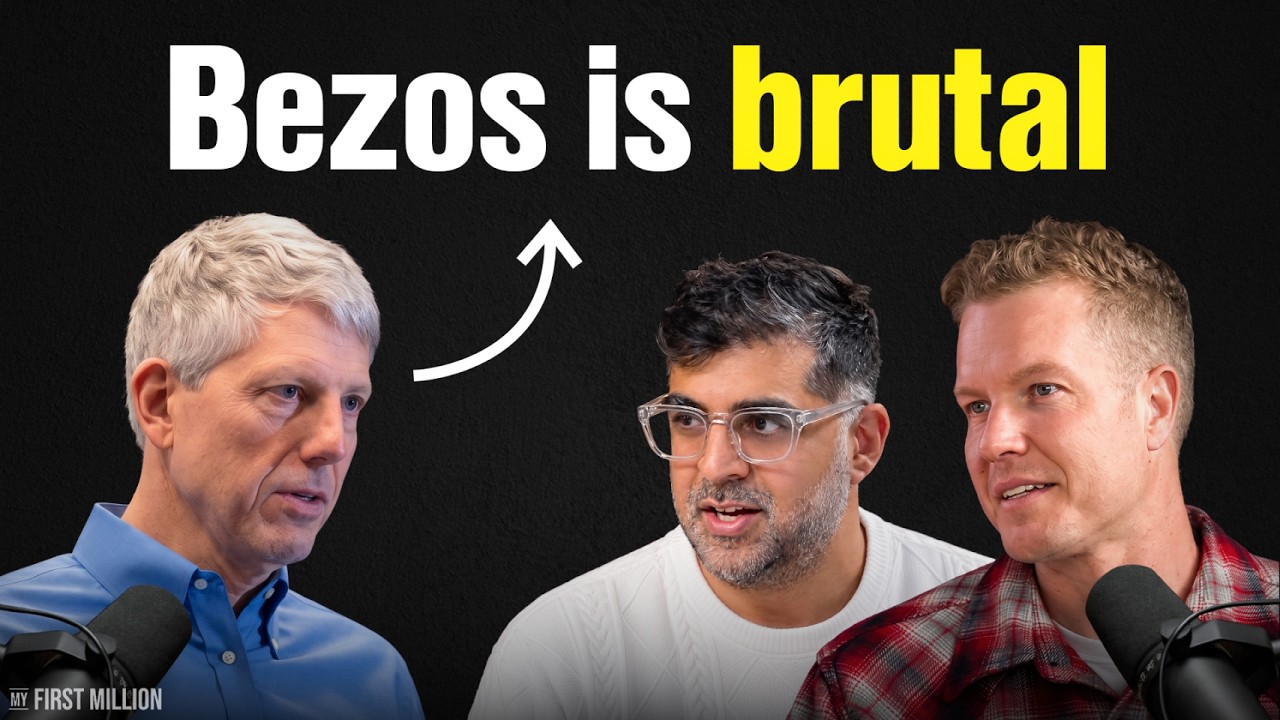
Ethan Evans spent 20 years at Amazon, rising to VP and leading Prime Video; he now works as an executive coach and runs a charity for Ukrainian refugees in Poland. This episode covers his firsthand observations of Jeff Bezos’s leadership style, Amazon’s operating culture, the origin of Prime, the psychology of extreme wealth, and his own shift from corporate executive to independent coach focused on helping others achieve financial security and then purpose.
Working with Jeff Bezos: strengths, flaws, and evolution
Bezos combined rare raw intelligence with 10,000 hours of pattern recognition from daily document reviews, letting him spot the key leverage point in a business he barely knew within minutes.
His taste was generally excellent — he backed Kindle, Prime, and the shift from two-day to one-day shipping — but he also drove the Fire Phone disaster, a $170M hardware write-off, because he couldn’t accept that his vision might be wrong.
Early on, Bezos gave only corrective feedback; a coach later prompted him to add praise, which he did mechanically (“Oh, yeah, but good job”) before walking out.
He could be cutting: once stopped a meeting to ask if the “A team” was available because the presenters were clearly the “B team”; another time told a PR lead “How could we be so stupid?” about a price-scanning app that looked like spying on small businesses.
When frustrated, he let emotion show — once replying “Just euthanize me” to a team that confirmed they were proceeding with a project he hated.
He used “question mark emails”: forwarding a customer complaint with only a “?” — giving the responsible VP 24 hours to diagnose and fix it.
Bezos told his CFO, “Tom, how much is that? I might want to spend it” — making clear the CFO counts pennies; the CEO decides how to use them.
Over time, Bezos retreated behind increasing security: from a single retired-pitcher guard to a SWAT-team panic button, a dedicated elevator, and a Fort Knox executive floor.
Ethan would still take a call from Bezos tomorrow — high trust based on competence and predictability — but notes Bezos has changed radically since leaving Amazon.
Amazon’s operating culture and principles
“Strategically patient, tactically impatient”: big bets take decades (Prime, space), but every quarter must deliver maximum progress; five years = 20 quarters, none can be wasted.
“Work-life harmony” replaced “balance” — if you enjoy the work, long hours aren’t a problem; “we work long, hard, and smart — two out of three don’t count.”
“Your career has seasons; maybe Amazon isn’t the right place in some seasons” — code for: if you want to see your kids, don’t work here, or work 6–8 PM, then 8 PM–midnight.
“Amazon is where high performers go to feel bad about themselves” — the bar rises relentlessly; you hit the goal, they raise it.
Homepage design was ruled by load-time neutrality: speed = sales; pretty pixels didn’t move the needle. The buy box stayed consistent; low price and clear delivery promises drove conversion.
During the 2007–08 recession, Amazon profited because its low-price focus attracted cash-strapped shoppers.
Bezos quoted Benjamin Graham: “Short-term the market is a voting machine; long-term it’s a weighing machine.” He ignored stock volatility and prioritized free cash flow over GAAP quarters.
He once called a single profitable quarter a “terrible mistake” because it created a comp that made future losses look worse.
The origin of Amazon Prime
Prime began as “Project 100” — a 100-day sprint to announce a fast-shipping program before a weak quarter, giving Wall Street good news.
It was originally pure two-day delivery (not shipping), masking the carrier so Amazon could later shift to its own one-day network.
The idea came either from Bezos or principal engineer Charlie Ward (who submitted it via Amazon’s internal “idea tool”); both claim credit.
Free shipping had been tested earlier: started at $100 minimum order, stepped down to $25 — the magic number where two media items (DVDs, CDs, books) fit in one box with enough margin to cover shipping.
Prime added perks (video, music, etc.) only later; the core was solving the “customers hate paying for shipping” problem Bezos had fought Jeff Wilke on.
Wealth, motivation, and the “adult in the room” at Twitch
Amazon stock rose ~9,000% during Ethan’s tenure; holding all grants would be worth ~$40–50M today, but he sold along the way to fund life (adoption, diapers, etc.).
Many Twitch employees vested at ~$2M/year after the 5x stock run-up, then left because market salaries (~$250K) couldn’t compete — a “vest cliff” Amazon wouldn’t re-match.
Ethan was sent to Twitch as the “parental guardian” / adult in the room; Twitch leaders initially feared he was a spy sent to replace Emmett Shear.
A Twitch leader once asked, “Why do we worry about profit? Can’t Amazon just pay for it?” — Twitch burned >$1B over five years while annually projecting profitability in three years.
Emmett Shear’s “trust equation” moment: when asked to pick the most important variable (intimacy, credibility, integrity), Emmett chose credibility — “when you say ‘I got this,’ it means you got this” — because too often leaders disappeared and the area collapsed.
Some VPs weren’t the smartest but were “I got this” operators who would turn a D into a B and hold the line; Bezos valued that reliability over high-beta brilliance.
Transition to coaching, 10-year planning, and career satisfaction
Ethan left Amazon (target comp ~$900K, actual ~$1M+) to coach; now earns ~$700–800K at ~20 hrs/week with high autonomy — happiness jumped from 7–8/10 to “11/12” on a scale he didn’t know went that high.
Biggest loss: the platform — as an Amazon VP, anyone took your call because it might mean a billion-dollar deal; now he’s “just an executive coach.”
He credits Sean (co-host) for the 10-year plan habit: write a sticky-note vision 10 years out, then work backward in annual blocks.
His 10-year vision: “Create more people who have the money and confidence to do something good in the world” — help them slay the “money monster,” “success monster,” and “I’m enough monster” so they can pursue the orphanage, charity, or impact they’ve deferred.
He used Twitch streaming (30–40 viewers, weekly) as a low-stakes reps ground to practice coaching live, despite Amazon’s PR restrictions — he secured Emmett’s explicit approval first, then defended it to HR by noting he only gave career advice, never discussed Amazon business.
Tony Robbins started the same way: cold-calling radio stations, promising 7-minute phobia cures, then meeting skeptics at a mall fountain to prove it — reps in obscurity before scale.
Communication technique: truth without damage
Core principle (from Leadership and Self-Deception): see the person as a human, not a machine to fix. Care first; the tone and body language convey “I’m trying to help you,” so even “your baby’s ugly” lands as support.
Coach-specific framing: “As a coach, it’s unfortunately my job — you’re paying me to give you very difficult news.” The client has already consented to hard truth, so the coach can be direct without being the “bad guy.”