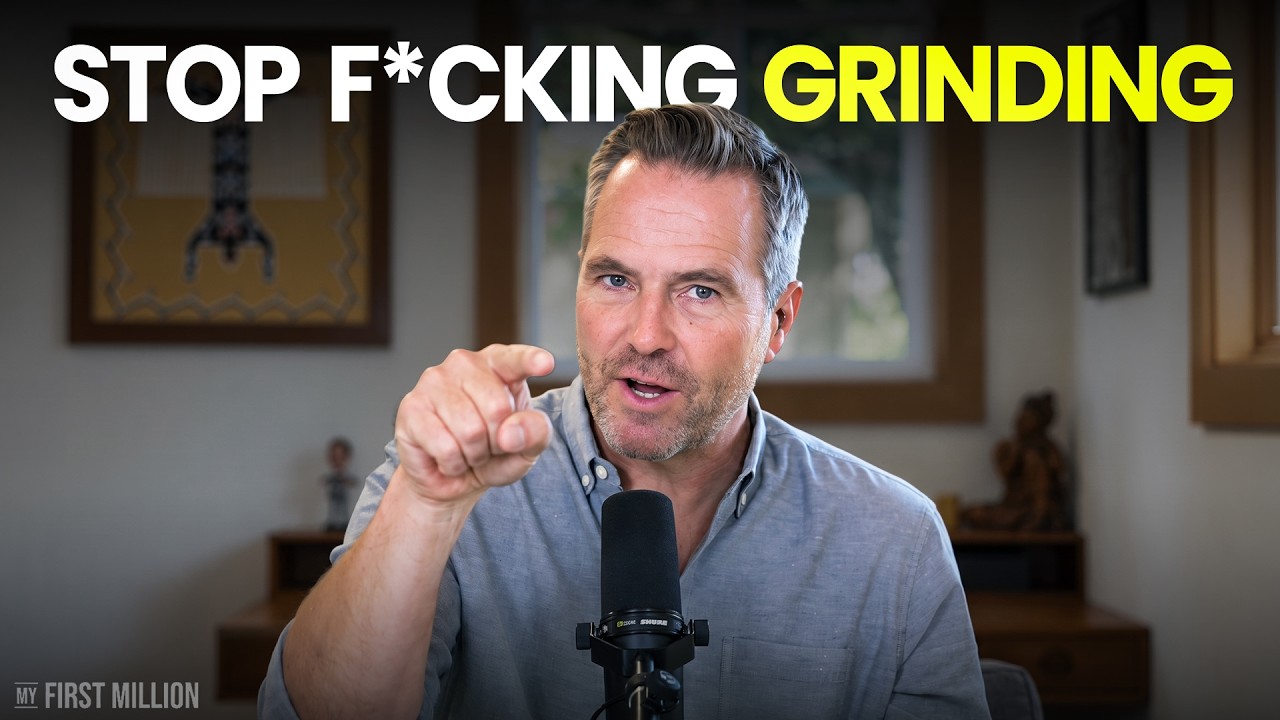
Joe Hudson coaches top-tier entrepreneurs and CEOs (including Sam Altman) by blending business strategy with deep psychological work; this episode distills his framework for transforming the internal patterns that limit high performers, covering limiting beliefs, emotional avoidance, nervous system regulation, conflict, self-talk, and practical weekly experiments.
Limiting beliefs are anxiety disguised as thoughts
The core limiting belief: “Will it last?” — appears after any transformation and triggers anxiety that masquerades as a rational concern.
A second limiting belief follows: “I’ve lost it” — treating the natural ebb and flow of learning as failure rather than part of the process.
Example: dieting — one piece of cake becomes “I can’t maintain this” instead of “I had cake, now I continue.”
Sam Altman’s limiting belief: you must grind and suffer to achieve outsized results, then you’ll be happy.
Counter-evidence: some of the most successful VCs work 3–4 hours/week after an initial grind period; success correlates more with relationships and decisions than effort.
Startups don’t fail from lack of effort — everyone in Silicon Valley efforts constantly — they fail from poor decisions and weak relationships.
Transformation requires addressing three levels: mind, heart, gut
Mind (prefrontal cortex): intellectual understanding — easiest for most people, but insufficient alone (e.g., knowing you should work out doesn’t make you work out).
Heart (mammalian/emotional brain): the emotions you refuse to feel that drive behavior — e.g., helplessness avoidance fuels overwork and isolation.
Gut (reptilian/nervous system): primal survival responses — activated by perceived threats (a Slack message saying “can we talk?” triggers fight/flight).
Real change requires working at all three levels; insight alone doesn’t rewire the nervous system.
The self-reliance pattern underpins many entrepreneurial struggles
Origin: childhood experience that no one will meet your needs — often because parents were critical, addicted, depressed, or you parented them.
Manifestations: difficulty asking for help, owning desires, trusting authority (rebel against others’ authority, don’t fully step into your own), announcing hurt.
The pattern is a coherent adaptation, not a character flaw — recognizing this creates space for new behavior.
The golden algorithm: the emotion you avoid is the emotion you invite
Avoiding helplessness by not asking for help → you leave without what you need → more helplessness.
Avoiding helplessness by grinding → burnout → worse decisions → more helplessness.
Solution: fall in love with the avoided emotion — treat it as a signal, not a threat.
Example: “I’m helpless” becomes “Great, this signals I’m not delegating, not letting people help, constraining my decisions — now I can act on that.”
Reframing emotions as messengers: you don’t shoot the messenger; you read the message and act.
Unkink your emotional hose
Emotions are energy moving through a hose; kinks create distortions.
Anger kinked one way = passive aggression (“I’m not angry, I just need you to do this”); kinked another = explosion (“You motherfucker”).
Unkinked anger = determination and clarity (Martin Luther King, Gandhi).
CEO example: constant anger from feeling alone → unkinked, it reveals “I have a boundary” and “something inefficient needs attention” — 20,000 employees want to please the CEO, but the CEO feels unsupported.
Phrases and visualization reshape identity — but awareness matters more than words
Positive affirmations work better when: felt emotionally, visualized in present tense, paired with visualizing negative outcomes.
Visualizing the worst case (divorce, company death, homelessness) until the fear dissipates frees you to act from desire, not fear.
Samurai and Stoics practiced premeditatio malorum — visualizing death/disaster to remove its power.
Practice: close eyes, visualize everything you don’t want, slow down and feel the emotions you’re avoiding — frequency matters less than depth.
Nervous system regulation: repetition and pleasure, not insight
Nervous system learns through repetition, not aha moments (though high-dose psilocybin occasionally helps unreliably).
Abusive self-talk acts like a tyrannical boss, keeping the nervous system activated.
Childhood conditioning (e.g., “5 minutes early is late”) creates hair-trigger responses to minor stressors.
Practice: when activation hits (goosebumps, dread), pause 1–2 seconds, notice “what is it like to be me right now,” then proceed — repeat hundreds of times until the pattern unpacks.
Conflict avoidance = progress avoidance
Conflict is where efficiency lives — ignoring it is like ignoring a factory worker pointing to a broken machine.
Two metrics for organizational health: how fast do they have hard conversations, and how fast do they resolve them?
Resistance to conflict comes from: fear of abandonment, “waste of time,” fear of destroying what you value.
Skills for hard conversations:
Don’t solve for them — ask for their plan (“Sales are off; bring me a plan tomorrow”).
Understand their context first — ask open questions, make them feel heard.
Be vulnerable about your experience (“I’ve lost trust, it sucks for me, how do we fix it?”).
Internal state matters most: if you feel you’re serving them, they receive it differently than if you feel judgment.
Abusive self-talk patterns and how to interrupt them
Four flavors: overt criticism (“you fucked up”), relentless pressure (“do this now”), false encouragement (“you got this” — implies you need it), hidden undermining.
Negative self-talk is repetitive; as it atrophies, thoughts become sparse and epiphanic.
Don’t try to change the content — change your reaction to it.
Experiment: pick a new reaction (compassion, curiosity, “prove it”) and apply it every time the voice appears for 2 days; then switch experiments.
The voice changes based on how you treat it — like any relationship.
Write down the top 20 things the voice says; find 7 ways each is false (ask friends if stuck).
Is this work worth it? Only if you enjoy the process
The exhaustion cycle: inspiration → “I have to do all this perfectly” → grind → burnout.
Meditation as self-abuse: sitting 90 minutes managing yourself with no joy.
Better approach: “What’s the one cool experiment this week?” — treat growth like learning piano (learn the fun lick first, then the chord, not the whole elephant).
If you’re in a stable, unchanging environment, low self-awareness can work; in fast-changing, high-margin domains (tech, AI), you must evolve your identity to survive.
Trajectory: “Why am I doing this?” → “I can’t see change” → “Holy shit, life is better” → “Why would I ever stop?”
Weekly experiments to start (no program required)
Enjoy 10% more: 5x/day, enjoy whatever you’re doing 10% more without changing anything — shifts mindset, changes what you say.
Do only what you enjoy for a week: forces creativity — e.g., hate taking out trash? Figure out how to enjoy it (Joe sat by the trash can until he cracked the code).
Thank 5 people/day: consciously notice what others did for you — dismantles self-reliance.
Find your billion-dollar purpose: “Would I sell this for $1B if I could never do it again?” — if no, it’s deeply meaningful; if yes, you’re chasing validation/money/winning, which builds businesses but not contentment.
The psychology of the 1%: decisive, paradoxical self-view
Fast-paced CEOs share: low second-guessing (too many decisions/day), decisiveness.
60–70% hold simultaneous beliefs: “I’m better than everyone” (conscious) and “I’m broken” (unconscious) — driving them to prove worth.
This isn’t unique to elites — the difference is the intensity and the stakes.
Joe’s path: punk rock → meditation obsession → VC → coaching
Rebelled against CEO father’s misery: mohawk, skateboarder, kicked out of college, hitchhiked, butchered fish in Alaska, played in a band.
Wife’s marriage prerequisites: therapy, 10-day silent retreat, 6 months in developing world.
Day 3 of retreat: 8-second samadhi (“I am one with everything, everything is good”) — “like getting hooked on heroin.”
7 years, 7 hours/day meditation, lived on credit cards, explored every modality (neuroscience, psychology, 2000-year traditions, Hoffman Process, somatic work).
Awakening: “no finish line, just easier and more spacious” — then identity trapped in “awake guy,” then evaporated.
Kids brought deep emotional work via Hand in Hand Parenting (book: Listen) — daughters now 17 and 20, “freaking amazing.”
Became VC by accident: art installation for wealthy family → gave oil/gold advice → family office role → realized he was a bad investor (needed to be needed) but great at coaching CEOs → blended business tools with personal work → Art of Accomplishment founded 2016, full-time 2018.
AI researchers’ doom predictions reflect their psychology, not just data
Researchers asked 20 questions (AGI timeline, extinction risk, utopia risk) — spread out on every spectrum, no consensus.
Conclusion: their views correlate more with upbringing/trauma than objective reality.
Societal responsibility: AI outcomes shaped by “democracy of clicks and money,” not one leader — we shirk responsibility by fixating on figureheads.
Meta’s business reflects Zuckerberg’s consciousness; AI will reflect its creators’ consciousness — hence coaching matters.
Where to start
Podcast: Art of Accomplishment (180+ episodes, topic-based, many include experiments).
YouTube: 15-minute coaching sessions (business and non-business) — potent, not just intellectual.
Experiments page: teaches how to design/run your own.
Council program: executive team summits for venture-backed startups (<50 people, post-PMF) — focuses on hard conversations, founder alignment.
Book coming in ~1 year: 52 experiments with supporting writing.