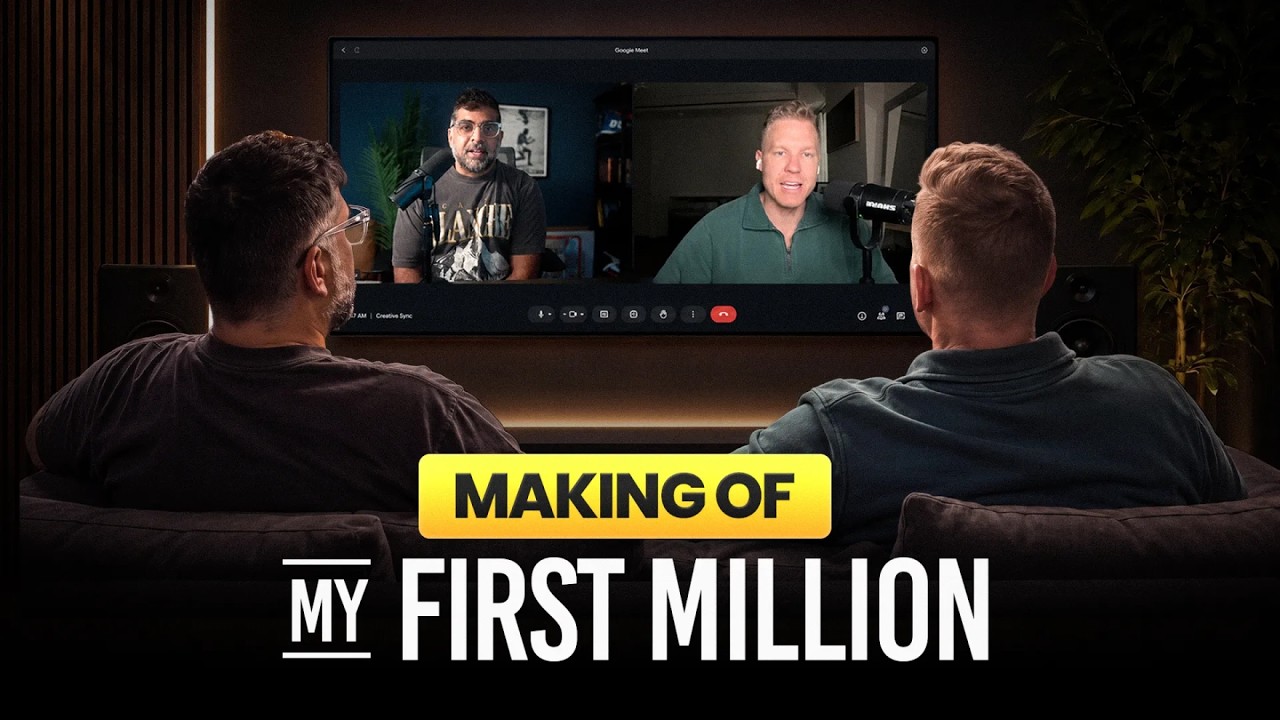
This is a public recording of a real strategy meeting for the podcast My First Million (MFM), now 6 years and 822 episodes in, with roughly 115 million downloads. The team — Sam, Sean, Ari, and new team member Cassie — use pre-submitted answers to 10 questions to guide a candid discussion about what’s working, what’s not, and what to prioritize over the next 90 days. The meeting surfaces three major initiatives: rebuilding a “clipper army” to distribute short-form content on social media, curating high-signal live events for the top 1% of listeners, and rebalancing the guest mix toward both bigger names and more unusual, unknown voices — plus expanding into topics like happiness, parenting, and the human condition.
The Virtue of Selfishness
Sam argues that the best version of the podcast comes from following their own curiosity rather than chasing data or clickbait headlines.
For the first 3 years, neither Sam nor Sean looked at analytics. Sam now occasionally gets pulled into YouTube metrics and suggests episodes based on what will perform well — but those are the episodes he enjoys least and gets the “Sunday Scaries” over.
The episodes that leave him most energized are unplanned: a story Sean tells, a book Sam wants to share, or a guest he’s genuinely curious about — not ones reverse-engineered from trending topics.
He references the Rick Rubin idea that the best way to serve your audience is to ignore them completely, and frames this as “the selfish thing” — doing what’s fun and interesting to them, which paradoxically produces the best content.
Where MFM Is Today
The podcast’s core format is simple: Sean says “Show me the money” (or a four-word shtick), Sam tells him something that opens his mind, and they try to one-up each other — a “giving contest.”
Despite the scale, the operation is comically underbuilt: no dedicated social media person, no one knows the Twitter login, the Instagram password was lost for years, and they didn’t even know a LinkedIn page existed.
Sam fed their numbers and competitors into a Claude prompt and got a 60-day growth plan, which he’s offering to listeners via the show notes.
Clip Army — The #1 Priority
Sam identifies short-form clips distributed on X, Instagram, TikTok, and LinkedIn as the single biggest gap.
He points to Basement Yard as a example: he’s never listened to a full episode but has watched ~200 clips and feels like he knows the show. Every clip delivers the same vibe — hilarious, likable, consistent.
By contrast, MFM produces clips inconsistently. When Sam was on Chris Williamson’s podcast, Williamson’s team clipped from it for 3 weeks straight, and one clip got a reply from Elon Musk — something that could have happened 20 times from MFM content but never did.
The “dog that didn’t bark” problem: they don’t know what they’re missing because the absence of clips is invisible.
They previously ran a “clipper army” bounty — $5,000 to the person who made the best clips — and got 20 million impressions in one month. The top clipper went on to build a short-form content company that sold to Morning Brew. They then immediately stopped doing it and forgot about it until this meeting.
The plan for Cassie: Raise a new clipper army over 90 days. Be “stupidly aggressive” — spend more than seems necessary, loosen controls, aim for scale. Pay per performance (e.g., $1 per 1,000 views). Use Discord and direct outreach to recruit 16-to-22-year-old editors. Post on their own accounts, not necessarily the brand account. After 90 days, evaluate whether to continue.
Sam frames this as Cassie’s primary test on the team: “This is the butt we want kicked.”
MFM 1% Events
Sean is uninterested in a traditional live tour for money or ego. His motivation is selfish: he wants to meet the most interesting top 1% of MFM listeners.
Through his business partner Ben Levy, he keeps discovering that founders of companies he admires are MFM fans — and he never knew. “It’s insane that we don’t know who the most interesting listeners are.”
The format: 100–150 curated people, a retreat/hangout vibe, invite a few podcast guests (like Andrew and Steph Smith) so attendees meet people they’d want to meet too. Low stress, no stage performance.
Sam proposes a complementary format inspired by NPR’s Tiny Desk: small (~20 people), intimate venue, entrepreneurial audience, where he and Sean do live problem-solving — “spitballing” with attendees about their businesses.
He references a talk he did at Mercury where he threw out his deck and just helped 20 people with their biggest business problems on the spot. He felt like a “magician” getting people unstuck.
This is much easier than performing comedy or live entertainment, and it generates clip content the way Hormozi’s Q&A workshops do — chop up the best moments into hundreds of short clips.
They could do these in New York, San Francisco, etc., bring family, and create content from the events.
Sam also floats the idea of decentralized MFM dinner clubs using a platform that pivoted to a supper club model — fans opt in to dinner with ~6 other listeners in their city.
Upside: life-changing connections (co-founders, friends, like-minded “business dorks”). Downside: liability and quality control — they won’t run them but will get blamed if they’re bad.
Sam’s view: if they only do newsletter, clips, and meetups for 6 months, he’d be happy.
Guest Strategy — Barbell Approach
Sam thinks they don’t aim high enough. He wants a barbell strategy:
Go higher: Land super-mega-popular guests and get them to talk about something new they haven’t discussed elsewhere.
Go lower/unknown: Find “nobodies” with extraordinary insight — like Sean’s former chief of staff Ishaan at age 22, or Theo Von’s Amish kid episode, which Sam calls a favorite.
Go older: Sam loves having 70+ year-olds on. He gets the most joy and wisdom from older guests.
Sean agrees they should invest more in the ends of the spectrum and less in the middle-tier guests.
Topics to Explore More
Sam wants to cover “softer” topics about the human condition: happiness, parenting, finding passion, raising children, dying fulfilled.
He cites Arthur Brooks as an example of the kind of guest he’d love — someone doing data-driven research on happiness or living a full life.
Graham Weaver is a past example: inspirational, with cool philosophies for living a wonderful life, who happened to be successful in business.
Sean notes they’re now dads, so parenting is personally relevant. He wants the non-obvious stuff, not clichés.
He suggests asking every guest with kids: “What’s something you do parenting-wise that’s atypical or non-traditional?” He’s heard from multiple entrepreneurs that taking a one-on-one trip with each kid at age 6–8 creates a core memory — he’s heard this seven times and feels dumb not doing it.
Content Format Ideas
Book episodes (quarterly): Sam reads widely and wants a “things that shaped my quarter” format — each brings a book, shares the big takeaways, rates them. Not a book club, but a way to make his reading overlap with MFM prep. He gives examples: a Brazilian business book about running a company via democracy, Obama’s biography (takeaway: “total psychopath, just like every other president”), and a men’s workwear style guide.
“Make it” episodes (like CNBC’s YouTube series): Deep dives into the backstories of recognizable everyday businesses — like how Bitchin’ Sauce got into Whole Foods, or how Stanley mugs went from construction gear to mom status symbol (the Crocs playbook applied to Stanley). Sam and Sean would both research one business per episode and riff on the story, the ups and downs, the mechanics. The title/thumbnail would make a clear promise about what you’ll learn.
Screen share / artifact episodes: Guests share their calendar, phone home screen, Chrome plugins, desktop organization, or desk setup. Sam is obsessed with finding “alpha” — the tools and workflows that make people effective. Sean likes this because it reveals something personal and idiosyncratic that no one else asks about (e.g., a sign on someone’s desk that says “trouble is opportunity,” or Warren Buffett’s “too hard” pile).
Ritual closing question: Sam loves Patrick O’Shaughnessy’s question at the end of every episode — “What’s the kindest thing anyone’s ever done for you?” — which gets heartfelt stories from successful people. He wants MFM to adopt a signature closing question as a tradition. He also references Diary of a CEO’s mechanic where each guest writes a question for the next guest. Ari is tasked with helping develop this.
Newsletter
Sam is open to a branded newsletter but is wary of the risk: if they say something dumb, factually incorrect, or off-brand, it could hurt their reputation. The key is de-risking it.
He envisions a format that includes: a summary of the last episode (3–4 interesting stories in plain speak, no gatekeeping), who’s coming up next, and a small extras section (Sam went viral for X, check out this product, etc.).
Diego, Sam’s former lead writer at Milk Road who wrote in Sam’s style for 2 years, could produce it.
The conflict: right now they direct people to HubSpot for offers. The newsletter would need to become the primary destination. Sam thinks more people would subscribe because they’d know they’re getting consistent value.
Guest Vetting and Checkered Pasts
Sean raises the issue of guests with problematic histories (he references Martin Shkreli and a guest named Thomas who turned out to have a fraud conviction mid-recording).
He doesn’t want to become a confrontational show, but feels a responsibility to address it if they have someone on. The bar: it has to be worth it. Martin Shkreli was worth it — interesting enough to justify the discomfort.
He asks Ari to keep doing what she does: flagging things that could blow up, vetting guests more carefully, and being the protective layer. Ari has previously caught jokes that didn’t land and advised cutting them.
What to Do Less Of
Solo episodes: Sam hates them — both the “talking to a camera” format and the “one host interviews a guest alone” format. They feel like work. The duo dynamic is what makes it fun — the “egg each other on” energy.
Sean doesn’t mind solo episodes as much, especially for in-person interviews where you pick up more than on Zoom. But he agrees duo is generally better.
The main reason they do solo is scheduling — when one can’t make it.
The Three “Big Rocks” for the Next 90 Days
Clipper army — Cassie owns this. Aggressive 90-day push with paid incentives, wide distribution, and a clear evaluation point at the end.
Guest strategy — Go higher (bigger names, new material), go unknown (unusual insightful voices), and expand into human-condition topics (happiness, parenting, investing, life philosophy).
Guest prep and new angles — Request screenshots of calendars, desks, phone home screens, and Chrome plugins before interviews. Develop a signature ritual closing question.