Sam Parr and Sean Puri welcome Ben Levy (Sam’s business partner and prolific Twitter user) to share and react to the most interesting things he found on X, covering viral consumer ideas, influencer businesses, Elon Musk’s latest moves, founder psychology, and a listener’s new pest control startup.
Wedding attendance marketplace goes viral
A website lets people buy tickets to attend strangers’ weddings with empty seats, already claiming 20,000 users.
Sam and Sean both reject the idea personally — Sam avoids weddings outside a 50-mile radius, Sean prefers Netflix — but debate whether it could become an Airbnb-style behavioral shift.
Ben notes a similar model exists in India; the group agrees the concept feels more like a novelty than a durable business.
Looksmaxing influencer Clavicular launches men’s skincare line
Clavicular (viral looksmaxing creator) announced a men’s skincare and makeup brand at the All-In Summit, asking for operator partners via email.
Sean compares him to Bryan Johnson as an elite social media player who turns attention into revenue (Johnson’s Blueprint waitlist generated $100M+ in pipeline).
Sam argues influencer-led brands need a hidden operator partner — citing Congo Brands (Prime, Alani Nu) as the model: anonymous Ohio founders who own more equity than the famous faces.
Sean warns that juggling fame and CEO duties rarely works; the best path is pairing a distribution genius with an execution genius.
Elon Musk demos Roadster with SpaceX rocket boosters
The new Roadster (delayed ~10 years) uses cold-gas thrusters to generate downforce, letting it drive upside down on a curved ramp and achieve extreme acceleration/handling.
Sam questions legality and utility; Sean frames it as a “gun range” product for private tracks; Ben shares a viral tweet: “Sometimes a demo is simply meant to remind the world that your competition has no desire to dream and no ability to evolve.”
The group acknowledges the spectacle but notes deposits have been held for years without delivery — credibility hinges on a real timeline.
Elon Musk to give SpaceX shares to every U.S. child
Musk announced gifting one SpaceX share to each of ~72 million American kids (~$10B total), directly in their accounts rather than via a foundation.
Sean sees this as a potential redemption arc after Musk’s favorability flipped negative over two years, but doubts his behavioral discipline to sustain it.
Sam shares a family anecdote: a relative accidentally bought $500K of SpaceX stock (intending $3K), then became obsessively aligned with the company’s success — illustrating how ownership changes attention and advocacy.
Anthropic announced a similar public-goods structure the same morning, but not direct-to-individual.
Andrew Huberman’s “Gym & Fridge” Men’s Health series
Huberman eats three cucumbers daily, uses Momentous protein (with affiliate code), and shows a disciplined but relatable routine.
Sam and Sean joke about Huberman’s “guy’s guy” appeal and the disclaimer-heavy delivery (“talk to your doctor”).
Ben praises the “Gym & Fridge” branding; the hosts brainstorm an MFM equivalent (“Stocks & Jocks” — show your portfolio and your boxers).
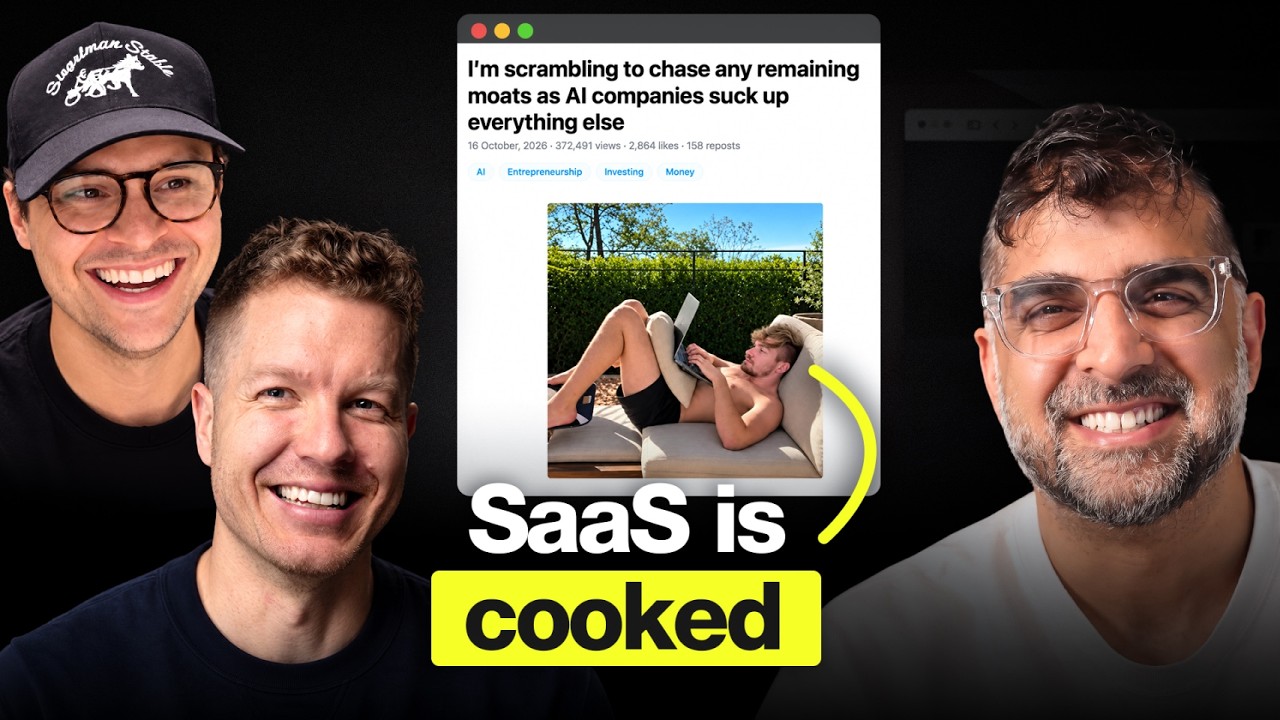
Peter Levels declares SaaS dead, pivots to AI apps with moats
Levels (indie hacker, ~$2-3M/year solo from Bali) blogged that he no longer believes in SaaS moats; only defensible positions are proprietary data, network effects, audience/distribution, physical assets, regulatory capture, and capital.
Sam initially pushed back (citing Beehiiv’s Tyler Denk listing all the hard-to-replicate pieces), but now thinks Levels may be right — AI lowers code barriers so fast that pure software moats are eroding.
Sean favors network effects (Craigslist, eBay) and brand (trusted names people buy from blindly) as the strongest remaining moats.
Sam prefers businesses where AI reduces cost but doesn’t replace the core demand (e.g., Amazon: physical goods + robotics logistics).
Both agree in-person experiences (sports, concerts, communities like Hampton) gain defensibility as digital commoditizes.
Sean notes Levels’ lifestyle (solo, high income, cool location, lifting, friends) is more aspirational to many than the stressed billionaire founder path.
Bryan Johnson attempts to dunk at 49
Johnson (Blueprint founder) set a public goal to dunk a basketball as proof of biological age reversal; he’s 6’1”, 180 lbs, needs ~39-inch vertical (above NBA average).
Sam (a dunker) says the penultimate step — a coordinated approach jump learned young — is the real barrier; raw vertical isn’t enough.
Sean had a “dunk” goal this year but hasn’t trained, relying on weight loss alone; he bets Johnson fails (Five Guys burger on the line), Sam bets he succeeds.
Jason Kelce (6’4”, ex-NFL) spent six months training and barely grazed the rim — suggesting the coordination gap is massive for non-basketball players.
Alexander Wang (Scale AI) on failure and risk
On David Perell’s podcast: “Failure doesn’t matter. It matters when you win, how big you win.” Wang internalizes this, enabling fearless risk-taking.
Sean connects this to Zuckerberg’s “Napoleon-like” internalization of lessons — keeping Meta dynamic vs. Google’s bureaucratic drift.
James Currier’s “Speed Talk” for founders
Currier (Stanford, NFX) gives founders a “speed talk”: you think you’re moving fast, you’re not; fear is the primary brake (fear of being wrong, judged, rejected).
Highest leverage in any business is founder psychology; highest leverage within that is identifying what they’re avoiding.
Breakthroughs often happen at the “effort moment” (running out of cash) — founders become decisive, simplify product, drop preciousness.
Sam plans to use this to yell at his partner about speed; Sean jokes that great leaders diagnose the other person’s flaw.
Jaylen Brown hires a harpist for sunset concerts
NBA star Jaylen Brown bought a gold harp and pays a harpist to play twice weekly at sunset while his chef cooks.
Sam and Sean discuss creative “cross-training”: Sam bought a sketchbook (unstuck), Sean learned piano, Tim Ferriss schedules 45-minute “creative gym” sessions to charge his battery for other work.
Kevin Espiritu (Epic Gardening, ~$100M revenue) taught himself sketching and now produces impressive daily drawings — proving the “creative gym” compounding effect.
Lex Fridman visits Jensen Huang (NVIDIA)
Huang’s YouTube algorithm: fried rice, geopolitics, dogs, pandas. Fridman’s: Modern Wisdom podcast clips, piano tutorials, alien/Jesus conspiracies, Luka Dončić highlights.
Lighthearted segment on algorithmic “fried rice” — the unexpected but beloved niche content each person consumes.
Listener launches pest control startup inspired by MFM
Ben’s brother Sam (real estate agent, 10 years in Phoenix) listened for years, tried 15 side hustles, finally committed to pest control.
Branded truck, AI-designed “Howdy Pest” website (hipster DTC aesthetic on unsexy service), hired a technician, booked $1K revenue in week one (first check from a trust).
Hosts invite Phoenix listeners to use HowdyPest.com; propose coaching him quarterly to $1M ARR.