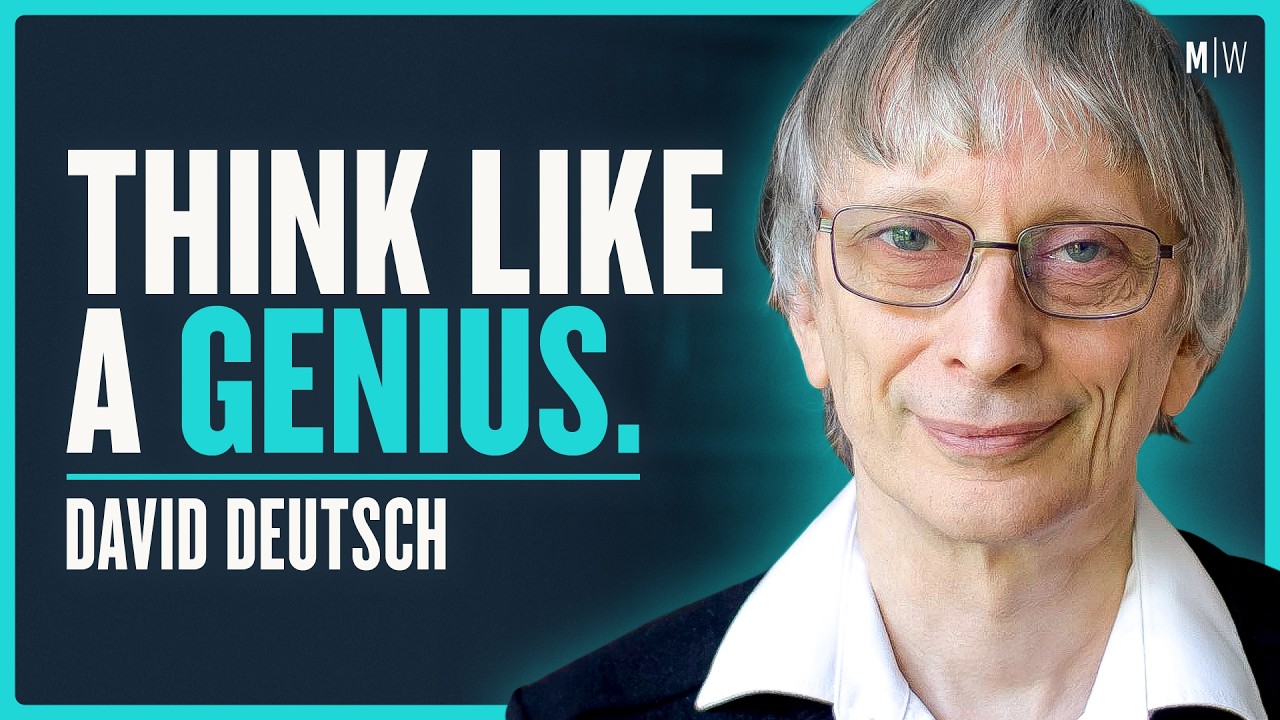
This episode features physicist and philosopher David Deutsch discussing his Popperian epistemology, optimism as a philosophical stance, AI risk skepticism, creativity, education reform, and the nature of a good life, drawing on his books The Fabric of Reality and The Beginning of Infinity and his forthcoming works.
Popperian epistemology and the nature of knowledge
Knowledge is created through a single universal process: conjecture and criticism, whether by evolution, scientists, or children learning language.
The learner must guess what the communicator means, test those guesses, and correct errors; knowledge cannot be downloaded like a computer file.
If communication fails, the fault lies with the communicator for not meeting the learner’s problem situation.
We are all alike in our infinite ignorance — each person knows different finite things, but the distance to complete knowledge is infinite for everyone.
Authority is a philosophical and sociological mistake; it is a power play, not participation in the growth of knowledge.
Being wrong, certainty, and error correction
The subjective sensation of certainty is no guide to truth; every adult has been proved wrong about something they were sure of.
Neither knowledge, ignorance, nor benevolence reliably indicates who holds the truth on a given question — even an enemy may possess the one truth that saves you.
Ideas should be judged only by whether they have survived criticism better than alternatives, not by the source’s reputation or one’s own confidence.
We should not aspire to certainty or even belief; belief is a corrupt category inherited from religion, and one cannot believe or disbelieve by an act of will.
The rational stance is to enjoy the sensation of being baffled and to seek error correction rather than confirmation.
Practical reasoning without paralysis
We navigate daily life by forming theories about how the world works (e.g., sandwich shops are regulated, airlines maintain planes) rather than reasoning from first principles each time.
A small fact can destroy a large reputation; if an airline has a maintenance scandal, a rational person may avoid it even if the absolute risk remains tiny.
The goal is not to eliminate all trust but to hold theories about institutions that are themselves open to criticism and revision.
Optimism as a philosophical stance
Optimism means: whenever something goes wrong, it is because we lack the knowledge to make it go right — failure is always a knowledge problem, never a fundamental barrier.
Pessimism treats failure as a permanent barrier; optimism treats it as a soluble problem.
This applies individually: a terminal diagnosis reflects current medical ignorance, not a law of nature, though the patient may not personally create the needed knowledge in time.
Optimism is not a cheerful outlook or a prophecy of success; it is an explanation of failure that keeps the door open to progress.
Why pessimism masquerades as sophistication
Tragic endings in fiction are as much a cheat as deus ex machina happy endings — both avoid the hard work of solving the problem realistically.
Writing a genuine solution requires creating new knowledge; writing disaster requires only giving up.
Current fashionable pessimisms (AI doom, climate catastrophe) pick arbitrary fears from an infinite set of possible catastrophes and treat them as inevitable barriers.
History shows this pattern: nuclear power was abandoned due to unjustified fears, causing the very climate damage pessimists now decry.
AI risk and the limits of LLMs
Deutsch considers AI doom scenarios unjustified fears analogous to past panics about nuclear reactors.
LLMs lack a creativity module; they achieve linguistic competence through statistical prediction, not explanatory knowledge creation.
The designers of LLMs did not solve the problem of creativity — they built language models that happened to work far better than expected.
Chess engines beat grandmasters through brute-force computation, a radically different process from human insight; we still do not know how to program the latter.
AGI requires explanatory creativity — the ability to imagine novel solutions, change axioms, and pursue problems for their own sake — which current architectures do not possess.
Creativity as explanatory knowledge creation
Creativity is the ability to create new knowledge; evolution is creative in this sense (e.g., evolving flight encodes aerodynamic knowledge).
Humans possess explanatory creativity: we can say why we prefer a move, imagine unseen possibilities (carrying a burning branch for protection), and change our criteria mid-stream.
A grandmaster sees strategic weaknesses, not exhaustive continuations; they can explain, teach, and adapt — a chess engine cannot.
Creativity involves genuine problem situations, not optimization against fixed criteria; it is the ability to find new problems worth solving.
Education and the bucket theory of the mind
The current system rests on the “bucket theory”: knowledge is a fluid poured from teacher into passive student.
This is a pre-Enlightenment holdover; everywhere else we reject authority-based knowledge, but education measures success by how well the bucket is filled (exam results).
When outcomes fail, the system blames the student (leaky bucket, unwilling recipient), never the “fluid” or the method.
Important educational outcomes (understanding, explanation, judgment) are unmeasurable proxies; the system incentivizes teaching to the test at the expense of what matters.
Better approach: voluntary access to experts (email a professor, join a community) rather than compulsory subordination; the internet makes this increasingly feasible.
Discipline, suffering, and the mountaineer analogy
“Discipline” describes opposite phenomena: the mountaineer who chooses a brutal climb because he loves it, and the student who forces himself through hated GCSE revision only to forget it all.
The mountaineer’s pain is not overridden — it is the point; he would not choose an easy climb.
All learning should be like the mountaineer: something you would pay the price for because the problem itself is worth your life.
In a rational society, the “I will get it done” muscle is used minimally and only as a bridge; the goal is to redesign the situation (better bin, shorter walk, find enjoyment in the task) so discipline becomes unnecessary.
The good life and individual diversity
There is no universal formula; humans differ from each other as much as humans differ from other species.
Popper’s ideal: find a problem, fall in love with it, live with it until death — and if you solve it, you get “delightful problem children” (new problems).
Survivorship bias: people who succeeded via “good discipline” (loving a hard path) often describe it in words that sound like “bad discipline” (knuckling down), misleading others.
Progress looks like destruction because hard-won solutions are indistinguishable from suffering when viewed from outside; the only visible clue is whether the pursuit has social approval.
Forthcoming projects
A science-fiction exploration of the Fermi paradox (written as fiction set in another universe to invite criticism without claiming truth).
A quantum mechanics textbook with colleagues Sam Kuypers and Chiara Marletto, correcting what they see as fundamental misconceptions in existing pedagogy.
A third major philosophical book, tentatively titled Irrationality: How Thinking Works and What the Obstacles Are, sequel to The Fabric of Reality and The Beginning of Infinity.