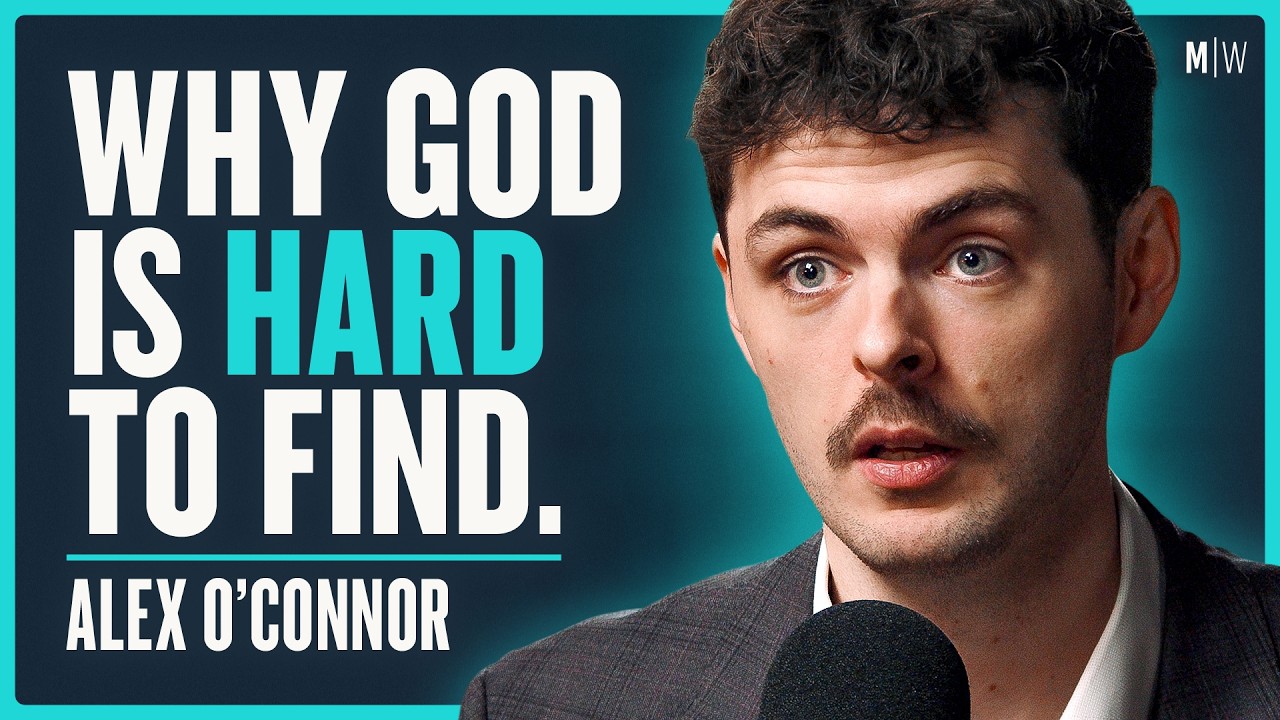
Alex O’Connor (Cosmic Skeptic) reflects on his shift from a combative atheist persona to a more open, agnostic stance shaped by taking consciousness and religious experience seriously, arguing that the “God debate” often talks past itself because it conflates propositional argument with lived mystical encounter.
The evolution from militant atheism to epistemic humility
O’Connor used to debate religion aggressively but now prefers “agnostic” because claiming certainty about ultimate reality — whether atheist or theist — is unwarranted; he finds it foolish to think his confidence approximates closeness to truth on questions like God or consciousness.
He does not celebrate deconversions; he values that his work prompts people to question inherited beliefs, but notes many religious people say he strengthened their faith by forcing them to examine weak arguments they held.
The “barista” analogy: he sees himself as stress-testing positions — if an argument is unsound, it remains unsound even if he later becomes a believer; most people believe things (God, flat earth, globe earth) for non-robust reasons.
Philosophy unlike physics makes no cumulative progress; everyone starts from the same place as Plato, wrestling with the same intuitions — it is an experiential phenomenon, not a consensus-building enterprise.
Historical examples: Aquinas abandoned the Summa Theologica after a Eucharistic vision (“all I have written seems like straw”); Pascal’s “Memorial” records a fiery encounter with the “God of Abraham, not the God of philosophers” — mysticism, not argument, often crowns religious life.
Anselm’s ontological argument was originally a prayer titled Fides Quaerens Intellectum (faith seeking understanding) — natural theology is recent; for most of history, religion was the “ocean you swim in,” not a separate compartment.
Consciousness as the hard limit of scientific explanation
Consciousness is not a “hole in the atheist worldview” but in every worldview; it is the foundational philosophical question because all knowledge comes through it — you never interact with the table directly, only with its presentation in consciousness.
Defining consciousness is likely impossible: definitions rely on shared experience (you can’t define “red” to a blind person), and consciousness is the very medium through which you point at things — like a flashlight trying to illuminate itself.
Science describes regularities and mathematizes behavior (Newton described how gravity works, not what it is; Einstein’s happiest thought: free-fall feels like weightlessness); it cannot reach the “substance” of reality — only its structural behavior.
Materialism claims the universe is made of “matter,” but physics only gives mathematical relations (charge, mass, spin) — no intrinsic nature; as Russell and Eddington noted, science tells us what matter does, not what it is.
The “only is what it does” view (ontic structural realism) leaves no substance doing the behaving; Carlo Rovelli’s relational quantum mechanics pushes this further — but if there is an intrinsic nature, the only candidate we directly know is conscious experience itself.
Emergence arguments fail: every cited example (temperature, computer images) is an emergence in consciousness — heat is felt warmth, an image is seen — so “consciousness emerges like X” just means “consciousness emerges like other conscious experiences,” explaining nothing.
Idealism, pansychism, and the monistic alternative
If consciousness cannot emerge from non-conscious matter, it may be fundamental: pansychism (electrons have proto-consciousness), idealism (one great mind, à la Spinoza’s Deus sive Natura), or theism (a conscious agent breathes consciousness into matter).
O’Connor leans toward idealism: the physical world is an appearance within a foundational mental substance — like a dream where distance and objects are real as appearances but have no independent spatial extent.
Schopenhauer: we know our own body from inside (will/consciousness) and outside (phenomenon); parsimony suggests the noumenon of everything is the same will/consciousness — not complex, but simple awareness that can manifest complexly (bricks vs. Empire State Building).
Modern artifact-saturated environments mask this: in nature, intrinsic animation (plants moving, ecosystems) makes a conscious substrate intuitive; we’ve replaced the living world with dead artifacts that don’t “behave” consciously.
Religious experience, meditation, and non-dual awareness
Mystical traditions across cultures converge on non-dual unity — the boundary between self and God/world dissolves (Eckhart: “the ground of God is my ground”; Sufi ana al-Haqq “I am the Truth”).
This differs from animistic “small-g gods” (Zeus, Thor) who are characters within the world; monotheistic/Brahmanic “God” is the ground of being — a different cognitive category.
Meditation and psychedelics may “turn off” the brain’s predictive concepts (the sled track in the snow) allowing raw perception — painters see blue sky as green/purple/white; meditators see the table’s warped texture without the “table” label.
Whether this is “more accurate” is unanswerable — there is no objective view to compare against; a thought experiment: children raised without cultural concepts might perceive differently (Molyneux’s problem: newly sighted blind people can’t match touched shapes to seen ones).
Prayer, not as petition but as alignment
The AI-agent prayer joke (500 Hail Marys/minute) highlights two things: prayer’s odd logic, and that few think AI is conscious.
Petitionary prayer isn’t informing God (“God, don’t forget Johnny in hospital”) — it aligns your will with the good (Jesus in Gethsemane: “not my will but yours”); secular grace before meals serves the same function: gratitude, mindfulness.
You can’t give anything to an infinite God; prayer is for the pray-er, not the recipient — if God was going to act anyway, prayer doesn’t change the outcome, it changes the agent.
Genetic engineering vs. education: refusing enhancement may be like refusing education, but we value education because it’s agent-relative; if looks become chosen, they become merit — but perfectionism has no endpoint (Botox spiral), and “buyer’s remorse” toward one’s own children is a moral horror.
Embryo selection: IVF already grades embryos; polygenic screening (Genomic Prediction) predicts IQ, height, disease, criminality — selecting against Huntington’s is accepted, but the slope to selecting for positive traits is slippery; non-identity problem (Parfit): choosing a disabled embryo doesn’t harm that child (a different child would exist otherwise), yet feels wrong — opens door to pre-conception eugenics without “harming” anyone.
Fantasizing vs. cheating: Jesus: “lust in heart = adultery” — not thought-crime but entertaining desire; the harm of cheating is the volitional giving-in, not the act (rape victim isn’t culpable; willing partner who is rejected still betrays intent). Pornography correlates with objectification and infidelity — evidence suggests resistance builds resilience, not exposure (office retreats + alcohol = affairs).
Dream fidelity: Mark Manson’s erotic dream where he didn’t cheat — only praiseworthy if you also own your dream crimes; dreams may reveal subconscious but are epistemically opaque.
Current projects and tour
Six-show North American tour (Nov 2026): New York (Town Hall), LA, San Francisco (sold out), Toronto — AMA format on consciousness, religion, etc.; tickets at alexoconnor.com/tour.
Working on undisclosed projects; plans to return to video essays (self-edited, time-intensive) alongside podcasts.
Curates Instagram algorithm (biblical studies, music) to avoid doom-scrolling triggers; aims to quit social media entirely but faces collective-action problem.