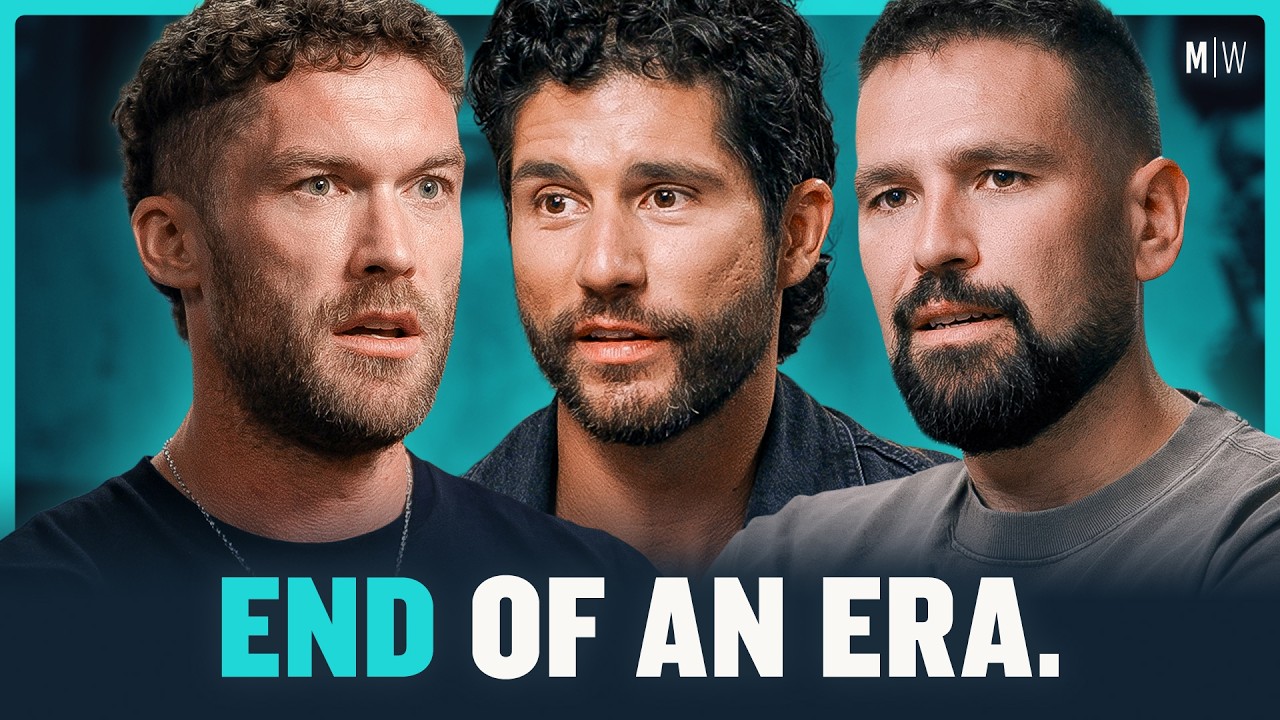
Dan + Shay, the Grammy-winning country duo, join Modern Wisdom for a wide-ranging conversation covering their origin story, the psychology of sustained success, the making of their new album Young, a near-breakup that saved their partnership, and why vulnerability in songwriting matters more than ever in the age of AI.
Origin story and early grind
Dan Smyers and Shay Mooney met at a house party in Nashville (507 Morton Avenue) where Dan had to break in through a locked door; the house had no heat, no AC, no locks, and rent was $150/month.
They bonded over being broke, sleeping on couches, and doing paid research studies (hard cider tastings, Hanes t-shirt testing) to survive.
An early magazine headline — “Dan and Shay, a chance encounter under the sheets” — became a running joke about their first meeting.
They coined the inside joke “Domino’s, the Italian pizzeria” with fellow artist Megan Moroney, who didn’t realize Domino’s was a chain until the pizza arrived.
“Tequila,” breakthrough, and the volatility of success
“Tequila” (released Jan 2018) became a cultural moment; the host credits it with convincing him to move from England to America after hearing it on Broadway in Nashville where the whole bar waited for the melody shift to take shots.
The song sparked a tequila popularity surge, but the duo didn’t secure a brand deal — “equal opportunity revenue generator for everyone else.”
Success brought new pressure: after arena tours and “10,000 Hours” with Bieber, COVID pulled the rug out; they felt they had to start over.
They discuss the “hedonic treadmill” of achievement — winning Grammys didn’t bring lasting satisfaction because they immediately chased the next milestone.
Reframing “we have to” into “we get to” became a daily practice; saying it out loud builds gratitude and sustainability.
Luke Bryan’s comment — “what am I supposed to sing about now that I’ve made it?” — resonates; they now draw from marriage, fatherhood, aging, and mortality instead of bar nights.
National anthem at the 2026 World Cup opening ceremony
They initially declined anthem gigs (high risk, low reward — “if you crush it, people say ‘good job for not screwing it up’”).
The World Cup offer came via FaceTime mid-interview; their first reaction was fear, not excitement.
They insisted on a stripped-down, traditional arrangement — no runs, no horns — so the crowd could sing along; organizers agreed.
Performing at SoFi Stadium: “felt like going to war”; Dan spotted Tom Cruise and David Beckham on the LED wall mid-song and nearly broke.
Afterward, strangers thanked them like war heroes in the Nashville airport; they hid in a bathroom to escape the mob.
Songwriting process and the Young album
They had a full album ready but scrapped it after an “existential crisis” about AI: “does anything we do matter anymore?”
They needed songs that felt inevitable for this season — autobiographical, vulnerable, rooted in their actual lives now.
Wrote the bulk of Young in a two-month burst after the first title track unlocked the direction.
“Her, the Kids and Jesus” — a literal snapshot of a morning routine — exemplifies the new literalism; they believe listeners’ “radar for fake” is higher than ever.
“Young” (title track) explores male aging, the illusion of invincibility, and the deception that parents have it figured out; Dan cried playing it for his dad.
“The Old Guys” confronts the fear of outliving a spouse; “Say So” addresses suicide and mental health.
“Say So,” grief, and purpose beyond charts
Written the day their friend/mentor Ben Vaughn (first publisher, label connector, pillar of Nashville community) would have turned 50 — they didn’t know it was his birthday until Dan’s wife pointed it out after hearing the demo.
Ben died by suicide a year prior; the song emerged organically from sharing stories about him in the writing room.
Initially hesitated: “is this too heavy for Dan + Shay? We’re the wedding song guys.” Decided to keep it anyway.
Their metric: “if it helps one person, if it saves one life, it’s a win — as good as a Grammy.”
DMs and in-person encounters confirm impact: “this song talked me off a ledge,” “you saved my life.”
Those moments silence online criticism (“not country,” “you suck”) and re-center their why.
Vulnerability, authenticity, and the “emotional Overton window”
Sad songs outlive happy ones because they heal: “when you’re sad, you don’t listen to ‘Friday’ — you listen to ‘Whiskey Lullaby.’”
Music creates shared empathy: singing a heartbreak song next to a stranger connects you differently than “Sweet Caroline.”
Pushing the emotional Overton window — going slightly further than the acceptable range of earnestness — signals you’re on the right track.
Long-form conversation (like this podcast) forces vulnerability; you can’t hide behind a wall for three hours.
AI can replicate style (Shay’s runs exist in models) but “it’ll never be Shay”; as long as humans consume art, human-made art will remain essential.
Duo dynamics, near-breakup, and repair
Most bands break up because they stop liking each other, not because the music suffers.
By 2021, they’d drifted: less time together off the road, no calls/texts, mediators involved, resentment simmering.
Duos are uniquely fragile — 50/50 split, no tie-breaker; Hall & Oates, Brooks & Dunn, Florida Georgia Line all fractured.
They faced a choice before a dream tour (opening for Kenny Chesney in NFL stadiums): break up or have the hard conversation.
Dan drove to Shay’s house; they sat on the porch until 3 AM, apologized, cried, and articulated a new covenant:
Respect and empathy for each other’s differences (Dan: pessimist/perfectionist; Shay: optimist/present).
Grace to grow and change without being locked into old identities.
“We don’t have to agree on everything. We just have to love and respect each other and share a common goal.”
Since that night, “there’s literally nothing that could tear us apart.”
Social media, criticism, and validation
No amount of success inoculates against criticism; “Gerald766969” with zero followers can still ruin a morning.
Algorithms amplify negativity; nobody reviews Chili’s to say “best experience ever” — only “found a foot in my burger.”
They’ve reached a place where hate comments don’t land: “I genuinely don’t put weight into the haters.”
Validation comes from the process: “how excited am I on the morning of a show? How good do I feel when it’s done?”
Live performance provides immediate, embodied feedback that digital metrics never can — a key advantage over podcasters/writers.
AI, curation, and the future of stardom
They miss the old curated system (radio, gatekeepers) that made stardom feel earned and grounded.
Viral speed now creates “stars” overnight with no foundation; “the faster it goes up, the faster it comes down.”
Independent media (podcasts) now rival traditional platforms in cultural influence — Trump’s campaign, JD Vance on Rogan, Darius Rucker’s Hall of Fame push.
They’re optimistic about the “anti-movement” among younger listeners craving real craftsmanship (woodworking, human music).
What to look for in a creative partner
Someone who challenges you and makes you better — Dan pushes Shay for take 10 after a “perfect” take 1; Shay pulls Dan toward optimism and data.
Complementary temperaments that meet in the middle of realism.
Shared ego-less commitment to the product: “we win when the song is the best.”
Reciprocity: each brings out the best in the other, silencing external noise.