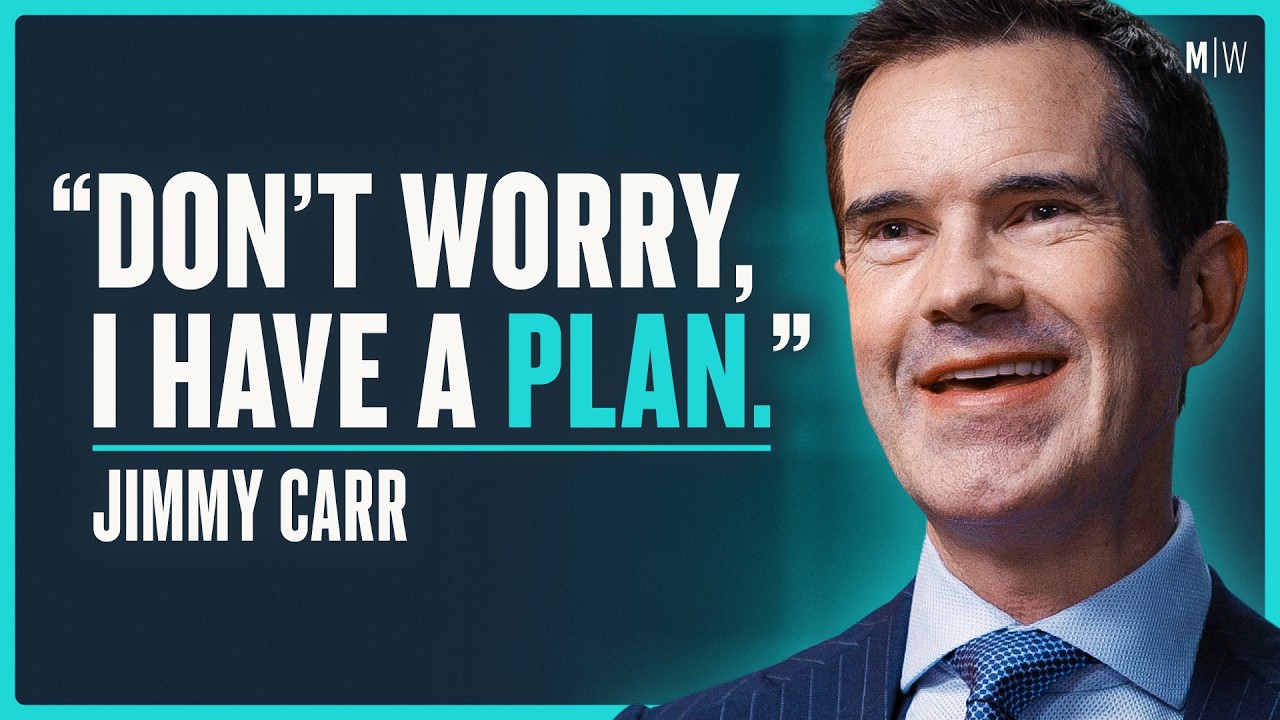
This episode of Modern Wisdom features comedian Jimmy Carr discussing his high-volume touring model (250–300 shows per year, often two per night), the psychology of performance anxiety, the societal roots of modern mental health struggles, and wide-ranging ideas on culture, politics, comedy craft, and personal mastery.
Jimmy’s Touring Model and Performance Psychology
Jimmy performs roughly 250–300 shows annually, frequently doing two shows a night (7 pm and 9:30 pm), which he frames as “one for me, one for HMRC.”
High volume reduces nerves: thousands of stage hours create an “airline pilot” familiarity where the show becomes a flow state — control without thought — rather than a source of anxiety.
He films every show; about a third of each performance is improvised crowd work, keeping the material fresh and intellectually stimulating through constant iteration rather than repetition.
Audiences self-select: they know his style, so offense is rare (“they bought tickets for a horror movie and they’re complaining they’re scared”).
Pre-show rituals are minimal (e.g., eating an apple backstage); confidence comes from reps and the certainty that the crowd is there for his specific show.
Anxiety, Overthinking, and the Societal Roots of Mental Health Struggles
Anxiety is “thought without control”; flow state is “control without thought.” On stage he is in flow; off stage, rumination can spike (e.g., 4 am panic attacks about counterfactual harms).
Overthinking is trying to “sniff our way out of a cocaine problem” — more thinking doesn’t equal more control.
Mark Fisher’s “privatization of stress”: rising depression/anxiety stats indicate a societal, not individual, failure. We’ve arranged society poorly for mental health (isolation, individualism, loss of communal structures).
“Am I depressed or is my life depressing?” — circumstantial sadness is often mislabeled as clinical depression.
Helplessness drives rumination: people think worrying prepares them, but no amount of anxiety changes outcomes. Control is an illusion; only reaction is controllable (Stoic framing).
Modern life inverts Maslow: people chase self-actualization without secure base layers (community, housing, purpose).
Happiness is a time machine: depression lives in the past, anxiety in the future; the present is usually fine but hard to inhabit.
Young Men, Social Structures, and Policy Provocations
The “manosphere” addresses a real problem (young male drift) with the wrong prescription. Jimmy is “pro-gang, pro-drinking, pro-gambling” in a specific sense:
Gangs: men together check each other; mostly positive, not just crime.
Drinking: Scott Galloway’s line — “risk to your liver is nothing compared to risk of social isolation.” Pubs are existing youth clubs; lower drinking age to 16 in groups (must bring three mates) to socialize consumption.
Gambling: reframe as “taking a gamble on yourself/career” rather than online sports betting; deal the younger generation into meaningful risk.
No tax on under-30s (or first £250k tax-free, per Rory Sutherland) to help household formation.
Peter Turchin’s “elite overproduction”: too many degree-holders promised status that doesn’t materialize → “counter-elites” attack the system. UK university expansion created a luxury good (degree) whose value collapsed when universalized.
UK tall-poppy syndrome vs. US “you can be anything” narrative: US victimhood culture partly stems from broken promises of the American Dream; UK suppresses ambition early.
Generations, Inequality vs. Abundance, and Societal Cycles
Jimmy rejects generational labels (Neil Howe’s “millennial” etc.) as horoscope-like; every cohort has entitled and ambitious people. Trump and Biden are same generation, totally different.
Political focus should be abundance, not equality: Star Trek future (needs met) vs. Star Wars (scarcity/conflict). Habituation makes any baseline feel normal.
Status/mimetic desire distorts money’s purpose: we want more than neighbors, not just needs met. “Not having to impress other people is the superpower.”
Strong men → good times → weak men → hard times → strong men cycle (often cited). We’re in “hard times” now: tech-driven atomization, leadership vacuum, kayfabe politics (WWE-style performative conflict).
Flow, Gratitude, Optionality, and Compound Interest on Skills
Flow state erases memory of the performance (e.g., can’t recall specific bits post-show) because the self moves aside. Paradox: most enjoyable moments are least memorable.
Gratitude practice: “If you only said one prayer and it was ‘thank you,’ that would be enough” (Meister Eckhart). Disposition > position. Celebration = gratitude in action, best done socially.
“Chairman Mao: you can’t smell the roses from a galloping horse.” Busy high-performers struggle to pause and appreciate.
Problems are features, not bugs: they mean something needs your attention. Boredom = unappreciated serenity (phone kills this).
Optionality trap: people think they want maximum options; constraints breed creativity (David Epstein, Alex Hormozi). “If you never cash in options, what’s the point?” — just start the business.
Compound interest on skills: 90% of Buffett’s wealth came after 60; time is the hidden variable. Systems beat goals: “What are you doing tomorrow?” Joke writing has tight feedback loops (audience tells you instantly); most projects don’t.
Self-confidence = “irrefutable proof you are who you say you are” (Hormozi). Small kept promises build self-trust; broken promises breed self-resentment (Mark Manson: “The small thing you didn’t say 6 months ago has been collecting interest”).
Comedy as Conversation Expander: Two Overton Windows
Comedy expands the conversational Overton window: the real value isn’t the 2 hours of laughs but the widened range of discussable topics on the drive home (sex, politics, death). Carlin, Pryor, Chappelle shifted what’s sayable.
A second, emotional Overton window: depth/sincerity/earnestness. Audiences crave authenticity but are “allergic to sincerity” (e.g., father crying on stage triggers cringe). Jimmy now blends razor-sharp one-liners with genuine, poignant crowd moments — “sweetening the pill with laughter.”
“Comedy is the shortest distance between two people.” Treating the audience like a best friend (no filter) creates disproportionate connection.
Live comedy restores communal gathering lost to atomized streaming: “we used to gather around the fire… now everyone’s on their own screen.”
Social Media, AI, and the Attention Economy
Native American belief: photos steal souls. “Maybe not one photo, but a thousand a day — that’ll do it.” Alienation from self via curation.
Language reveals function: net, web, internet — they catch people. Huxley: we’ll give away power for cheap dopamine (soma = tablet).
AI as musical instrument: anyone can make noise; mastery takes practice to direct it into symphony. “We so wanted a God we created one in our image: all-knowing, all-powerful, lives in a cloud.” We are the universe experiencing itself (Hegel); AI is left-brain (complicated), humans are right-brain (complex/comprehension).
Hope: AI removes drudgery, frees us for connection/art. Risk: we’ve forgotten how to comprehend/connect.
“Favorable Conditions Never Come” — Action Over Waiting
C.S. Lewis: we always wait for distractions to end before doing real work. Only those who seek knowledge while conditions are unfavorable achieve much.
UK abortion stat: 1 in 3 viable pregnancies end in abortion → people feel they can’t start families. “Favorable conditions never come” = scarcity mindset.
1990s were relatively quiet (post-Cold War unipolar moment). Now multipolar, fracturing: US Navy shrank → Somali pirates (canary); mainstream media, academia, legacy parties losing legitimacy. Revolution = replacement of elites.
Robert Frost: “Civilization is a clearing in the forest” — must be relitigated/rebuilt each generation.
Fixing the UK: Four Levers of Competitiveness
UK is “seventh biggest city (London) surrounded by a very poor country.” Wealth doesn’t reach Newcastle/Middlesbrough.
Four levers to make a nation competitive:
Currency: devalue the pound (overvalued due to City of London); makes exports cheaper, helps the 50 non-holiday weeks.
Energy: most expensive in world (~4× US). Build nuclear like 1970s France (56 plants, cheapest energy in Europe, energy sovereignty). 20–25 year horizon, not 2030 fantasy.
Tax: flat tax, one-page form (Estonia model: govt can’t ask same info twice). Collects more revenue, fuels abundance not equality.
Brain drain: UK produces same entrepreneurs as US from top universities, but 5× fewer stay. They leave.
Fixing the US in Two Moves
Open primaries for all federal offices → candidates appeal to center, not base. “90% of people agree on 90% of everything.”
Term limits for Congress/Senate → checks and balances actually check. Constitution is “amazing technology” but requires active maintenance. Bernie Sanders has been in government longer than Jimmy’s been alive.
Address Problems While Small; Teaching Comedy as a Craft
Blake Burge: “If you want a calmer life, address small problems while they’re small. Cost rarely gets cheaper with time. Procrastination turns uncomfortable into unavoidable.”
Quality of life ≈ number of uncomfortable conversations you’re willing to have + people you can sit in silence with.
Comedy is teachable: ordering thoughts, writing them down, finding authentic voice. More useful than Grade 8 piano for speeches, relationships, presentations.
Jokes = System 1 → System 2 snap (Kahneman). Setup = pattern recognition (LLM brain); punchline forces genuine thinking. “Wakes us up” from autopilot.
Musical notation analogy: Pope Gregory forced notation → 400 years later Bach/Mozart/Beethoven. Comedy has no shared vocabulary; Jimmy’s book/course (with Abby Grant, Amanda Baker) aims to create one — “notation for jokes.”
Oldest surviving template: pull-back reveal (comic-strip zoom-out) and wordplay. Oldest recorded joke (~4,000 yr): barber asks “How do you want your haircut?” — “In silence.”
Podcasting’s Influence on Live Comedy
Crowd-work clips online deepen audience connection: people want conversations, not just photos. Persona (joke-teller) and podcast mode (thinker) merging on stage.
Set now: 90 mins of bang-on one-liners + 30 mins of live, unrepeatable chat. “Quicksilver” quality — this moment only happens once.
Rhythm/timing: ~92 BPM cadence (Obama, Churchill) lets audience lock in. Not speed — placement of beats.
Clichés, Repeated Wisdom, and the Suicide Bit
Nabil Kareshi: “Most important life lessons are hardest to communicate because they sound like clichés.” Drilling fundamentals works; critical mass of exposure needed for adoption.
Suicide bit: “Suicide doesn’t work. You want to end pain, but you only redistribute it to those who loved you.” Shifts burden to the sufferer: “This is my burden to carry.” 90% of men who died by suicide had sought professional help — current model insufficient.
“Feel everything. Beauty and terror. No feeling is final.” (Except if you make it final.)
Drug Policy: Portugal, Fentanyl, and a Provocative Marijuana Take
Portugal (Lisbon): was heroin capital. Decriminalized and ring-fenced enforcement money for rehab, education, housing. Solved it: usage dropped, crime plummeted, organized crime defunded. Politics later crept back in.
Fentanyl: “China’s revenge for the Opium Wars” (British forced opium on China; now US gets fentanyl via Mexico). Skid Row zones in US cities are visible collapse.
Jimmy’s marijuana take:
Under 30: illegal (performance-inhibiting, kills drive in critical self-starting years).
30–50: legal (adult choice).
50+: mandatory (pharmacologically sideline older generation, redistribute playing field to young). Half-joke, half-structural critique.
Obsession > Motivation > Discipline; Let the Wave Carry You
Discipline: “I’ll make myself do it.” Motivation: “I want to do it.” Obsession: “I can’t not do it.”
Most “motivated” people are cooled-off past obsessions now baked into identity (e.g., gym habit from university bodybuilding obsession).
Serial obsessives should lean in when it hits: alignment of motivation, opportunity, skill, timing. It’s temporary — rarely same obsession at 50 as at 30.
Society pathologizes obsession (links to addiction), but directed obsession = “freest discipline and motivation you’ll ever get.” Every mental cycle coheres toward the target.
“Do what feels like play to you but looks like work to others.” Boss move: find pro-social, non-destructive obsession and let it drive you for a season.
British Culture: Oikophobia and Lost Pride
Oikophobia (Roger Scruton): hatred of one’s own culture. UK needs pride in its past: beat Nazis, ended slavery, English language, Beatles, Hawking, Berners-Lee, Newton, Darwin. “A place without a past has no future.”
Tall poppy syndrome and rigid class (accent/school vs. US money-based) are “lethal poisons” in an otherwise charming culture.
Local community pride exists; national pride has been eroded. Reclaiming it isn’t jingoism — it’s civilizational confidence.
Closing Dynamic
Jimmy credits the podcast circuit (and this show specifically) for shifting his performance: merging joke-density with conversational depth, expanding both Overton windows.
Mutual appreciation; the conversation itself exemplifies the “no-filter, deep-dive” dynamic they describe.