A group of friends and podcasters gather for a wide-ranging, freewheeling conversation that touches on viral food pairings, sports history, media trends, drug epidemics, investigative journalism, AI, and the psychology of modern life. The discussion moves quickly between humor, personal anecdotes, and deeper cultural critique, with recurring themes around incentive structures, the gap between perception and reality, and how technology and media shape human behavior.
-
Peanuts in Coke and the science of taste
- The group tries the viral combination of salted peanuts dropped into full-fat Coca-Cola, inspired by a Haruki Murakami essay describing it as a popular American habit.
- The pairing works because salt on the peanuts suppresses bitter taste receptors on the tongue, amplifying the perception of sweetness without adding sugar.
- Carbonation adds carbonic acid (Coke sits at pH 2.5, roughly stomach acid), and the fat and salt of the peanuts interact with the acidity and sweetness in a way the group describes as “accidentally perfect.”
- The drink continued to improve over time as the peanuts sat in the Coke, though the aesthetic was compared to something you’d see after eating too much Mexican food.
-
The highest-paid athlete in history
- The group guesses Michael Jordan, Tiger Woods, and Arnold Palmer, but the correct answer is Gaius Appius Diocles, a Roman chariot racer.
- Diocles earned an estimated 15 billion dollars in today’s money purely from prize winnings over his career, with no sponsorships or endorsements.
- The conversation contrasts ancient sports capitalism with modern American sports, where salary caps and draft systems are described as surprisingly “un-American” or even “communist” in structure.
-
Overhyped and underhyped trends
- AI is overhyped in discourse: The group feels exhausted by the binary framing of AI as either utopian or apocalyptic, with no middle ground. They compare it to early internet skepticism but note that even AI doomers acknowledge its power.
- Mainstream media is underpriced: Despite declining viewership, mainstream outlets like the BBC and major networks still shape political conversations. A former UK cabinet member noted that conversations inside Number 10 Downing Street are heavily influenced by what’s on the BBC, even though almost no one under 65 watches it.
- The UK is underpriced: Despite terrible recent bond ratings and economic doom, the group argues the UK’s intellectual property output (the internet via Tim Berners-Lee, DeepMind/AI, Newtonian physics, the Bitcoin white paper in British English) is unmatched per capita. The UK is described as the “technical guy” that invents everything while the US monetizes it.
-
Kratom as a growing drug epidemic
- Kratom, a Southeast Asian leaf sold over the counter at gas stations and head shops, acts on both stimulant and opioid receptors. The group discusses its increasing addictiveness, particularly concentrated “7-OH” (7-hydroxymitragynine) extracts.
- Multiple people in the group’s circle report withdrawal worse than heroin. One addict interviewed said he knew his kratom had been diluted because the mini mart switched suppliers and he could tell from the first dose.
- The drug is described as “sneaky” because users don’t realize how high they are until they’re deep into a habit. It’s sold as a supplement but functions as a powerful psychoactive opioid.
- The group is producing a documentary on the kratom epidemic, with plans to travel to Thailand to trace the supply chain.
-
Mental health diagnosis and language
- The group discusses how mental health has become both underdiagnosed (people suffering without help) and overdiagnosed (people adopting diagnoses as identity).
- They compare Type 1 diabetes (genuine medical condition) with Type 2 (heavily influenced by lifestyle and choice) to illustrate how mental health bundles together vastly different experiences under one umbrella.
- People increasingly list mental health conditions in social media bios as a form of identity, which the group sees as a search for certainty and community in a system that isn’t working for them.
- The same dynamic applies to homelessness: many homeless people have serious mental health issues, but some actively choose to opt out of a system they see as failing.
-
DNA testing and personalized health
- Multiple group members used a service (Intel XDNA, ~$3,000–$4,000) that provides full genetic profiling and compares results to population data.
- Key findings included: one member carries a gene that means a regular dose of morphine during surgery could kill him; another is in the bottom 10% for magnesium absorption; another has the COMT “warrior/worrier” gene associated with addictive personalities and obsessive task completion.
- When results were fed into an LLM and asked to describe the person based solely on DNA, the output was strikingly accurate: “high drive, high stress operator, perform or perish nervous system.”
- The group references a 1950s Air Force study where a cockpit built to fit the “average” pilot fit zero pilots, arguing that personalized medicine based on genetics will replace one-size-fits-all health advice.
-
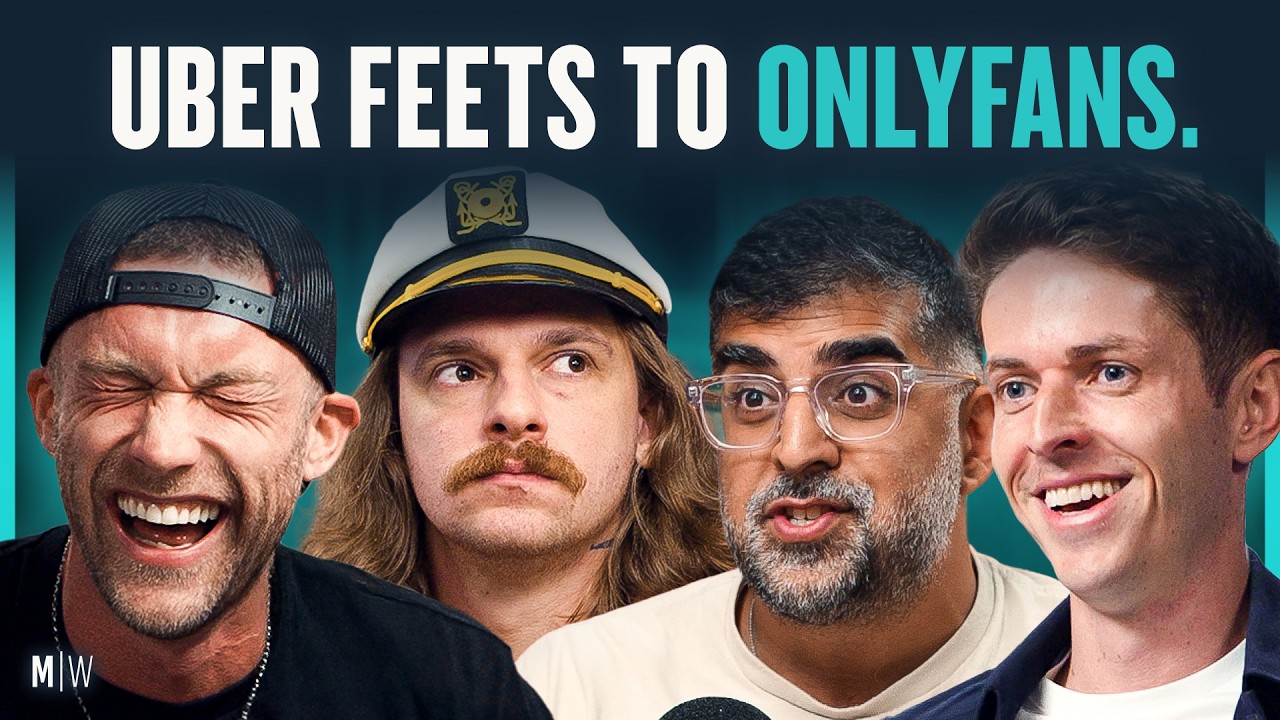
The Uber Eats to OnlyFans pipeline
- A viral story about an Uber Eats driver who started including photos of her feet in food delivery confirmations and saw her tips skyrocket.
- The group jokes about the inevitable pipeline from service work to adult content once people realize they can monetize attention for free.
- This leads into a broader discussion of “male living spaces” (a subreddit showcasing peak bachelor pad setups), including a lat pulldown machine facing a TV, a Stormtrooper figure, and a bedside table made of cinder blocks.
-
Investigative journalism and the Stop Nick Shirley Act
- California introduced the “Stop Nick Shirley Act,” legislation ostensibly designed to protect healthcare workers from doxxing and threats of violence, but which critics argue is designed to criminalize investigative journalism that exposes fraud.
- The group draws parallels to Puerto Rico, where a financial board installed by Congress in 2016 has funneled $2 billion of taxpayer money to Wall Street consultants while residents still lack reliable electricity and some have been without power for eight years.
- Puerto Rico recently revoked parts of its Transparency Act, making it easier to see who is filing FOIA-style requests, which the group sees as a direct attempt to suppress investigative work.
-
The game you choose defines you
- A discussion of the book The Score, which argues that the most important life decision is choosing the right game to play, because the scoreboard of any game rewires your desires, motivations, and identity.
- YouTube’s scoreboard is views, which means creators optimize for views regardless of whether the content is life-changing. The group references the McNamara Fallacy: measuring what’s easy to measure while ignoring what matters.
- Proposed solutions include YouTube’s “Hype” feature (limited weekly upvotes for small creators) and the idea of a “golden like” feed where users flag their single best piece of content each week.
- Some creators, like James Smith, have hacked this by tracking book sales per video rather than views, optimizing for the metric they actually care about.
-
Supernormal stimuli and the hijacking of human instincts
- The concept of “supernormal stimuli” comes from Nobel Prize-winning ethologist Nikolaas Tinbergen, who showed that birds would abandon their own eggs to sit on larger, brighter fake eggs because the exaggerated features hijacked their brain’s reward system.
- This maps onto modern life: junk food (extreme salt/fat/sugar), cosmetic surgery (Fisherian runaway where sexually selected traits escalate to the point of dysfunction), and social media (engagement metrics that escalate infinitely).
- The group references a tweet by Jay Alto: “You pity the moth for confusing the lamp for the moon, yet here you are confusing a screen for the world.”
- The “antidote” is a reset: even a short break from soda, screens, or social media recalibrates the baseline, making previously irresistible stimuli feel overwhelming.
-
AI: promise, peril, and the DeepMind documentary
- The group discusses the DeepMind documentary (The Thinking Game) and the significance of “Move 37” in the AlphaGo match, which they describe as a turning point in human history.
- AI is already replacing doctors in some cases: one member cured a 10-year skin condition by uploading his medical history to Gemini, which recommended a shampoo (Nizoral) that two human doctors had missed.
- At the same time, deepfakes and AI-generated content are making it impossible to determine truth, especially after events like the Charlie Kirk assassination spawned conspiracy theories about holograms and AI manipulation.
- Tesla’s approach to training humanoid robots involves putting 10,000 robots in a warehouse and letting them “self-play” (like Alpha Zero learning chess by playing itself), rather than relying on human demonstration data.
- Allbirds, a failing shoe company, pivoted to AI by buying GPUs and renaming itself, causing its stock to surge 582% in a single day despite no actual business change.
-
Phil Collins inducted into the Rock and Roll Hall of Fame
- In a closing moment of levity, the group reveals that Phil Collins (drummer and singer of Genesis, solo artist) is George’s father, and has been inducted into the Rock and Roll Hall of Fame in 2026.
- His response: “Obviously, I’m pleased and honored to be inducted. It wraps up what has been a wonderful life in music,” which the group reads as passive-aggressive given the decades-long delay.