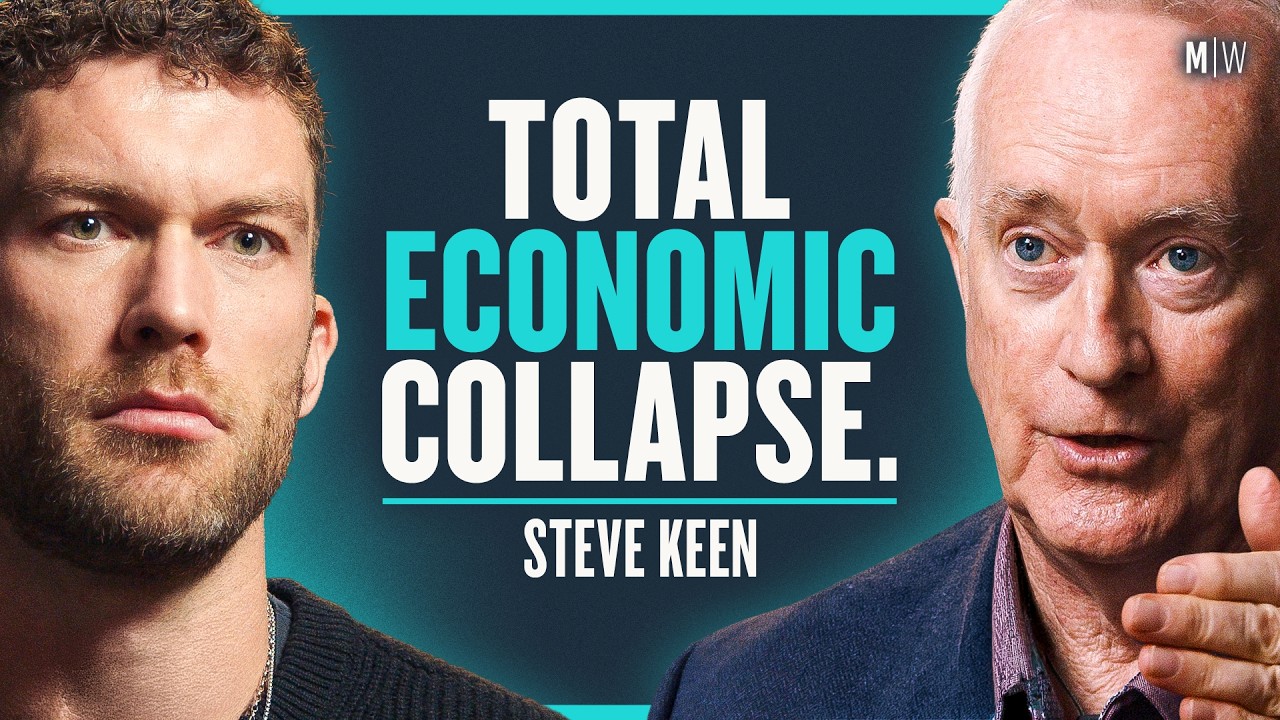
This episode features economist Steve Keen arguing that the global economy faces a converging “perfect storm” of private-debt-driven stagnation, Western deindustrialization, an AI investment bubble, catastrophic climate change that economists fundamentally misunderstand, and a Middle East war disrupting critical supply chains — together threatening near-term food shortages, energy crises, and civilizational instability.
The perfect storm: multiple converging crises
Keen identifies five simultaneous drivers: excessive private debt (not government debt) left over from the 2008 crisis; an epochal shift of manufacturing from the West to China; global warming amplified by El Niño; an AI investment bubble nearing its bust phase; and the Iran war cutting off fertilizer, helium, semiconductors, sulfuric acid, and specific oil grades.
He argues economists have failed to see these connections because their models treat the economy as an equilibrium system and ignore energy, materials, and climate physics.
Economic stagnation, inequality, and the housing trap
Since the 1970s shift from full-employment policy to inflation-targeting, per-capita growth fell from ~3% to ~1% annually, unions were crushed, and workers lost bargaining power — so productivity gains flowed to bankers (via rising private debt service) rather than wages.
Keen’s modeling shows rising private debt causes a falling labor share of GDP: capitalists maintain their profit share, so interest payments to banks come out of workers’ incomes.
Housing has become a leveraged asset game: a house that cost ~1× annual income in the 1970s now costs ~10×, requiring two earners and massive debt; the pyramid collapses when the next cohort can no longer borrow more.
The UK stands out as the worst Western performer: deindustrialized, financialized, and with real wages so eroded that even top academics live near the poverty line after tax and housing costs.
AI: transformative technology, destructive bubble, and the distribution problem
AI is a genuine epochal technology (like railways in the 1800s) but follows Schumpeter’s boom-bust pattern: entrepreneurs over-invest, creating a debt-fueled boom, then a slump when the technology undercuts old industries and fails to meet inflated sales expectations.
Current AI investment is ~2–3% of GDP; a reversion to ~0.5% would trigger a demand slump and stock-market crash akin to the 2000 telecom bust (which left “dark fiber” that later powered the internet).
The deeper danger: AI eliminates the clerical and manufacturing jobs that give workers bargaining power, worsening the 50-year trend of income shifting from labor to rentiers.
Universal Basic Income becomes inevitable only if AI displaces the vast majority of jobs; Keen prefers a Guaranteed Basic Income (targeted to those who lose work) to avoid universal inflation.
Climate change: economists’ fatal error and the AMOC threat
Mainstream climate economists assume the spatial correlation between temperature and GDP today (trivial) applies temporally to future warming — a “stupidest, most dangerous” error that tells politicians 4°C warming only cuts GDP by 10–23% by 2100 (≈0.05% annual growth reduction).
Climate scientists warn 1.5°C is dangerous, 3°C catastrophic, 5°C+ risks extinction; economists surveyed in 2021 said 7°C warming by 2220 would shrink GDP by just 25%.
The Atlantic Meridional Overturning Circulation (AMOC) — a deep-ocean flow 10–17× all rivers combined — may shut down between 2025–2095 (best estimate ~2050), dropping European temperatures 10°C in three decades (London range −20°C to +25°C) and cutting global grain-growing area by ~70%, causing global famine.
El Niño is now “turbo-charged” by 90% of trapped heat residing in oceans; the next event could spike global average temperature 0.2–0.4°C almost overnight.
Iran war: supply-chain collapse in fertilizer, helium, semiconductors, sulfuric acid, and diesel
The war cuts 20–30% of world fertilizer output (natural-gas-derived), threatening a global famine by 2027 as soil nutrients deplete; carrying capacity without artificial fertilizer is 1–2 billion people.
Helium (co-product of gas extraction) cools semiconductor fabs to near absolute zero; lost supply + leakage means GPU production for AI will falter.
Sulfuric acid (another gas co-product) is essential for copper refining and countless industrial processes; its loss compounds the copper shortage needed for electrification.
Middle East oil has unique sulfur content (“sour crude”) irreplaceable by light fracking oil or heavy Canadian/Venezuelan grades; diesel shortages will halt farming and freight.
Keen calls the war an “insanely bad decision”: Iran’s mountainous geography, 90M people, STEM-educated workforce, and pre-planned decentralized command (31 regional divisions) make invasion impossible.
Philosophical turn: Saganism, work, and human worth
Keen proposes “Saganism” — a science-based civic religion replacing tribal myths with reproducible experiments as “miracles,” scientists as “saints,” the Pale Blue Dot as the central icon, and the mission to preserve and explore life in a likely empty universe.
He argues hunter-gatherer societies (Dunbar-number groups of ~150) allocated status through gift-giving and communal contribution, not wages; modern alienation comes from tying survival to jobs and losing community.
“What keeps you busy?” should replace “What do you do for a living?” to decouple personal worth from economic value.
Near-term outlook: expect food restrictions and systemic breakdown within a year
UK government already advising households to stock days of food; 2026 saw record dry spells followed by record rain — climate volatility will cut domestic yields.
Fertilizer, diesel, and helium shortages will hit Southeast Asia first (unable to bid for scarce inputs), but Western nations will face rationing and price spikes.
If AMOC flips, Western civilization ends; if not, the Iran-war supply shock + El Niño + AI bust + private-debt overhang still constitute a historically unique peacetime crisis.