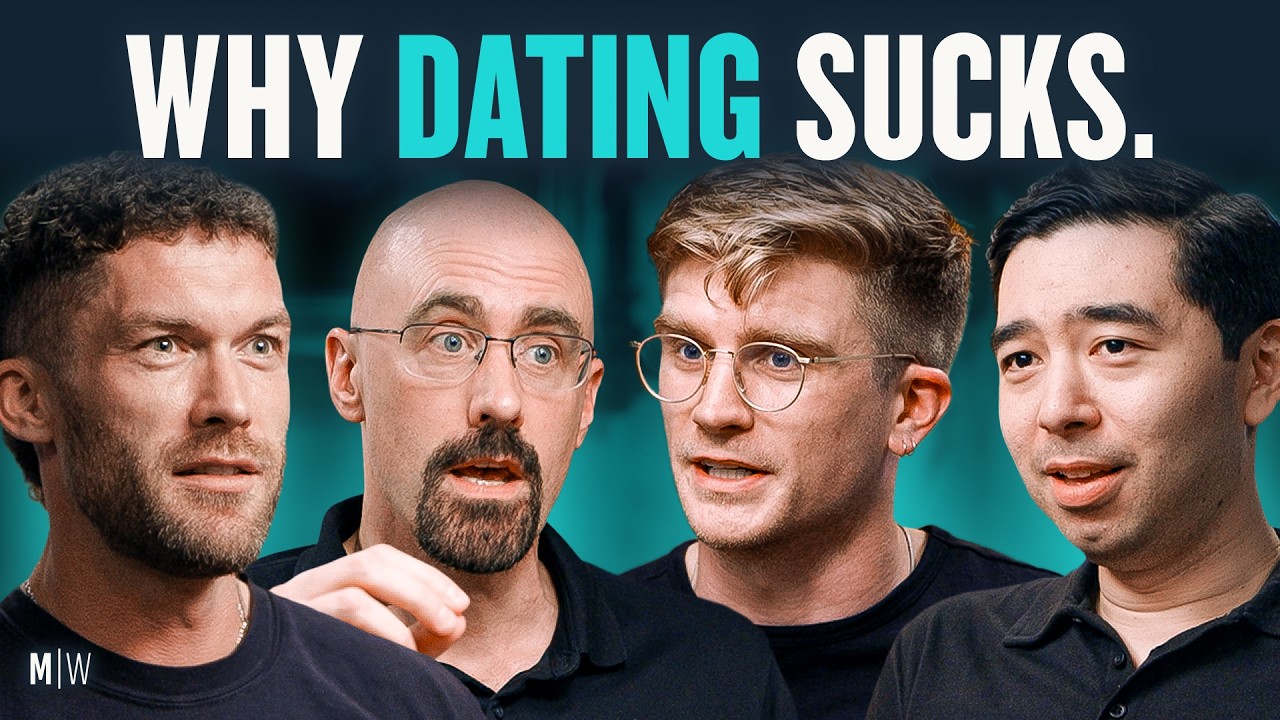
This episode features a roundtable discussion on the new science of female attraction psychology, with evolutionary psychologists Rob Henderson, Steve Stewart-Williams, and others examining dance attractiveness, looksmaxxing, the “ick,” mating market dynamics, sex differences in preferences, male beautification trends, formidability versus attractiveness, and the evolutionary basis of human mating behavior.
The Science of Attractive Dancing
A Northumbria University motion-capture study found women rate male dancers most attractive when they move their head, neck, and torso extensively, vary their rhythm creatively, and use their whole body naturally rather than repeating the same limb movements.
The panel notes the winning dancer’s style appears somewhat feminine — keeping elbows close to the body — which mirrors findings in facial attractiveness research where moderate femininity in men can be preferred over extreme masculinity.
“Masculine” dancing (mosh-pit thrashing, shadow boxing) is discussed as a turnoff; shadow boxing in particular signals performative toughness without an opponent, which women find repulsive because it reveals the man is posturing and possibly losing even an imaginary fight.
Looksmaxxing and the “Ick”
The panel agrees extreme looksmaxxing (bone smashing, chemical injections, surgery) gives women “the ick” for ordinary men because it signals narcissism, vanity, short-term mating orientation, and self-absorption rather than relationship potential.
Influencer Clavicular’s success with women is attributed to fame from promoting looksmaxxing, not the looksmaxxing itself; fans mimicking his protocols without the fame likely appear vain and insecure.
The “first rule of looksmaxxing: don’t talk about looksmaxxing” reflects two motives: avoiding the stigma of artificial enhancement (natural beauty is valued over manufactured beauty) and gatekeeping competitive advantages in the mating market.
A Chinese study (Zia et al.) found makeup and plastic surgery boost women’s rated attractiveness, but men’s willingness to date them drops when they know enhancements were used — the attractiveness gain remains but datability is attenuated, partly due to negative personality inferences (insecurity, deception).
Evolutionary Psychology of the “Ick”
PhD student Louisa Lee is researching the “ick” as an evolved disgust response tied to the behavioral immune system (pathogen avoidance) and moral disgust; women experience it more intensely because they are the choosier sex, facing higher costs from a bad mate choice.
The sex difference reflects asymmetric risks: men’s primary risk is missing a mating opportunity; women’s is mating with the wrong person, so women evolved a lower threshold for visceral disqualification.
Examples include a man missing a turn while driving or telling a joke that falls flat — minor competence or social-skill failures that transiently reduce a woman’s attraction but rarely affect men’s attraction to women.
The Myth of the Chad and Sexual Marketplace Realities
The “Chad” narrative (top 20% of men monopolizing 80% of women) is largely a myth amplified by dating-app swipe data (e.g., top 10% of men on Hinge get 60% of likes) and viral anecdotes, not actual sexual behavior.
General Social Survey data since 2000 show ~18–20% of men and ~12–18% of women report three or more partners per year — the same small, sociosexually unrestricted minority of both sexes are having most casual sex with each other.
Most men and most women report zero or one partner in the past year; the modal sexual life is monogamous or celibate, not a harem dynamic.
Dating apps create an availability heuristic: anomalous rejection stories go viral, while boring successful relationships don’t, distorting perceptions of the mating market.
“Dark matter” of women — those not on apps, not posting, in relationships or uninterested — is invisible online but constitutes the majority.
Marriage as Affirmative Action for Men
Monogamous marriage functions as “sexual redistribution” or “DEI for men”: it pairs men and women one-to-one, guaranteeing most men a partner they couldn’t secure in a deregulated marketplace where top men could accumulate multiple mates.
The sexual revolution deregulated mating, creating “late-stage sexual capitalism”; now both right (manosphere) and left (women adopting labels like demisexual, sapiosexual, solo poly) are reacting, some calling for renewed norms.
Polygyny can benefit some women (access to high-status men), but monogamy’s collapse disproportionately helps high-status men and hurts lower-status men; women’s pushback against renewed norms may reflect reluctance to return to pre-1960s gender roles, not a preference for polygyny.
Serial Monogamy as the Human Default
Humans are predominantly serial monogamists: pair-bond, reproduce, bond weakens, re-pair. A 2026 Kinsey Institute study (N=10,000+) found the average number of passionate love experiences is 2.05; 42% report one or zero, 58% report two or more.
In hunter-gatherer societies, ~5% of first marriages last a lifetime; most involve serial pair bonds. Even with total sexual freedom, most people choose exclusive pair bonds most of the time.
A small minority pursue high-sociosexuality strategies (polygyny, promiscuity), but the species-typical pattern is monogamous pair bonding with occasional switching.
Women’s Resource Preferences Soften When They Are Richer — But Not Disappear
A new PNAS experiment (45 conditions, virtual environments manipulating individual income and local gender economic inequality) found both men and women upregulate resource preferences when poor or when the opposite sex is richer — a strategic adjustment to environmental incentives, not a fixed sex difference.
Beauty preferences did not shift; age preferences did not shift (contrary to cross-cultural predictions); only resource preferences moved, supporting a behavioral-ecology “phenotypic gambit” view: people track what the environment makes valuable.
Real-world data show high-earning women still marry men earning at least as much (the “tall girl problem” — scarcity of higher-earning men forces some compromise, not preference reversal).
High-achieving women have higher absolute standards across the board (looks, resources, parenting, politics); their relative weighting of resources may dip, but the absolute preference persists.
Abundance vs. Scarcity Shifts Body-Type Preferences
Cross-culturally and experimentally, men in scarcity (hunger, famine, low-SES cultures) prefer heavier women (fat as caloric insurance, fertility buffer); in abundance, men prefer thinness (signals youth, nulliparity, conscientiousness/impulse control).
The shift is small in acute hunger studies (~10 lbs) but large across cultures (e.g., fattening huts in Mauritania vs. Singaporean ideals).
Status signaling interacts: in scarcity, fatness signals resource access; in abundance, thinness signals discipline. Both can signal conscientiousness in their respective ecologies.
Modern hunter-gatherers live in marginal habitats (pushed there by agriculturalists); ancestral environments likely included resource-rich zones where abundance preferences could evolve.
Stated vs. Revealed Preferences: The Eastwick Challenge
Paul Eastwick argues speed-dating and relationship-evaluation data show no sex differences: women care more about looks than they say, men care more about resources than they say, eroding the evolutionary prediction.
Panel pushes back: speed dating is evolutionarily novel, looks-dominant, often uses restricted samples (students with similar prospects); revealed-preference data from existing couples suffers from survivor bias (couples where men lost jobs already broke up).
Large-scale real-world data support predicted sex differences: men’s wealth predicts marriage, remarriage, fertility; women’s looks predict marriage and husband’s wealth; women’s wealth does not predict marriage outcomes similarly.
Keeper AI matchmaking data (high-stakes stated preferences with financial skin in the game): women are 12× more likely than men to refuse a partner who earns less, 6× for less intelligent, 4× for less educated — marrying down is a near-dealbreaker for women, a non-issue for men.
Dating Apps Select for Dark Triad Traits
College-student study: current Tinder users scored significantly higher on dark triad (psychopathy, Machiavellianism, narcissism) than non-users; traits that win on apps (self-promotion, manipulativeness) may be orthogonal or antithetical to being a good spouse.
Jake Kuzloski (Keeper AI): “Being good at dating apps is mostly orthogonal to being a good spouse.” The skills that maximize matches (gamification, performance) may undermine long-term relationship competence.
Facial Attractiveness Dominates Height on Apps
Whitmouth study: on a gamified dating app without height filters, facial attractiveness was 12× more influential on swiping than height. Height filters artificially inflate height’s importance; without them, face is everything.
The 6-foot threshold is culturally arbitrary (180 cm in Europe); metric conversion would “solve” it for many men — a tongue-in-cheek “DEI for men.”
Male Beautification Is Exploding
Male beautification (grooming, skincare, gym, cosmetic procedures) has risen decade-on-decade since the 1990s; the average Gen Z man’s routine would be unrecognizable to his grandfather.
Men have tripled parenting time since the 1970s (driven by college-educated men); both trends reflect response to women’s rising socioeconomic status: men compete on looks and parenting because resource provision is less differentiating.
Women’s luxury consumption (handbags, shoes) may function as mate-poaching deterrence (“look how invested he is”) and intrasexual status signaling to other women, not attraction to men.
Among makeup wearers, men spend more time applying it than women (less practice, possibly beauty-influencer skew); weightlifting is the second-largest male beautification behavior.
Formidability Predicts Mating Success Better Than Attractiveness
David Puts et al.: men rated as more formidable (likely to win a fight) by other men had more sexual partners over 18 months; women’s attractiveness ratings of the same men predicted nothing.
Fame + muscularity = double formidability (The Rock effect): other men won’t challenge, women get access uncontested.
Female Teacher Sex Scandals: A Supernormal Stimulus of Attention
Viral cases involve attractive female teachers with male students; male teachers offend more often but female cases go viral due to anomaly.
Hypothesis: the adolescent boy’s unprecedented, intense sexual attention (first exposure to a peak-fertility woman) is a supernormal stimulus for the teacher — akin to OnlyFans creators receiving massive sexual attention from thousands of men. The power and novelty of that attention, not just the sex, drives the behavior.
Being Desired vs. Desiring: A Fundamental Sex Difference
Twitter poll (forced choice): 75% of men would rather sleep with a very attractive person who isn’t attracted to them; 75% of women would rather sleep with an unattractive person who is very attracted to them.
Being desired is a primary turn-on for women; men prioritize the partner’s attractiveness. This aligns with Esther Perel’s observation that women need to feel desired, but contradicts her claim that women aren’t turned on by a partner’s arousal.
Dangers of Minimizing Sex Differences
Denying evolved sex differences leads to: (1) pushing people into non-fitting roles (reverse of traditional gender-role enforcement); (2) missing sex-specific health presentations (e.g., women’s heart-attack symptoms differ); (3) naive risk-taking (e.g., young women assuming men’s sexual motivations mirror women’s at frat parties).
Acknowledging differences ≠ endorsing inequality; it enables accurate prediction and protection.
Dual Mating / Mate Switching: New Evidence Forthcoming
Ryan Dobson and colleagues have new research on dual mating and mate-switching hypotheses presented at HBES; details under embargo but described as significant updates to the long-running debate.
Women’s Sexual Desire Declines Faster Than Men’s in Relationships
Within-relationship data: women’s libido drops ~50% in the first year, continues declining; men’s stays relatively stable. Remating resets women’s desire.
Possible explanations: (1) non-conceptive sex as mate-retention strategy early, then bargaining chip later; (2) women’s higher reproductive costs with age; (3) couples converge on the lower-desire partner’s level (women want less, men compromise).
Baumeister: women report having the amount of sex they want; men report wanting ~2× more — the couple zeros in on the woman’s preferred frequency.
What Counts as “Human Nature”? WEIRD vs. Hunter-Gatherer Evidence
Debate: are sex differences in mate preferences most visible in WEIRD societies (where needs are met, true traits emerge) or in hunter-gatherers (ancestral ecology)?
William Buckner (anthropologist): sex differences in mate preferences are less consistent in small-scale hunter-gatherer societies (e.g., Wodaabe men compete on beauty, women choose on looks) — alarm bells for evolutionary psychology.
Counter: differences appear robustly in industrialized societies and cross-culturally in folktales/fairy stories (women’s appearance, men’s resources prioritized universally), suggesting an innate push expressed more extremely in novel abundant environments.
Gay men prioritize youth/looks (male-typical); lesbians prioritize resources/ambition (female-typical) — supports evolved sex-typical preferences independent of target sex.
Closing Notes
Rob Henderson: Substack (robkhenderson.com), paperback Troubled.
Steve Stewart-Williams: A Billion Years of Sex Differences, The Ape That Understood the Universe, Substack Nature-Nurture-Nietzsche.