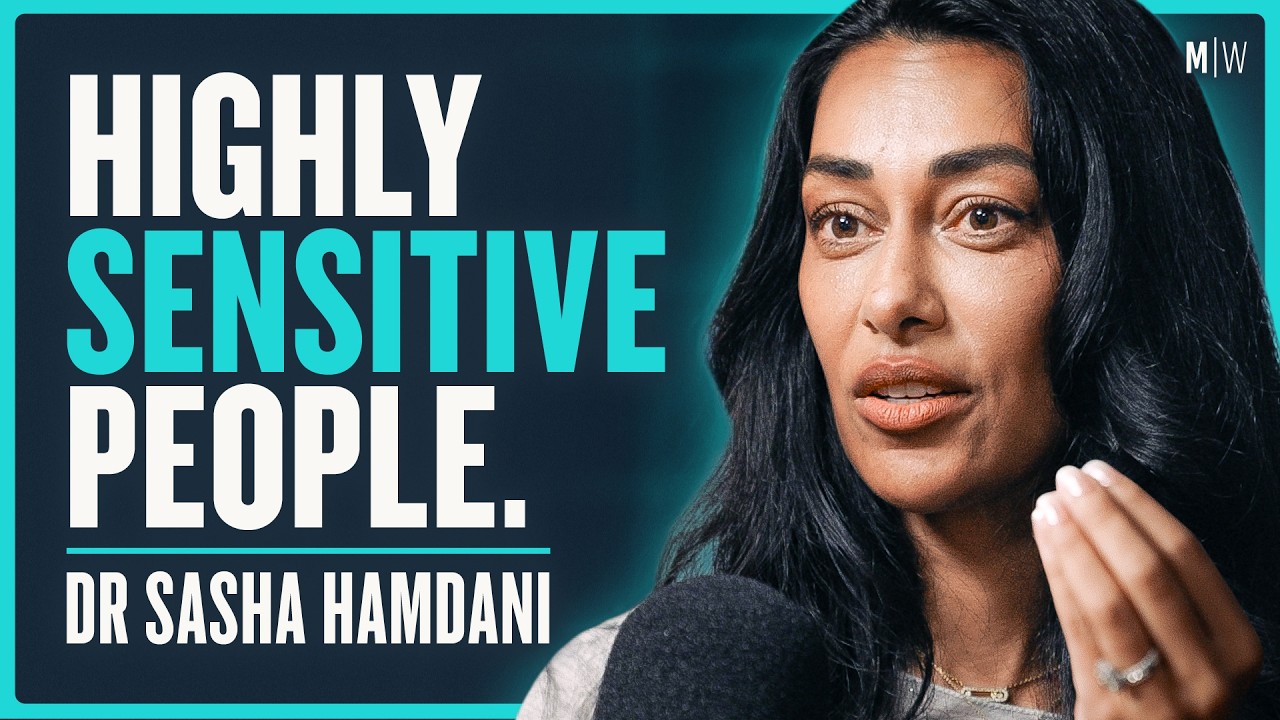
This episode features psychiatrist Dr. Sasha Hamdani in conversation with Chris Williamson about the lived experience, neurobiology, and practical management of emotional sensitivity and rejection sensitive dysphoria (RSD), drawing on Dr. Hamdani’s clinical work, research, and personal experience as an emotionally sensitive person.
What emotional sensitivity looks and feels like
Emotionally sensitive people feel things quickly, deeply, and for a long time, taking in high volumes of emotional data throughout the day.
They overanalyze every interaction — scanning for “Am I doing something weird? Is this person mad at me?” — which consumes significant cognitive bandwidth.
They spend substantial energy anticipating potential negative interactions, masking behavior, and overcompensating before events even occur.
Even silence and neutral moments get interpreted through a threat-detection lens, creating constant background processing.
Rejection sensitive dysphoria (RSD) as a distinct neurological phenomenon
RSD is a robust emotional and sometimes physical response to rejection or criticism — not just hurt feelings, but a sensation of “the air pushed out of my lungs” and “I don’t know if I can recover from this.”
It consumes the person rather than remaining a passing annoyance, and can mimic a major depressive episode in intensity.
The core driver is fear of disappointing others, which stems from fear of rejection, criticism, or being thought badly of — all hitting at once and overwhelming real-time processing.
Dr. Hamdani distinguishes RSD from “highly sensitive person” (HSP): HSP is sensitivity to everything (sounds, lights, chaos), while RSD sits on a spectrum of specifically emotional sensitivity.
The term “rejection sensitive” was coined by Dr. William Dodson based on longitudinal patient data showing rejection and criticism as primary triggers for profound emotional responses.
Dr. Hamdani argues for expanding the conversation to emotional sensitivity broadly, which captures emotional dysregulation — a missing piece in ADHD and anxiety discussions for years.
The neurobiology: why the brain reacts this way
Two key brain areas are implicated: a hyperactive amygdala (threat detector) that picks up emotional data intensely, and an underactive prefrontal cortex (judgment, regulation) that should contextualize but doesn’t come online effectively.
The connection between amygdala and prefrontal cortex is also “frayed,” so top-down regulation fails even when the prefrontal cortex tries to engage.
Dopamine dysregulation: not simply low baseline, but “not enough dopamine at the right place at the right time” — impairing the ability to weather emotional ups and downs.
Dr. Hamdani references COMT gene variants (she has two copies) affecting catecholamine clearance: some people are “airplanes” (quick up/down, less depth), others “submarines” (deep, slow to resurface).
Norepinephrine surges create the physical component: chest pain, breathlessness, heart racing, sweating, tremors — the body signals genuine danger, not just psychological distress.
The limbic system “goes wild” when emotional data arrives, lighting up emotional circuitry and driving cascades that the person must navigate in real time.
Hormones as a massive, underdiscussed modulator
Hormones globally reshape the system: estrogen drops lower dopamine, reducing emotional regulation capacity — so women are intrinsically more rejection-sensitive during low-estrogen phases (premenstrual, perimenopause, postpartum).
Testosterone can be protective for emotional regulation and alertness; as it declines in men (50s–60s), emotional sensitivity can rise sharply, often without tools to handle it.
This hormonal dimension makes emotional sensitivity dynamic across the lifespan, not a fixed trait.
Men are socialized to suppress emotions except anger — the only socially acceptable outlet — so emotional sensitivity in men often manifests as irritability, rage, or avoidance.
Boys are told “man up,” “don’t cry,” from kindergarten onward; girls who fall get scooped up, boys get “that’s not a big deal.”
Emotionally avoidant men may be emotionally sensitive men in disguise who never had space to explore or express it.
Male suicide statistics (over 90% had mental health contact in UK) suggest the problem isn’t just “not talking” — it’s that when men do open up deeply, they often face aversion from other men and women.
“Man points” dynamic: men need a surplus of traditional masculinity (muscle, money, status) to “earn” permission to be vulnerable; those who need support most (no surplus) get the least sympathy.
Evolutionary perspective: why rejection hurts so much
Social rejection historically meant expulsion from the tribe and death — the brain treats it as survival threat.
Dr. Hamdani doesn’t view this as purely maladaptive: she wouldn’t trade her emotional sensitivity, which makes her a better physician, parent, partner — a form of high emotional intelligence.
The challenge isn’t feeling deeply, but living in a world that doesn’t know how to support that sensitivity.
Strengths that come with emotional sensitivity
Direct pipeline to high emotional intelligence: deep understanding of others’ emotional states, picking up micro-cues (body position, tone, volume) others miss.
In psychiatry, this lets Dr. Hamdani detect tension patients can’t articulate — “amalgamating” cues into clinical direction.
Makes her a better friend, partner, parent: ability to sit with a child’s big emotions, recognize the feeling, and offer safety instead of force.
Self-esteem, validation, and the compliment problem
Self-esteem is inherent self-worth; confidence is situational belief in capabilities — RSD erodes the former.
Emotionally sensitive people often need constant reassurance as reality-testing: amygdala loops and stress cascades create desperate need for external confirmation that the negative narrative isn’t true.
Compliments can be hard to believe — brushed off or distrusted — depending on the relationship, context, and momentary self-consciousness.
Building self-esteem without external validation is possible: understanding one’s own neurobiology (“this isn’t a personal failing, this is how my brain works”) bolsters self-worth tremendously.
Waiting for a text feels unbearable because the brain fills the uncertainty with worst-case narratives (“they’re with someone else,” “they’re not interested”).
Anxious people often sabotage relationships preemptively — Dr. Hamdani ended every relationship in her 20s before being rejected, not because partners did anything wrong.
Vulnerability hangover: after opening up, shame spirals (“they think I’m a weenie, I can’t handle anything”) drive pulling away.
The core thread: not the deep feeling itself, but the story about what the feeling means and what others think — heavy shame component.
Uncertainty vs. bad news: why ambiguity is worse
Bad news allows a game plan; uncertainty lets the brain construct nightmare scenarios that defy physics (dead grandmother laughing at you).
Ghosting is especially damaging: no closure + automatic self-blame (“something about me forced this away” = “I’m insufficient”).
Sensitivity vs. fragility: when to work on it, when to pivot
Not for others to decide — the person experiencing it must judge.
The world is currently “a hard place to be a human in” if you want to feel feelings; emotionally sensitive people have never been given tools, only told “you’re too sensitive, toughen up.”
The goal: not change the processing (you’ll still read the data), but catch it in the moment to impact intensity and duration — make it a usable moment.
Dr. Hamdani’s book Too Sensitive (out August 25) distills 12 tools from three years of pulling across psychology/psychiatry — tools she wished existed for med school, dating, marriage, parenting.
The most powerful regulation tools (Calm Your Mind Toolkit)
Movement: physical pattern disruption — even subtle (tensing calves, moving legs under a table) — shunts oxygenated glucose to prefrontal cortex, helping override amygdala. Fidgeting in ADHD serves this self-regulation function.
Delay your reaction: initial impulse is urgency (quadruple-texting). Purposeful delay lets amygdala cool and prefrontal cortex come online; the narrative becomes less negative, and often the other person responds in the gap. Key: mindful intent (“I’m giving my brain time to stop overheating”), not passive rumination.
Mindfulness as non-judgmental observation: not “factory reset” (thinking nothing), but welcoming thoughts/feelings in — “there’s the part of me that cares about work, there’s the part judging me for distraction” — with gratitude for their protective intent. Yale study: mere observation reduces brain activation vs. judgmental rushing to solve.
Parenting as an emotionally sensitive person
Chaotic but all parenting is; Dr. Hamdani’s measured, calm husband provides emotional ballast for the family.
Sensitivity helps: when a child has a big emotion, she recognizes the feeling and knows what helps — safety and freedom to self-regulate, not snapping or forcing.
Social media and sensitive teenagers
Dr. Hamdani herself gets triggered comparing, tying self-worth to engagement numbers — despite being a physician who studies the brain.
Teens with undeveloped prefrontal cortices are at higher risk; total shielding is impossible (“the train is moving”), so the task is teaching navigation skills.
Nature vs. nurture: origins of sensitivity
Large genetic component; chaotic/tumultuous upbringing creates hypervigilance (scanning for cues), amplifying sensitivity.
Parenting that dismisses feelings (“you don’t need to cry, move on”) in hopes of building resilience can backfire — validating the feeling (“this is a big deal to you”) while not encouraging victimhood is the tightrope.
Workplace challenges: the ambitious mother paradox
RSD shows up as not even applying (spooked in interviews, walking out) or overcompensating until burnout — especially high-achieving women pressured to “do it all, not complain.”
Structural tension: women fought for workplace access; asking for accommodation implies difference, risking hard-won gains. Emotional sensitivity feels like a liability in capitalist, meritocratic, fast-paced environments.
Childbearing compounds it: ~2.5% gray matter loss postpartum prunes non-child executive function — the “chief of staff” brain becomes “fluffy.”
Two paths: accommodate within existing roles (pivot to use new empathy skills), or transition to careers that leverage the new skill set (e.g., therapy). Framing and agency matter — must feel like choice, not demotion.
Market doesn’t care; businesses need profitability. Culture change needed so pivoting doesn’t feel like “chalking up an L.”
The core equation: sensitivity in, emotional intelligence out
Sensitivity is the input; emotional intelligence is the output — advantages and challenges both real.
Emotions can’t be delegated or hacked like executive function; they live inside and consume brain space if unregulated.
Dr. Hamdani’s hope: give people agency over their emotions through tangible, in-the-moment tools.
The takeaway for someone drowning in a spiky world
You don’t have the tools yet. Life is hard, the world is hard, emotional sensitivity is beautiful — but keeping your head above water when emotions are big requires tools you can grab and use in the moment. That is life-changing.