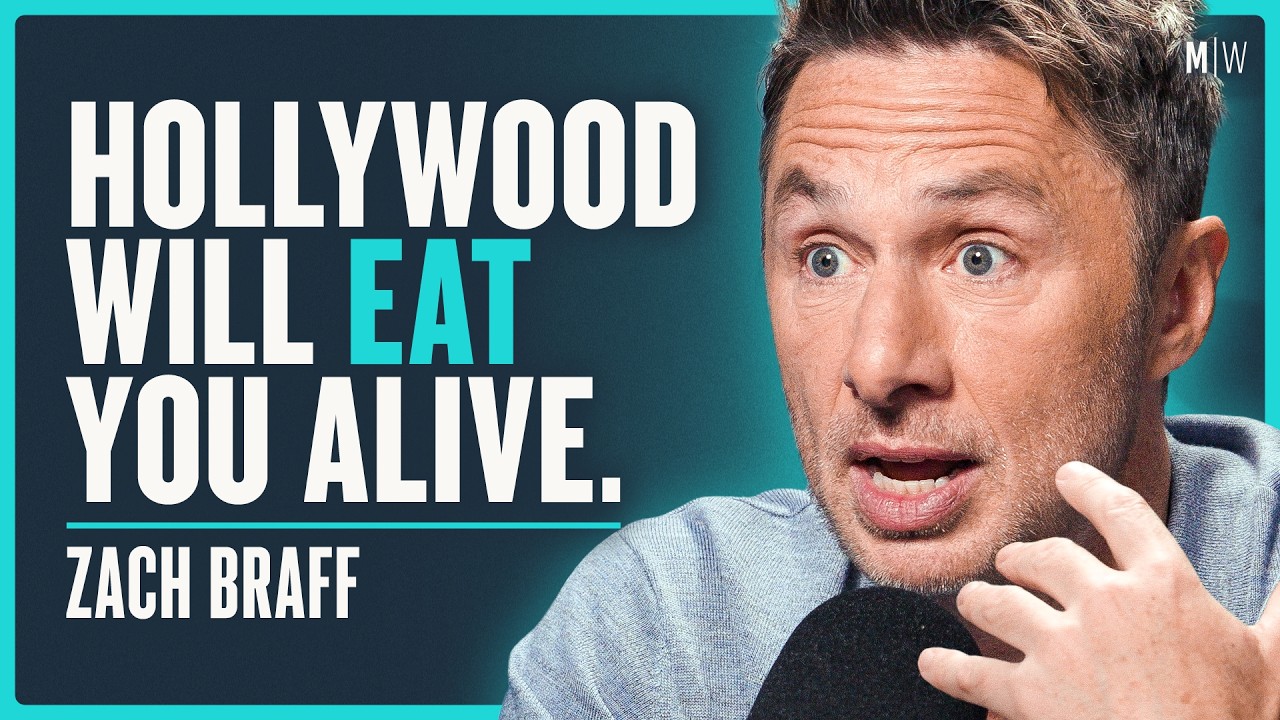
Zach Braff — actor, director, and star of Scrubs — returns to the show decades later in a new leadership role, and the episode explores what that homecoming reveals about craft, obsession, and the hidden costs of success in entertainment.
What Makes Theatre Special to Zach
His father took him to many shows growing up in North Jersey, but most went over his head until he saw Les Misérables at age 13 — the first time art moved him to tears and showed him the power of live performance.
What makes great theatre magical is the shared experience with an audience — people laughing or crying together in real time, with every performance being different.
Bad theatre is genuinely painful; he never walks out at intermission because he feels too bad as an actor himself, but he also doesn’t go in blind — he filters what he sees based on trusted recommendations.
The Doctor Career He Never Had
In high school, he volunteered with a local ambulance rescue squad as an EMT, going on calls and doing grunt work like carrying gear and taking blood pressures.
The adrenaline and the feeling of helping people were thrilling, but he didn’t have the academic interest or grades to pursue medical school.
He sees a parallel between his directing work and architecture/design — both involve having a rough idea and assembling a team of exceptionally talented craftspeople to execute it.
Unsung Heroes of a Film Set
The cinematographer is the director’s most important collaborator — responsible for lens choices, lighting, and color grading, all of which shape how a scene feels. Most laypeople assume this is all the director’s work.
The first assistant director (first AD) runs the entire set — marshaling crew, background actors, and logistics. It’s so stressful that first ADs stereotypically die young.
On Scrubs, episodes were shot in just 5 days (newer streaming comedions now get 6.5). The first AD manages the schedule and tells the director when to move on, even when a scene isn’t quite right — the director must decide whether to spend more time or simplify the next scene.
Returning to Scrubs — From Actor to Boss
Bill Lawrence created Scrubs and was its singular visionary, but with multiple other shows running and a Warner Brothers deal (while Scrubs is a Disney property), he couldn’t micromanage the revival.
Zach stepped into the executive producer role knowing the show better than anyone, but the reality didn’t hit until they were shooting the pilot — mirroring the plot, where JD’s mentor tells him “you’re in charge” and then leaves.
The pilot’s cut changed everything — the studio, network, and Bill himself all responded positively, and it felt like a genuine passing of the torch.
Why Nostalgia Alone Can’t Sustain a Reboot
One of the biggest pitfalls of revivals is milking nostalgia with constant callbacks, which exhausts audiences and fails to build a new one.
The original Scrubs was about three interns; the revival is about those same characters now as senior doctors and teachers. The focus shifted from the students to the mentors.
The show needs to work for people who never saw the original — and the revival’s success has actually driven many new viewers to go back and start the original series from season one.
How Scrubs Changed Zach’s View of His Own Past
Doing the rewatch podcast with co-star Donald Faison was a catalyst for the revival — they were candid about where they thought they overacted or where episodes fell short.
He realized he started taking the show for granted and that his performance declined in later seasons. Now, in charge, he’s hyperaware of maintaining quality — especially his own.
The Trap of Being Known for One Role
A breakout hit is what everyone wants, but it rarely leads to a wide new range of opportunities — people get typecast because audiences fall in love with one character.
Bryan Cranston is the classic example: Malcolm in the Middle defined him until Breaking Bad (which was passed on by every network before AMC took it) reborn him.
Zach was lucky to have his directing career, but only recently has he started getting acting parts outside the JD mold — a small role on Bill Lawrence’s Bad Monkey and an indie film called Clean Hands where he plays a narcotics cop who lost his daughter.
When Your Strengths Are Also Your Weaknesses
Zach has OCD, which manifested in childhood as obsessive tapping and superstitious rituals (touching things a certain number of times to prevent harm to his family — a child’s version of Pascal’s wager).
His father had a temper, which left him in a chronic state of anxiety and hypervigilance — always on edge, waiting for something bad to happen.
That same anxiety and obsessive attention to detail fuels his writing, comedy, and directing. He’s the person on set at 2 AM making sure an insert shot of a phone is exactly the frame he pictured.
The cost: he can’t switch it off. It bleeds into his personal life, and he acknowledges that the obsessive career focus has come at the expense of building a family or long-term partnership.
The Price of Going All In
He doesn’t idle well — he gets anxious during long breaks from work. Creating is where he feels most himself and most fulfilled.
The self-critical voice never turns off: even when something is good, he sees how it could be better with more time, more resources, more tweaking.
He tells young people entering the industry that they must go 100% all-in because the competition is fierce and unforgiving — half-assing an audition when others are memorizing two-page monologues is pointless.
He’s experienced this firsthand: he once spent a week memorizing a two-page monologue, crushed the audition, and didn’t even get a callback. The role went to someone else. That’s the lottery of the business.
Why Influencer Culture Appeals to a Generation
The number one career aspiration for young kids is YouTuber, number two is influencer. Part of the appeal is that it’s a permissionless world — no one can reject you from doing it.
There’s no casting director saying no. You can put unlimited content online and be the star regardless of whether anyone else would have picked you up.
The rejection is soft — views and engagement — rather than a hard “you didn’t get the part.”
The Psychology of Interrogation
Zach is fascinated by detective interrogation techniques and wants to develop a project around them.
One effective strategy: a female detective switched from aggressive confrontation to warmth — bringing the suspect a blanket, food, sitting close — and he gradually opened up and confessed.
A universal technique: detectives move physically closer and closer as the suspect gets nearer to confessing, creating intimacy and a sense of inescapability.
He sees a parallel with attachment styles: anxiously attached people (hypervigilant, detail-oriented) would make the best detectives noticing small clues, while avoidantly attached people (able to partition off emotions) would make the best SWAT or kinetic operators.
Broadcast TV Isn’t Dead
The Scrubs revival pulled in 11 million viewers within the first 5 days, defying the narrative that broadcast TV is dead.
Modern metrics track live viewing, plus-3-day (DVR and streaming within 3 days), and plus-7-day numbers. All matter.
Live broadcast audiences are a fraction of what they were in the Friends or MASH era, but shows like Survivor, Abbott Elementary, and Scrubs still draw meaningful numbers.
An unexpected benefit: many people who never watched the original Scrubs went back and started from season one, giving the revival a massive built-in prequel audience.
Game of Thrones and the Joy of Deep Fandom
The first season of Game of Thrones was a cultural phenomenon that pulled in viewers who weren’t even into the genre. The scale of production was so massive that nearly anyone with a British accent and a beard in Ireland was tapped as an extra.
The “Battle of the Bastards” episode is one of the most brilliantly executed pieces of television ever made.
A fan channel called Emergency Awesome broke down each episode in detail, and its host essentially predicted Jon Snow being a Targaryen a full season before it aired by applying Chekhov’s gun logic — nothing after season 3 was superfluous, and every detail paid off.