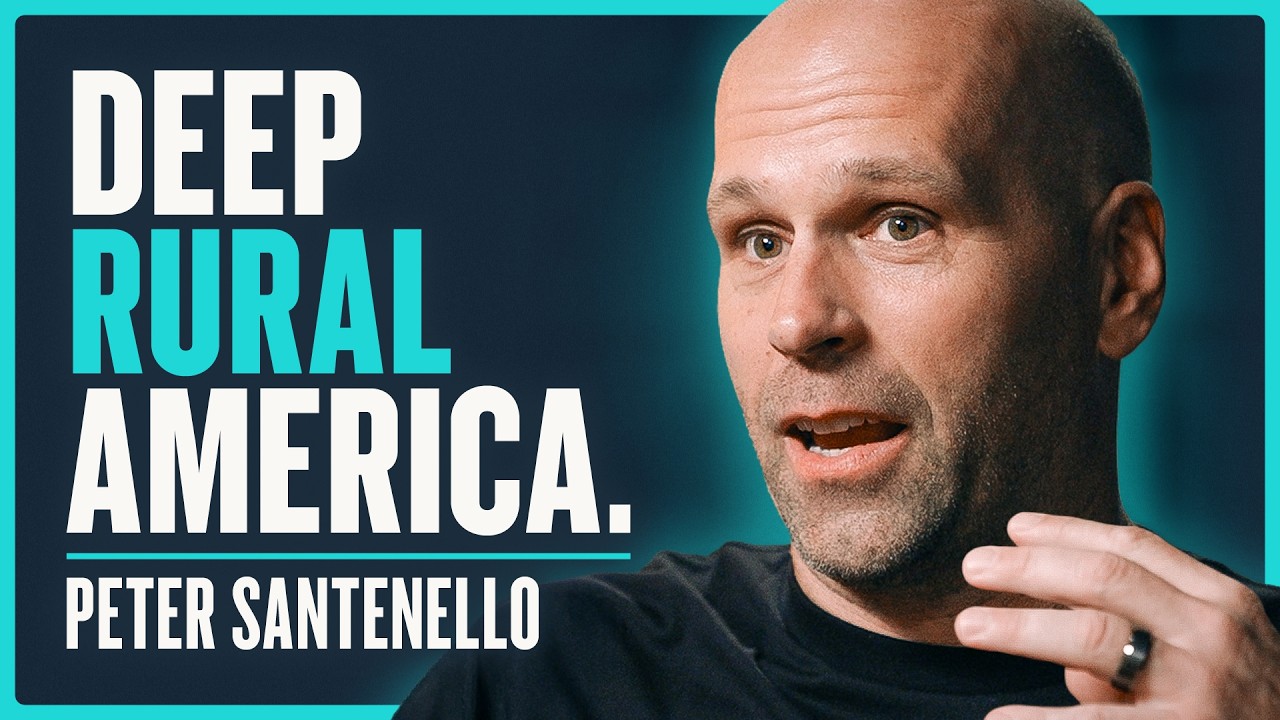
Peter Santenello is a travel YouTuber who explores overlooked American communities — from Amish country and Native reservations to Appalachia, inner cities, and the border — after a decade of international travel taught him he understood his own country least; his channel and new book aim to show the granular, often contradictory reality of American life without tragedy porn or political framing.
Origin story: from Austin waiter to global wanderer
Santenello grew up in Vermont, moved to Austin in his early 20s waiting tables at Fleming’s Steakhouse, dreaming of saving $20,000 to spend seven months in Europe on a Ducati.
A winter in Switzerland led to a one-way ticket to the Republic of Georgia at 25; the corruption, bribes, and raw adventure became a “gateway drug” to two years across 50 countries, running out of money in Uzbekistan and taking 25% credit-card cash advances to keep going.
He deliberately did not film any of it — glad he didn’t, because content creation turns travel into work and constrains the freedom to just observe.
Living abroad teaches you more about home than home does
After years abroad (Ukraine, Iran, Saudi Arabia), Santenello finds himself culturally displaced in the U.S. despite speaking the language: seamless communication masks alienation that “jump-scares” you when a cultural reference (Jaffa Cakes, The Inbetweeners) falls flat.
The U.K. expat experience mirrors this: you forget you’re foreign until you can’t share a cultural touchstone, then the isolation hits harder because you’re “supposed” to belong.
George Mack and Steve Jobs’ “connect the dots backward” idea resonates — only in retrospect does the arc from Austin waiter to global documentarian make sense.
Underrated destinations: culturally different but accessible
For Americans’ first big trip abroad: Istanbul (Turkey) — culturally distinct, hospitable, still user-friendly; Syria is not a weekend getaway (visited at Christmas 2000s, saw fear of speaking freely under Assad).
Iran offered free range on an Italian passport; Saudi Arabia opened right as he arrived; each new country built a new audience but no through-line — algorithmic audience capture by nation, not theme.
Pandemic forced return to U.S.; domestic content finally found a U.S. audience and sustainable revenue.
Ukraine: the accidental launchpad
At 38, stalled in San Francisco, a friend invited him to Ukraine (dev team there); sublet his apartment, moved to the countryside, lived with a displaced family in primitive conditions (hand-dug well, 94°F room, mattress springs through back).
Six videos from that stay — selling corn on Berdyansk beaches, tangling with the “corn mafia” — went viral in Ukraine; he became “Ukraine famous,” on national TV, proving the format could work.
Subsequent Iran and Saudi series each captured local audiences but fractured the channel; no U.S. base until pandemic return.
What Americans don’t understand about America: scale and granularity
Less than half of Americans flew in 2025; ~51% hold passports — but two weeks’ vacation, family obligations, and cost make international travel unrealistic for many.
The U.S. contains 576 federally recognized tribes (each a distinct culture like European nations), St. Lawrence Island (Siberian Yupik, 3× Maui, see Russia from shore), Miami as Latin America’s capital, Amish sects from ultra-conservative to car-driving — “build your own bowl” diversity within one country.
Most people never leave their bubble; Santenello’s goal is to show other bubbles without judgment.
Native America: no monolith, wide economic extremes
Threads across tribes: storytelling mastery, humor, basketball (“hoops”) as cultural glue, military enlistment highest per capita.
Resentment varies: some hold Wounded Knee (1890) as living trauma; others mirror Vietnam’s rapid reconciliation; no consensus on terminology (Indian, Native American, Indigenous, First Nations).
Economic chasm: Pine Ridge (poorest reservation) vs. Seminole Tribe (Hard Rock Cafe owners, ~$128k/year per member, kids graduate high school as millionaires).
Seminole tribal council gave sanctioned “North Korea tour” — showed only the good; attorney later demanded video removal, flexing an $800M Wells Fargo settlement.
Appalachia and the drug crisis: isolation vs. opportunity
Two regions stand out for poverty: Central Appalachia (WV, eastern KY) and Mississippi Delta — both “left behind” by coal’s decline and cultural mockery.
Inner-city kid has subway access to jobs; Appalachian kid has no local economy — coal jobs remain but youth avoid them; vacuum filled by OxyContin (Sackler pill mills targeted miners’ pain), then fentanyl.
Fourth-generation miner: first prescribed Oxy, addiction deepened when jobs left — physical pain became psychic pain.
Kensington (Philadelphia) is the most disheartening place Santenello has seen globally — fentanyl + xylazine (“tran”) causes necrotic wounds, people face-down on curbs; “compassion” means forced removal to rehab, not enabling street death.
Homeless-industrial complex: NGOs, housing contractors, tent distributors profit while problem worsens; ACLU/freedom arguments prevent mandatory intervention.
Company towns: modern indentured servitude or good deal?
Historical model: company scrip, company housing, widow evicted unless kids replace father in mines — perilously close to slavery.
Today: Baghdad, AZ (Freeport-McMoRan copper) — $90k avg wage, $350 rent for 3BR/2BA, pool, daycare, great schools, zero crime (crime = fired = evicted).
Trade-off: total economic dependence, mandatory retirement eviction, insular social world; some workers save, buy outside property, retire nearby.
Not inherently exploitative if wages and amenities are high, but replicates feudal housing-employment linkage most modern workers escaped.
Amish: more connected than the internet
“English” = anyone non-Amish (including Japanese, Black visitors); sects range from Schwartzentruber (no phone/electric) to Beachy (drive cars).
Marcus (Old Order) bummed a ride to a shuffleboard barn, played Santenello — never intended to film, just wanted transport; Amish communication network (Aspen-tree roots) spreads info faster than internet.
Pandemic flipped perception: “left behind” became “I want that” — self-sufficient food, community, no panic.
Hasidic Jews: intensity in the heart of Brooklyn
Satmar (most conservative) to Lubavitch (wife shops Gucci); Shabbat dinner required rabbinic approval to film.
Secular “digital Sabbath” (phones away, shared meal) captures the social technology without theology — period of presence, no screens, no work; universally beneficial idea.
East LA / Chicano culture: the uncanny valley between Mexico and America
Chicanos: English native language with Spanish accent, multi-generational, lowrider car culture, tight community.
“In Mexico they call us American; in the U.S. they call us Mexican” — distinct third culture, neither here nor there.
U.S.–Mexico border: walls, asylum loopholes, and cartel logistics
~750 of ~2,000 miles have primary barrier (35–38%); rest is terrain, sensors, patrols.
Tijuana: double mega-walls; without them, “bum rush” north.
Yuma sector (2019–2021): 140 nationalities; “OTM” (Other Than Mexican) policy — Indians flown Delhi→Mexico City→Mexicali, cartel Epcot-style handoff, gap in wall, U.S. phone, dial 911 → CBP pickup → asylum claim → bus to interior (NY, Chicago, LA) with court date 5–7 years out.
Green light = cartel payday, unsustainable influx; cities unprepared (Chicago police stations full of sleeping migrants).
Santenello accessed reality via elected sheriffs (Yuma’s Sheriff Wilmot — handlebar mustache, cowboy hat) while CBP had gag order; local law enforcement autonomy enabled coverage national media missed.
Hamptons: working class beneath the billionaires
Jimmy Ding (surfboard repairman) — old-school local; started tour at the dump to show service workers who keep the enclave running.
Real estate vertical since 1950s/60s; tension: how does a fisherman hang on when his childhood home is now a tear-down for a hedge-fund palace?
UK vs. US: London as a city-state, America as 50 countries
UK = poor country surrounding a very rich city (London); north/south divide stark (Newcastle vs. London = different climate, culture, press attention).
US = massive coordination problem (3,000+ counties, elected sheriffs vs. city police, layered jurisdictions); young country (trees in UK older than USA) built fast, messy, but sheriff autonomy lets journalists in.
Risk-taker DNA: 4–8 weeks at sea, 1800s steamships cut to 1–2 weeks; ancestors who said “fuck it, let’s go” populate the country.
Smith Island, MD: Elizabethan English survives
Jerry, 374-year family lineage, watermen dialect — some archaic vocabulary (“yarn” for friend), but accent is Southern Chesapeake, not British; still, a living linguistic relic.
Community vs. free agent: the cost of belonging nowhere and everywhere
Santenello admires 10-generation rootedness but thrives as a free agent — “belong everywhere and nowhere.”
Wife edits, mini-dog, two contractors (Thai translator, Filipino VA) — tight family unit stabilizes the nomadic maker life.
Ryan Trahan (similar scale) runs solo + iPhone; Santenello needs maker mode (story, shoot) separated from manager mode (logistics, admin) — Paul Graham’s essay: cannot switch manager→maker same day; must batch days or protect mornings.
Current output: book tour, channel, long-game mindset
Book Your Fellow Americans — channel stories + backstory + historical context; publisher wanted “zag” to doom/gloom trend; uplifting, chapter-per-community.
Rejects short-term “RPT” (Russian Package Tour) mentality — grab everything now, scarcity mindset; meaningful work requires long horizon (he didn’t find his path until 38).
Age timelines are arbitrary without a known death date; move countries at 34 with two suitcases, build over years, not quarters.