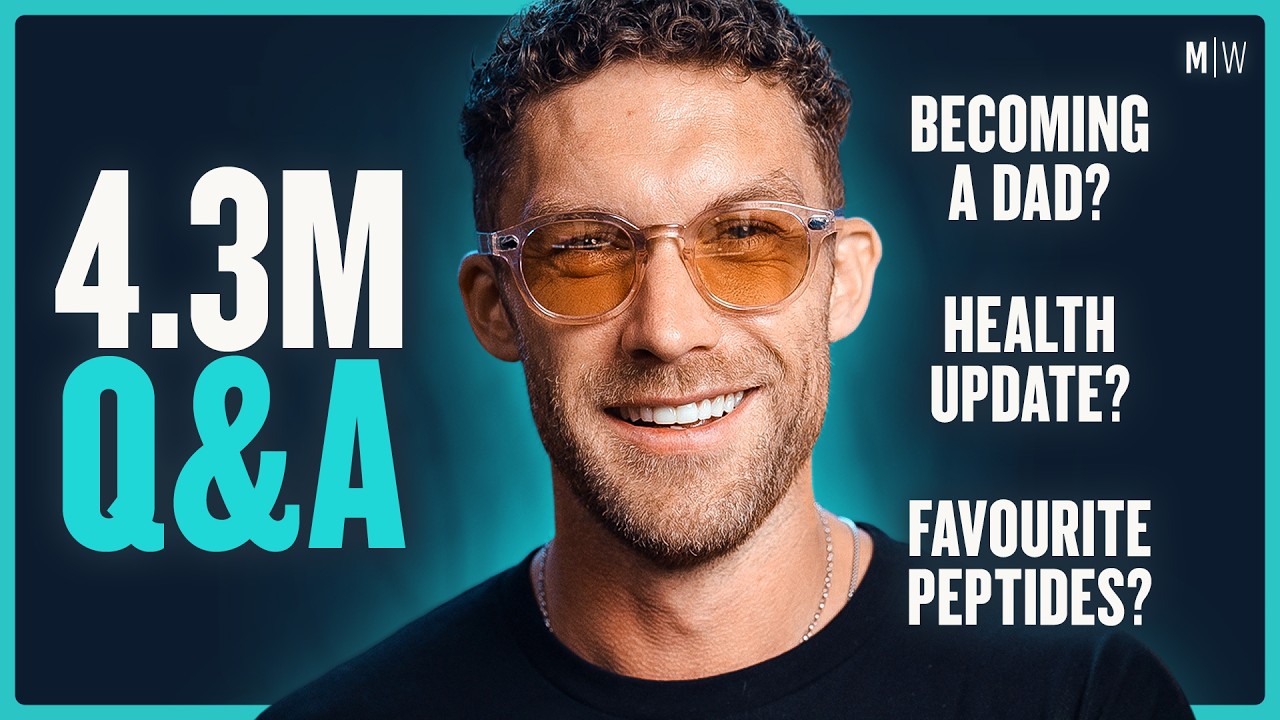
Chris Williamson hosts a wide-ranging Q&A episode drawn from audience submissions, covering self-improvement fatigue, relationship boundaries, injury recovery, health struggles, personal evolution, podcast growth, and future plans — all framed by his ongoing attempt to balance useful insight with a tone that doesn’t feel like another item on a to-do list.
Self-Improvement Fatigue and the Shift Toward Enjoyable Learning
Many listeners feel burned out by grind-heavy, “your feelings don’t matter, work harder” content that turns learning into homework and guilt.
Chris senses a cultural shift: financial niches have moved from long-term investing to get-rich-quick schemes, reflecting a broader short-termism that may fuel self-improvement exhaustion.
He aims to keep the show valuable but low-pressure — citing the two-and-a-half-hour Odyssey episode with Alex Petkas as a model where you learn without feeling obliged to overhaul your life.
When to Walk Away From a Relationship
A listener feels lonely 90% of the time because her partner prioritizes his ambitions; Chris says the reason for the absence doesn’t matter — the felt experience of chronic loneliness is the signal.
You cannot think your way into feeling differently; trying to convince yourself that neglect is okay is a recipe for misery.
He advises a direct conversation: “I feel lonely almost all the time… your dreams are kind of my nightmare… I deserve to feel better than this, and if that doesn’t work for you, I need to prioritize me.”
Romantic discernment is preventative healthcare; don’t feed on relational scraps left over after someone else’s priorities.
Recovering From a Ruptured Achilles
Chris fully tore his Achilles playing cricket in mid-2020 — a 12-month rehab that, perversely, was easier during lockdown because the world wasn’t moving on without him.
The worst phase was the 13-day wait for surgery: non-weight-bearing caused his leg to atrophy to two-thirds its size in under two weeks.
He credits diligent daily rehab (an hour every morning) for his full recovery, plus mental anchors: The Obstacle Is the Way, The Art of Resilience, and the Andy Murray documentary Resurfaced.
He kept podcasting through it, recording with his leg elevated and laptop on his crotch — a reminder that consistency doesn’t require ideal conditions.
Upcoming AI Debate Episode
Next debate episode will feature Zack Kass (pro-AI), Liv Boeree (moderately skeptical), and Ajeya Cotra from 80,000 Hours (quite skeptical).
Goal: bridge the gap between entry-level and deeply technical AI conversations so any listener gets a solid framing in one episode.
A geopolitics debate is also desired (dream lineup: Balaji Srinivasan, Peter Zeihan, Professor John Mearsheimer), but scheduling conflicts have delayed it.
Tour Updates and Live Show Format
UK/Ireland tour in October (Edinburgh Oct 11, then 10–12 dates); Dublin VIP sold out; tickets at chriswilliamson.live.
New show Mostly Wise includes Q&A, meet-and-greet, and surprises; Australia leg sold out.
Listeners attending can submit stories, worst first dates, life hacks, or problems at chriswilliamson.live/stories for potential on-stage discussion.
Post-tour, he plans a 7–10 day London podcasting sprint (guests likely: Finn, Horatio, Alan, Bugsy Malone, Brian Cox, Mary Harrington, Freya India, Rory Sutherland, possibly David Deutsch).
Hair, Fiction Recommendations, and Author Dreams
Hair cycles between very short and curly (“golden doodle follicular constitution”); no afro planned.
Red Rising by Pierce Brown remains his top fiction series; Brown is writing Red God and will eventually appear on the show.
Dungeon Crawler Carl by Matt Dinniman is “face-rippingly good” and Dinniman is also booked.
Dream roundtable: Brandon Sanderson, Matt Dinniman, Pierce Brown (or Patrick Rothfuss).
A Belief That Once Protected Now Confines
For years, Chris defaulted to extreme caution — scrutinizing every decision, avoiding rash moves — which prevented early mistakes but slowed growth.
He now sees that “planning” was often catastrophe fantasization: a socially acceptable form of anxiety that masquerades as prudence.
He’s shifting toward gut-led decisions, accepting more mistakes as the cost of agency; his gut is telling him to follow his gut.
Ongoing Health Struggles: Mold, Lyme, and the Invisible Load
Still dealing with toxic mold exposure (mostly) and Lyme; treatments include hyperoxygenation (forced fever at 40.5°C for four hours), hundreds of sauna sessions, binders, HBOT, sleep, morning walks — “putting pennies in the jar.”
No acute fix for chronic complexity; progress is slow, non-linear, and easy to hide.
He’s kept it quiet partly from shame — not wanting to be “the guy always whining about health” — but acknowledges that running Modern Wisdom and fixing his health are both full-time jobs.
To others with tinnitus, POTS, dysautonomia, autoimmune issues, mold, Lyme, EBV, CMV: “I’m still in the club even if I’m not whining about it all the time.”
Why We Ask for Advice Before Deciding
It’s a lack of self-trust: we outsource legitimacy to others to confirm what we already intuit.
This is evolutionarily normal — ancestral decisions were made in consultation with the tribe, not in isolation.
Gentle exposure therapy: practice small decisions without asking; use trusted feedback as a sounding board, not a crutch.
Navigating Conflicting Dating Advice
Internet discourse says men must be tall, rich, emotionally masterful, and perfectly put together; real-world data says the average adult is obese, divorced, and has <$1K savings.
The bar is low in practice; the loudest voices online represent a tiny, unrepresentative slice.
If you’re listening to a self-improvement podcast at 30 minutes in, you’re already in a rarified stratum of conscientiousness.
People with impossible standards often don’t understand their own value — “trying to sell a sandwich for the price of a McLaren.”
From “Macho Hustler” to a Man Who Feels
Best gain: successes feel real; you’re connected to your life instead of floating through it like a ghost.
Worst cost: failures and pains hit fully — no detachment buffer. You can’t numb the bad without numbing the good.
Chris Bumstead’s line: “You have to feel the bad and the good. You don’t just get to pick one.”
Meditation retreat amplified this: 6–8 hours daily with no distraction meant all suppressed material surfaced — harder, but more alive.
He wants the hustle mode to be a tool he can turn on, not a default identity.
The Painful Gap When Inner Work Outpaces Outer Reality
The “lonely chapter” / “monk mode” creates a slingshot tension: you pull back (inner work) but the world hasn’t released you yet.
Pain comes from seeking external validation for internal progress; when the world feels indifferent, you doubt the work.
Congruence (thoughts, feelings, actions aligned) feels good even in “bad” people (Trump, Tate cited as high-congruence examples).
Advice: externalize milestones — celebrate sobriety markers, first published piece, recorded song — with others. Make inner progress visible.
Faith is required; the uncertainty is the entry price. Survivorship bias? Maybe. But it’s the toll for crossing from where you are to where you want to be.
Shadow Force Episode Status
Full episode with Doug Baldwin (Nightwolf Hawk from Shadow Force) was redacted by the Shadow Force organization; only short clips released.
Chris won’t fight them legally; if someone else publishes the full version, “you’re a better man than me.”
Favorite Animal
Listener’s otter (“cute, good swimmers”) raised by a platypus: “freak alien otters” with venom, egg-laying, mammalian traits.
Ultimate hybrid: platypus × golden retriever (“golden retrievers are not dogs; they’re their own animal”).
How to Actually Start Instead of Just Thinking
Talking, planning, fantasizing, and tweeting about a project consume the same neural reward circuitry as doing it — but without the risk of failure.
You inoculate yourself from public failure by guaranteeing private failure via inaction.
Commitment devices: habit group with friends, tear up a $1 bill (lowest denomination) for each missed day — social shame drives compliance (has gotten people off cocaine).
Shrink the first step: not “write a book,” but “two Substack posts a week for four weeks.” 30 pushups > 0 pushups.
Training partner / co-working: free, high-leverage accountability.
Tony Robbins pain/pleasure exercise: write past/present/future costs of inaction, then past/present/future gains of action; reread daily.
Coming to Terms With Early Health Struggles Despite “Doing Everything Right”
Feels cosmically unfair: non-smoker, non-drinker, decade of discipline, yet sick while a 65-year-old smoker in Wyoming is fine.
Constructing a “grand narrative” about deservingness drives apathy: if it’s out of my control, fixes are too — agency erodes.
Better frame: belief in agency is more useful than the agency itself. “Life happens through me” (surfing) vs. “life happens to me” (drowning) vs. “I happen to life” (paddling out).
Daniel Schmachtenberger’s insight: true humility and empathy only come from a period where you genuinely didn’t know if you’d ever get better.
Result: far less judgmental, more aware of invisible suffering in others. “Going through it yourself makes it impossible to ignore how hard life can be.”
How Modern Wisdom Has Evolved With a Team
Core remains: Chris chooses guests, defines topics, shapes the intellectual direction — taste cannot be outsourced.
First 800 guests booked solo (outreach, scheduling, logistics); now a team handles execution so he can focus on curation.
Reading time squeezed but discipline-dependent: four pages of a good article can yield three episode ideas.
Shiny object syndrome is the real threat; saying no gets harder as opportunities get sexier.
Biggest Improvements Looking Back at Old Episodes
Social confidence: first Jordan Peterson episode required pre-interview breathwork to lower heart rate; by the third/fourth, he was bored waiting.
Comfort with silence: letting guests (and listeners) sit in pauses instead of filling with “mhm, mhm” — silence is a third participant in the conversation.
Early episodes: he nodded and said “mhm” every time; now he just nods.
Advice for Young Men (18–24) on Becoming a “Good Man”
Don’t speedrun manhood. 18–24 is a “sick time” — low responsibility, high exploration. Rushing to be a grown-up makes you miss your life.
Best definition: a man who knows where he’s going, is having fun getting there, and is comfortable in his own skin (filtered through basic virtue — not exploitative, manipulative, or dishonest).
Transitioning Out of the “Lonely Chapter”
Be gentle with social ineptitude after prolonged isolation — you’re rusty.
Don’t judge new people too fast; as your discernment rises, fewer people match your frequency — like a food critic finding fewer enjoyable restaurants. That’s not failure; it’s the nature of refinement.
Celebrate the arrival. You left patterns, friends, routines behind — acknowledge the crossing before the next one begins.
Meditation Retreat (Journey / Jhana) Takeaways
Jhana differs from mindfulness: instead of pushing thoughts away, you invite them in — “Here’s a part of me thinking about work. Come here. I’m grateful for your diligence.” Then the shame part: “Come here too.” Creates internal cohesion.
Key downloads:
“Goals are contracts to self-criticize until we succeed — running from a monster that never gets tired.”
“Forgiveness is choosing to no longer suffer what you cannot change — giving up hope of altering the past. You forgive to lighten yourself.” Includes forgiving yourself for not forgiving yourself yet.
“Your best decisions don’t come from your head. For important things, your heart decides; your head executes. Bad decisions come from too much head, not enough heart.”
“Suppression is not strength. ‘You should be over this by now’ assumes development comes from age, not work — and that we stop accumulating wounds.”
Biggest challenge: 1.5–2 hour sits, multiple times daily. Effortful despite “doing nothing.” Highly recommends Journey for self-compassion work.
More Roundtable Episodes Coming
Loves the format: “sneaks personal development in while it sounds like you’re just listening to the boys chat.”
Human / Musa / Sigurd Mostly Wise roundtable was “chef’s kiss” — started with ED meds, ended roasting Human for six girlfriends.
Open to suggestions for future multi-guest combos.
Imaginary Guest When Recording Solo
First 1,000 episodes: bedroom wall, Airbnb, hotel window, spare room — “looking into the void” of the camera lens.
Now: Jared (producer) sits silently, giggles occasionally.
If figurative: Joe Rogan (guested 5x, calls Rogan “the final boss of my social anxiety”).
SIBO Treatment
Small Intestinal Bacterial Overgrowth — common in high-protein lifters due to fermentation load.
Standard antibiotic protocol based on breath test (hydrogen vs. methane vs. hydrogen sulfide).
SIBO is relatively linear to treat; H. pylori and candida are gnarlier.
Breath test is painless but annoying (4–5 hours breathing into a tube).
Taming Limitless Ambition
Don’t tame it. In 5–10 years you’ll miss this intensity; working at this rate later is harder.
Let it wear you like a skin suit. Treat it like a fever, not an Achilles rupture — nothing speeds it up, just ride it.
Most pain comes from meta-suffering: shame about not enjoying small moments → frustration about shame → resentment about frustration → boredom about resentment.
30-day experiment: let ambition run, don’t fight it, don’t demand enjoyment of small moments.
Originality Is Undetected Plagiarism
No idea is truly original; everyone builds on language, culture, prior thinkers.
“Originality is just undetected plagiarism.” Even James Clear’s Atomic Habits — if you apply his system and generate new insights, are they yours or his?
Chris sees himself as a gravitational well for insights, filtering through his own values and phrasing (loves aphorisms as “idea handles”).
“Any idiot can learn through mistakes. I prefer to learn through the mistakes of others.”
Genuine Ambition vs. Insecurity Disguised as Ambition
Behaviors look identical (hard work, money, achievement); the fuel differs.
Key test: when you succeed, do you feel joy or relief? Joy = running toward; relief = running away.
Long-term, if you’re introspective and achieving, the insecurity fuel runs out — booster rockets fall away, new fuel takes over (like a rocket launch).
Advice He Gives But Doesn’t Take
“Fear less.” Tells others: “It probably won’t go as wrong as you think. Worrying is useless. No amount of anxiety changes outcomes.”
Says it partly to remind himself; the fear-based framing (“what if this goes wrong?”) remains prevalent for him.
Getting better at it, but still needs to hear it from others — saying it to them bounces back.
Next Five Years: Dad Life, Golden Retrievers, Business, Podcast, Health
Wants to be a dad — “full-on preparatory dad brain.” Five-year win: two goldens, three kids.
Neutonic: aims to be huge; proudest moment was turning down an acquisition 18 months post-launch to protect the product.
Podcast: deeper, sincere, earnest conversations that relieve listeners’ weight.
Health: fix the chronic issues.
Warning: “Unrelenting father content. Farmer’s Dog, toxin-free baby grows, flame-retardant healthy nursery paint. You’ll be disgusted. I can’t wait.”
Manosphere / Andrew Tate Question
On Tate: UK extradition is serious; hasn’t followed the case details closely.
On “manosphere” label: “I’m either the middle of the manosphere, a gateway drug to dangerous ideas, or a blue-pilled cuck feminist — depends which Twitter algorithm you’re on. I’m all of those things. Tricexual in that way.”
Hairline Secret
Holding fast like William Wallace. James Smith has the “racist accent” (South African); Chris has the hairline. Muttonic balance maintained.
Peptides He Uses
Uses therapeutically to fix problems, not enhance baseline.
Current stack: BPC-157 + TB-500 (recovery/gut; post-tooth extraction bone regrowth), Thymosin Alpha-1 (immune), SS-31 (mitochondrial support for fatigue).
Past: Cmax, Semax, MGF-23, PT-141.
Warns: gray market quality is unreliable; verify sources. Not medical advice.
Book Recommendations
Two reading lists (100 each) at chriswilliamson.com/books and chriswilliamson.com/morebooks — top 5 on each.
Red Rising (Pierce Brown), Dungeon Crawler Carl (Matt Dinniman), The Precipice (Toby Ord) highlighted.
Protein Shakes
Powder: Momentous whey (grass-fed, non-GMO, European cows, NSF certified).
Ready-to-drink: Pioneer Pastures (A2 milk, 30g protein, “Core Power but healthy”).
Merch Drop
Last drop ended yesterday (6-day window). Sign up at mwmerch.com for next drop early access.
Is Modern Life More Stressful Than Viking Invasions?
Ancestral nervous system built for predators, cold, famine — now sensitized to social micro-threats (group chat exclusion, ghosting, boundary-setting).
Smaller concerns feel bigger because the ecology is safer but the hardware hasn’t updated.
Meritocracy removes ballast: you’re only as valuable as your contribution; no guaranteed tribe.
Shame about “small” fears compounds the stress (“I shouldn’t feel this way”).
Core message: You’re allowed to feel how you feel. Judging your feelings makes bad feelings worse. The system adapted to modern ecology — that’s it. Don’t shame the adaptation.