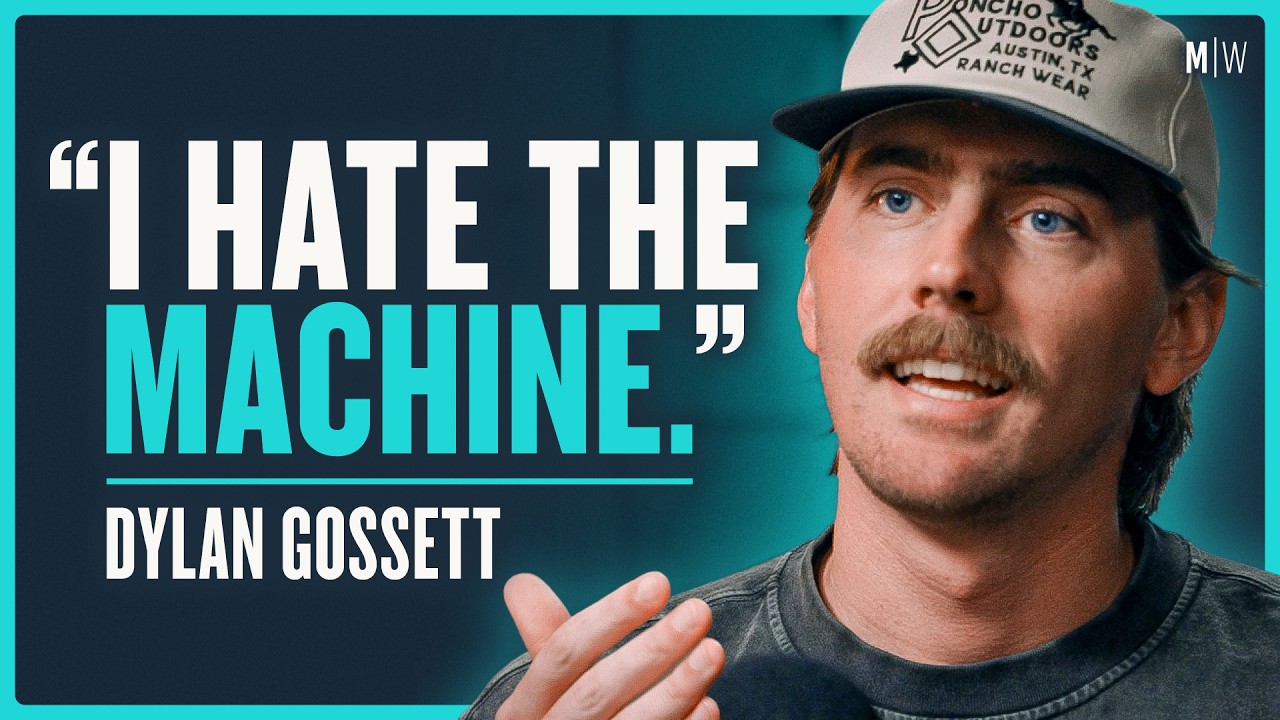
Chris Williamson hosts country artist Dylan Gossett for a live performance and conversation about his breakout hit “Coal,” the mechanics of viral music, songwriting authenticity, AI’s creative threat, and the strange psychology of male vulnerability in modern country.
The Breakout Song “Coal” and Its Unlikely Path
Dylan wrote “Coal” in roughly 25 minutes while living in Austin and working grueling 20-hour days in event operations at Circuit of the Americas during F1 season.
The song sat unreleased for 1–2 years; he only posted it after a camping buddy with A&R instincts heard it, voice-memoed it, and insisted he do something with it.
His wife suggested TikTok; he hated the platform but posted a single raw clip that eventually drove half a billion streams.
He posted the song only 7–10 times total, rejecting the industry playbook of endless pre-saves, teaser clips, and paid amplification.
The lyric “they say pressure makes diamonds / how the hell am I still coal” captured a specific feeling: working hard, seeing no visible progress, and feeling lonely in the grind.
Dylan believes the song only resonated because he had lived the life behind it — blue-collar hours, real relationships, and a frame of reference outside music.
Navigating the Music Business Without Losing the Craft
He references The E-Myth Revisited: a baker who opens a shop, scales it, and stops baking — a warning that success squeezes out the very work that made you great.
The “hedonic treadmill” applies to goals: four years ago he would have killed to stress over an album rollout; now those stresses feel like burdens.
Touring economics are brutal: stadium shows cost fans thousands (tickets, parking, hotels, babysitters), while a $15 club show down the road competes for the same discretionary dollar.
“Blue dot fever” — tours cancelling or underselling — stems from oversaturation, dynamic pricing, and cost-of-living pressure all hitting at once.
Agents can no longer rely on the old model of returning to a city after an album cycle and growing 20%; fans now pick one show a year and often choose the new act.
Dylan’s team has always optimized for ticket sales over viral moments; he deleted most country-music accounts from his feed to protect his headspace.
Authenticity, Polish, and the Algorithm’s Incentives
The industry quickly commodifies “authenticity”: once a raw style works, teams engineer imperfections (hat falling on keys, staged “natural” moments).
Dylan refused to run ads or follow the standard rollout formula, likely leaving reach on the table but preserving a line he won’t cross.
He sees a barbell: super-produced pop-country on one end, stripped-back raw acoustic on the other; the mushy middle is where acts die.
Country’s Billboard share jumped from 7% (2020) to 27% (2025) while rap halved; he expects cycles to swing back eventually.
“Truck edits” and niche Instagram ecosystems (moody truck videos with lyrics) are now paid placement vehicles; they boost exposure but don’t guarantee a hit if the song isn’t strong.
He can often hear when a trending track has a marketing machine behind it — thousands of coordinated clips, pre-save campaigns, playlist pushes.
Songwriting Process: Gibberish, Couch, and Ownership
Songs start on his couch at night, noodling guitar while his wife watches TV; he sings gibberish until consonants and vowels coalesce into a line.
“Headed Back to Austin” began with a melody and the phrase “I’ll take burning on the weekend straight down 29”; the rest followed.
He co-writes with his brother Blake (multi-instrumentalist) and occasionally others, but his best material comes alone in his living room.
He values lyrical ownership: if he writes a chorus and verse, he resists outside help on the bridge because “I want to complete my thought.”
He would consider cutting outside songs (he did for Blake’s “Rambling,” the album title track), but only if the connection feels close and the song is undeniable.
He turned down Nashville-style writing rooms; the transactional, scheduled creativity doesn’t work for him.
AI, Effort, and the Meaning of the Win
He and Chris discuss the “fading affect bias”: bad memories fade, good ones persist, so older selves have less emotional evidence than younger selves — a dangerous illusion of wisdom.
Chris’s writing rule: do the hard part yourself (the “finishing garnish”) because easy wins are forgettable; hard ones change you (Mark Manson line).
Dylan agrees: the satisfaction of a song is tied to the failure and repetition that preceded it; AI shortcuts erase the highs and lows that make the win matter.
Handwritten letters vs. AI-generated cards: the effort is the signal; convenience encroaches on every domain (sit-down → drive-thru → Uber Eats; movies → YouTube → Shorts).
He draws a line at artistic and sentimental work: washing machines are fine, but letting AI write the chorus or the love letter crosses into “something else making the music for you.”
Rhyming dictionaries and DAWs are tools; generative AI that writes the lyric or melody feels like a different category — he trusts the “ick radar” to know the difference.
Male Sadness as Country’s Dominant Mode
Country gives men a socially sanctioned outlet for vulnerability: singing “Coal” at a show lets blue-collar guys put arms around each other and scream lyrics they’d never say in a group chat.
Female country often codes as empowerment; male country codes as confession — the crowd reacts “brother, I got you” to men, but “here we go again” to women singing heartbreak.
Kelsea Ballerini’s “I Guess They Call It Fallin’” (Lexapro, vape, career vs. kids regret) struck him as a rare raw female counterpart.
The “tortured hero” trope lets men open up only behind a chord progression — artistic distance as defense mechanism.
Most men lack this outlet; therapy, Substack, or drinking with buddies are the alternatives.
Audience Capture vs. Criticism Capture
Audience capture: iteratively feeding the crowd what they reward (bombast, outrage) until you resent the avatar you’ve become.
Criticism capture (Ethan Strauss): pre-emptively caveating, throat-clearing, or performing aggression to front-run hate — equally warping.
Both dynamics turn creators into puppets of reward/pain levers; social media’s instant feedback (green-room tweets mid-show) accelerates the distortion.
Dylan tries to stay week-by-week on singles, resisting the waterfall-release machine; he admires Turnpike Troubadours dropping A Cat in the Rain with zero singles, just a desert billboard.
New Album Rambling and What’s Next
Album Rambling releases September 25; title track written by his brother Blake.
He performed “Clothesline” live — a mid-tempo heartbreak song with a clothesline metaphor (“baby, I know you’re just gonna hang me out to dry”) — likely a single.
He wants to expand his sound (drums, slide, uptempo) without alienating the core acoustic fanbase; cites Billy Joel and Bob Dylan (Newport electric moment) as models of deliberate reinvention.
The tension: serve the audience that brought you here vs. avoid trapping yourself in a trope (“acoustic sad guy”).
He remains grateful, grounded by his wife, and focused on ticket sales as the true north metric.