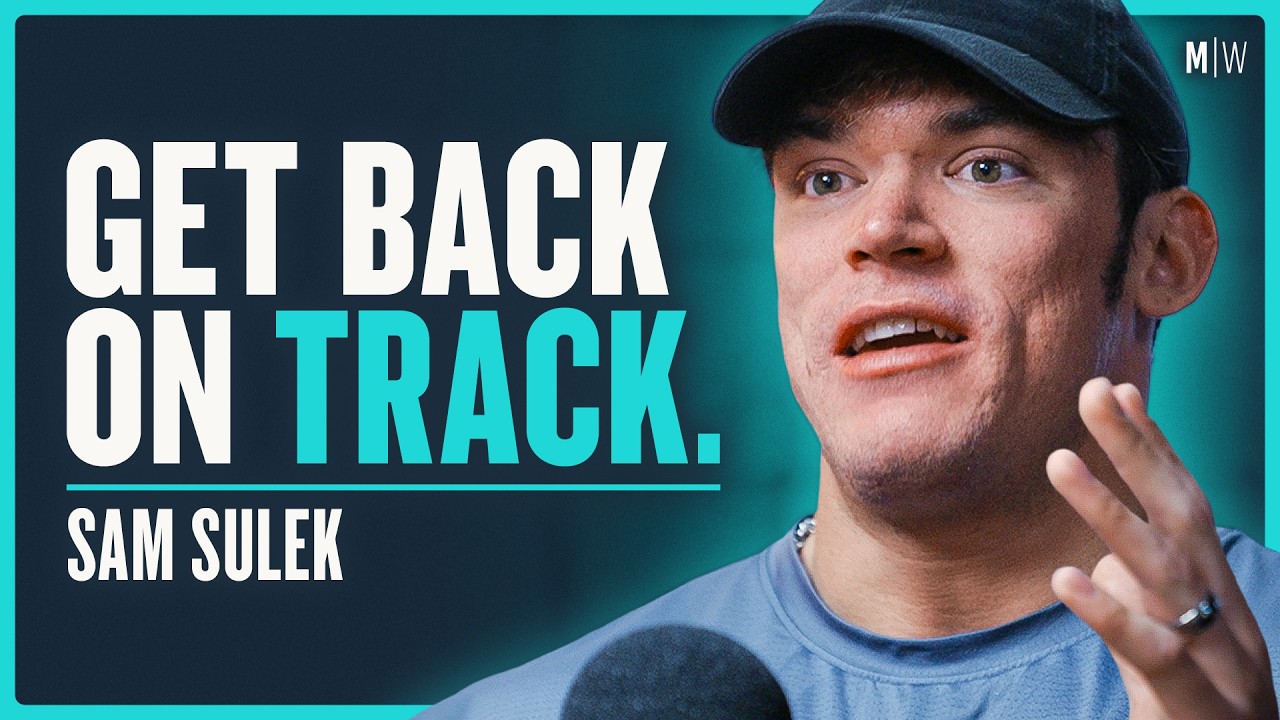
Sam Sulek, a 24-year-old bodybuilder and YouTuber with over 1,200 daily training videos, discusses his philosophy of progressive self-improvement, the psychology of sustained effort, and how he navigates fame while staying grounded in first principles.
The Core Philosophy: Raise Your Own Bar Relentlessly
Sam’s central mental model is gradual, endless bar-raising: meet your current standard, then immediately set a higher one, making “going harder” feel normal over time.
He compares this to the strongest guy in the gym — his “crazy” effort is just his baseline; the perceived intensity gap exists only because observers haven’t adapted to that level.
He aims for “effortless effort” — practicing without striving — where maximal output becomes seamless and automatic, not a dramatic event.
The real driver of results is intensity, not exercise selection: a basic dumbbell curl done with extreme focus beats a “perfect” exotic movement done half-heartedly.
He prioritizes training hard over training smart (though both matter), arguing most people over-optimize programming while under-delivering effort.
Mastering Basics Beats Over-Optimisation
Exercise science studies use “average” sedentary subjects (e.g., 5’9”, 180 lbs, 2,000 kcal, 50 g protein, no cardio) — not applicable to someone training seriously.
Intellectual value (reading about new supplements, mechanisms) ≠ practical value (actually doing the work); the latter compounds, the former often becomes procrastination.
The “grind slop” trend reflects burnout from over-optimizing every daily variable (perfect morning routine, exact sleep timing, etc.), creating fragile systems that collapse under minor disruption.
Robust principles (regularity, darkness, cold, quiet for sleep; protein, carbs, fats for diet) work across environments; rigid tactics break when life intervenes.
Sam’s “boy kibble” meals — meat, starch, sauce/veg mixed in a big bowl — exemplify this: unglamorous, repeatable, nutritionally complete, and enjoyable in two ways (taste + goal alignment).
Managing Public Exposure and Private Life
Sam announced his marriage after years of silence, illustrating a “digital hijab” approach: deliberate boundaries between public content and private life.
He warns creators: once you open a door (relationships, family, drama), you cannot close it; future partners and audiences will hold you to what you’ve shared.
Fitness content is inherently repetitive (hundreds of “chest day” videos); creators who chase views often pivot to personal drama, which Sam avoids by keeping his off-camera life separate.
Marriage shifted his time horizon: he now values long-term building (family, legacy) over short-term optionality, seeing commitment as a performance enhancer — a partner who loves who you are, not what you do.
The Winter Arc: Training When Motivation Vanishes
Winter removes external motivators (sun, social events); the physiological dip (low vitamin D, cold) is real but the psychological wiring matters more.
Sam’s framework: “What would me in 3 months want me to do right now?” — act on behalf of your future self, even (especially) when you don’t feel like it.
Motivation is an unnecessary middle step; you can execute without it. The discipline to “go through the motions” during a funk preserves momentum so you don’t wake up months later with 50 lbs gained and zero progress.
Downward spirals are self-reinforcing: skip gym → eat trash → sleep poorly → metabolism drops → gain fat → feel worse → repeat. Upward spirals work the same way: train hard → eat/sleep better → recover → train harder → see progress → get motivated.
Entering 2027 With Momentum (Start Now, Not January 1)
Most people wait for January 1; Sam suggests easing in now — get the membership, do one session, then two, then three. The jump from 0 to 1 is the hardest and highest-ROI step.
“I could do it if…” is almost always “I don’t want to.” Honesty about preference beats rationalization.
For someone in a downward spiral: find someone who documented the exact path from your current state to where you want to be (e.g., 500 lbs → 200 lbs). Monkey-see-monkey-do is the most potent motivator because it proves possibility.
Bodybuilding Culture: Characters Carried the Sport
The 1990s–early 2000s (Arnold, Yates, Coleman, Cutler, Warren, Green, Heath) had WWE-level characters; the show was the spectacle, and personalities drove fan investment.
Social media democratized access but diluted mystique: everyone posts prep content daily, so the stage show lost its theatrical punch. Relatability replaced larger-than-life personas.
Sam and Chris Bumstead are rare exceptions who broke through with authenticity — not manufactured relatability, but simply doing what they’d do anyway, on camera.
Learning From Chris Bumstead
Bumstead carries a “reality distortion field” — intense focus that quiets a room — yet remains grounded, introverted, and family-first. His “dad mode” life (church, Costco, coffee) is the real flex.
Sam respects that Bumstead never sought fame; it found him. The sport got a benevolent figurehead (like Rogan for podcasting) — someone who lifts others up rather than gatekeeping.
Self-Coaching: Ownership Over Optimization
Sam coached himself for his first two shows (NPC qualifier → Arnold pro debut) because:
He enjoyed the autonomy; a prescribed plan feels like homework, self-designed work feels like play.
He avoided the “coach credit/blame” dynamic: if he looked good, people would credit the coach; if bad, the coach would blame his non-compliance.
He accepted the risk: if he failed, it was his failure — a mental flex he valued more than a potentially optimized outcome.
He’d consider a coach only if targeting an Olympia qualification, where elite-level peaking nuances (sodium, water, carb timing, psychological management) exceed self-taught knowledge.
Peptides, GLP-1s, and the Hype Cycle
Sam co-owns a peptide company (transitioning to telehealth/doctor-prescribed model Oct 1). He uses BPC-157/TB-500 for recovery, GHK-Cu for skin/inflammation — legitimate tools, but massively overhyped on TikTok by uninformed teens.
The Ozempic/GLP-1 frenzy mirrors past supplement cycles (ashwagandha, turkesterone): real utility, but delivery method (injections) triggers “medical/icky” bias. If it were a shake, acceptance would be instant.
Anchoring + adoption drive perception: caffeine is “normal” because everyone uses it; MK-677 is “cheating” because few do. Over time, both shift.
Sam hasn’t tried GLP-1s — his appetite sits in a “sweet spot” — but acknowledges they’re a lifeline for people with high hunger drive (genetic/environmental luck of the draw). Principles (calories, progressive overload, sleep) are universal; tactics must match individual biology.
Principles Over Tactics: The Durable Edge
Tactics are fragile (work only in specific conditions); principles are robust (work everywhere). Sam’s 8 years of self-directed training gave him the principles to self-coach a pro prep.
He treats knowledge like a sponge: extract concentrated wisdom from experts (books, legends like Platz, Yates, Cutler) but integrate it into his framework, not outsource agency.
The ultimate superpower: the ability to wake up one day and say “enough” — change direction instantly. Momentum compounds both ways; the Matthew Principle applies to habits.
Where to Find Sam
YouTube: @SamSulek (daily uploads, ~1,200 videos)
Instagram: @SamSulek
Content: raw, unscripted training sessions — “if you want to see a good workout, that’s for sure”