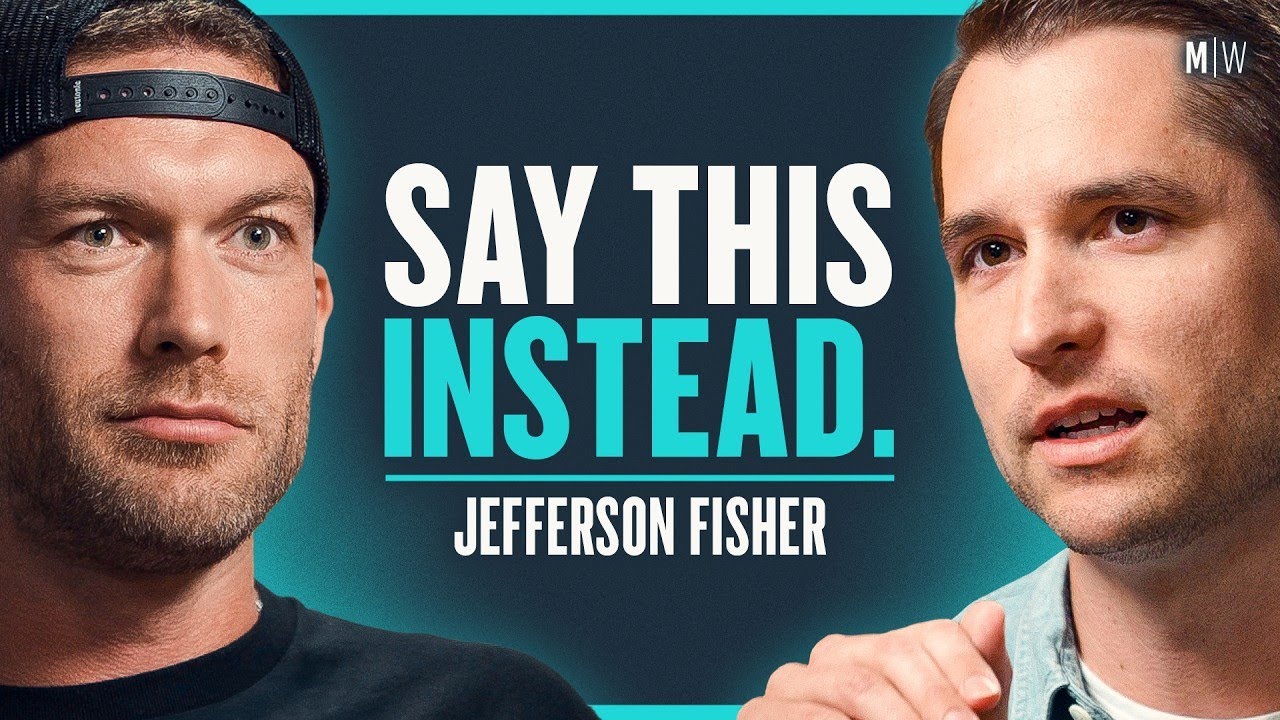
Jefferson Fisher, a trial lawyer turned communication coach, breaks down why most people struggle with difficult conversations and offers practical tools to stay calm, be direct, and connect more deeply. The core problem is that communication was rarely taught, only modeled, and many people grew up seeing conflict resolved through yelling, aggression, or avoidance. As a result, most adults lack the skills to navigate disagreement without either shutting down or escalating. Fisher draws on his experience in courtrooms, depositions, and personal relationships to show that the same principles that work in high-stakes legal settings apply at home, at work, and in everyday life.
Why Conflict Feels So Scary
Conflict requires courage, not aggression. Many people mistake yelling for strength, but staying calm and working through something hard takes far more bravery. Fear of vulnerability is a major driver, especially among men, who often treat emotional openness as a no-go zone when it is exactly what is needed.
People lose control quickly because it is the path of least resistance. Yelling and defensiveness require zero effort. Slowing down, breathing, and responding calmly demands real strength and goes against the body’s natural fight-or-flight wiring.
The body cannot tell the difference between social danger and physical danger. When someone feels confronted, offended, or that their autonomy is being questioned, the same physiological response kicks in as if a bear were behind the bush: pupils dilate, fists clench, jaw tightens, breath holds. This is why people often do not realize they are yelling, and why phrases like “we need to talk” trigger immediate anxiety.
Open loops are where fear expands. Ambiguous messages, such as “we need to talk” with no context, or a thumbs-up emoji instead of a real response, create a vacuum that the other person fills with speculation and dread. Starting with context and the headline, not the backstory, prevents this.
How to Hold Space for Someone
Theo Vaughn sitting with Sean Strickland is a masterclass in space holding. When Strickland became emotional, Vaughn did not try to fix it, relate to it, or solve it. He simply said, “We don’t have to talk. I can just sit here with you.” That is what holding space looks like in practice: no performance, no fixing, just presence.
“Your emotions aren’t too big for me.” This line, from Connor Beaton, communicates that there is room for the other person to be fully themselves without fear of being dismissed, abandoned, or judged as “too much.” It directly counters the fear many people carry that their emotions will overwhelm the other person.
“My love for you is big enough to handle this.” Fisher uses this with his children to communicate that love is not conditional on performance or behavior. It is a model for how anyone can reassure someone that they do not need to earn acceptance through being perfect.
Tools to Regulate Yourself in the Moment
Make your breath the first word you say. Before responding, take a breath. This is the single most effective way to slow down a conversation and prevent reactive escalation. Fisher teaches this to every client before depositions and cross-examinations.
Name what is happening out loud. Saying “I can tell I’m getting defensive” or “I can tell something else is coming up for me” invites the other person into your internal experience rather than leaving them to guess. It transforms the moment from a confrontation into a collaboration.
Use timeouts generously, but commit to returning. A timeout of two minutes is not enough. Research suggests it takes around 20 minutes to regulate after a high-emotion exchange. The key is to signal that you are not abandoning the conversation: “I need some space, but I will come back to this later this afternoon.”
Schedule important conversations in advance. Do not ambush someone with “do you have five minutes?” Instead, say, “I’d like to talk to you about something important to me. When’s a good window this week?” This lowers anxiety and gives both people time to prepare.
Write it down before you speak. Putting pen to paper on what you want to say, why you want to say it, and what you are asking the other person to do brings clarity. It also frees your brain from holding the concern in working memory on repeat, which Fisher calls the “worry list” approach, borrowed from Stephen Covey’s idea of scheduled worry time.
What Anger Is Really Hiding
Anger is almost always a secondary emotion. Underneath anger is usually fear, sadness, or grief. Fisher references the line: “I sat beside my good friend Anger, and he turned to me and said, my name isn’t Anger, it’s grief.” In relationships, anger that seems disproportionate is often an old script playing, rooted in childhood experiences of feeling controlled, unsafe, or not enough.
Anger evolved as a deterrent, but it no longer works for behavior change. Before law enforcement, being loud and scary was the only way to signal that a line had been crossed. Now, anger almost never leads to the other person changing their behavior. The harder you push, the more hardened they become. The more you tell someone they are wrong, the more convinced they are that they are right.
Shame often shows up as defiance. When someone is met with shame, the surface response is anger and defensiveness, but underneath is usually self-loathing and sadness. This is especially common in men, who may default to stoicism rather than risk showing vulnerability.
How to Set Boundaries Without Blowing Things Up
A real boundary has three parts: what you will not do, what happens if they continue, and what you are willing to walk away from. Simply saying “I don’t like that” without consequences is not a boundary; it is a preference.
Frame boundaries around your own actions, not their behavior. Rather than “you can’t yell at me,” say “I don’t respond to that volume.” This is a power move that keeps you in control and confident, which naturally makes the other person feel less in control.
Timeouts are not abandonment. There is a critical difference between slamming the door and leaving versus saying, “I’m not leaving this conversation. I can see you need space, and I’m good with that. Can we talk about this later this afternoon?” The latter keeps the team intact.
Use “seems like” and “sounds like” to draw people out. Borrowed from Chris Voss, phrases like “It seems like there’s something on your mind” or “Sounds like that really matters to you” invite the other person to open up without putting them on the defensive.
Dealing with Passive Aggression
Passive aggression usually originates in childhood. It develops when someone learned that their direct needs would not be met, so they started expecting others to read their mind. They use the back door instead of the front door because voicing needs directly did not feel safe.
Ask “What’s coming up for you?” This disarms passive-aggressive behavior by signaling that you sense something else is going on and you are willing to help bring it to light. It shifts the dynamic from guessing to direct communication.
Recognize that passive aggression once had utility. At some point in that person’s life, holding things in and expecting others to figure it out was a survival strategy. Understanding this does not excuse the behavior, but it explains it.
How to Deliver Bad News
Start with the hard news first. Do not bury the lead with pleasantries, gratitude, or past-tense language. If you are breaking up with someone, the first words out of your mouth should be: “This isn’t a relationship I can see myself continuing in.” If you are firing someone: “This news is probably going to shock you. I need to let you go.”
Being direct is kinder than being nice. “Nice” focuses on surface pleasantries and avoids the truth. “Kind” cares enough to be honest, even when it hurts. People can take bad news. What they cannot take is being left in an open loop, guessing why.
Start with “no” first, then gratitude, then kindness. Do not say “I’d love to, but I can’t” because the word “but” deletes everything before it. Instead: “I can’t make it. Thank you so much for inviting me. I’m sure it’s going to be a great time.”
Treat difficult conversations like a cold plunge. The first few seconds are a shock to the system, but then clarity comes. The worst approach is a slow, agonizing climb where you never actually say the thing. Get to the hard part quickly, and the rest of the conversation becomes easier.
Do not absorb the other person’s emotions. Empathy is a superpower, but feeling so much of someone else’s pain that you avoid telling them the truth is not helpful. You can feel their feelings without carrying them. They get to choose what to do with their emotions; you do not have to fix it.
Responding to Insults and Meanness
Give five to seven seconds of silence. When someone says something ugly, let it sit. Do not catch it like a ball in tennis. Just let it fall on the table. Then ask: “You good with that? You still proud of that?” This puts a spotlight on their behavior without you escalating.
Ask them to say it again. Almost no one can repeat an insult on command because they do not want to see their own ugliness reflected back. They were expecting a dopamine hit from your reaction, and instead they got a mirror.
Ask “Did you mean for that to sound as insulting as it did?” This questions the root of their intent. It forces them to either admit they meant to hurt you or back down. It also works as a reality check for ambiguous text messages where tone is unclear.
Liars and manipulators want anger; they fear calm. If someone is lying or being offensive and you respond with measured, controlled curiosity, it is far more unsettling to them than if you yell back. Slowing down, asking open-ended questions, and saying “I need to come back to that later” are devastatingly effective.
Why Being Right Is Overrated
Connection matters more than correctness. The person who always has to be right is usually the loneliest person in the room. Winning an argument and losing the relationship is a net loss. Nobody wants to be with someone who cannot back down.
Use perspective language instead of disagreement language. Rather than “I don’t agree with that,” say “I see things differently” or “I have a different take on that.” This comments on the perspective rather than attacking the point, which invites dialogue instead of defensiveness.
Type one empathy is feeling someone’s emotions. Type two empathy is understanding how they arrived at their perspective. Most people can do the first. The second, believing that someone arrived at their view through a coherent process even if you do not share it, is much harder and much more valuable.
We are obsessed with being right because our sense of worth is tied to it. Nobody thinks they are the villain in their own story. But moral superiority is not a substitute for genuine understanding.
Detecting Deception
Liars cannot stand silence. If someone has lied and you let it sit or say “I need to come back to this,” they become uncomfortable. Truth-tellers are at peace because they know what is true. Liars know what is not, and they will often push back disproportionately: “How could you not possibly believe me?”
Liars ask you to solve the problem for them. They will ask “What do you think I was doing?” or “What do you think I should have done?” A truth-teller does not need you to construct their reality for them.
Indignation can be a performance. Outrage can mirror what an innocent person looks like, so it is not a reliable indicator on its own. The key is whether the person can tolerate you not believing them.
Repairing After Conflict
Gold standard repair has three steps: ownership, acknowledgment, and reaffirmation of the team. Own what you said without blaming the other person. Acknowledge how it likely made them feel. Then communicate that you are still working toward the same goal together.
Bad times are a better predictor of relationship longevity than good times. Very few people leave a relationship because there were not enough peak moments. Most leave because there was too much rupture without repair. The hard conversations are invitations to grow deeper together.
Choose a partner you can communicate with. Shared interests and attraction matter, but without strong communication, the relationship will not survive the stress of kids, schedules, and life. You need someone who can put up with your ugly moments, whose love is big enough for your bad days, and who expects you to own and grow from those moments.
The One Principle to Remember
One conversation is rarely enough. Putting all the pressure on a single moment increases anxiety and the fear of getting it wrong. Instead, frame important discussions as ongoing: “I’d like to have a conversation with you about this over the next few weeks.” This lowers the stakes of any single exchange and communicates that the relationship is bigger than any one disagreement.