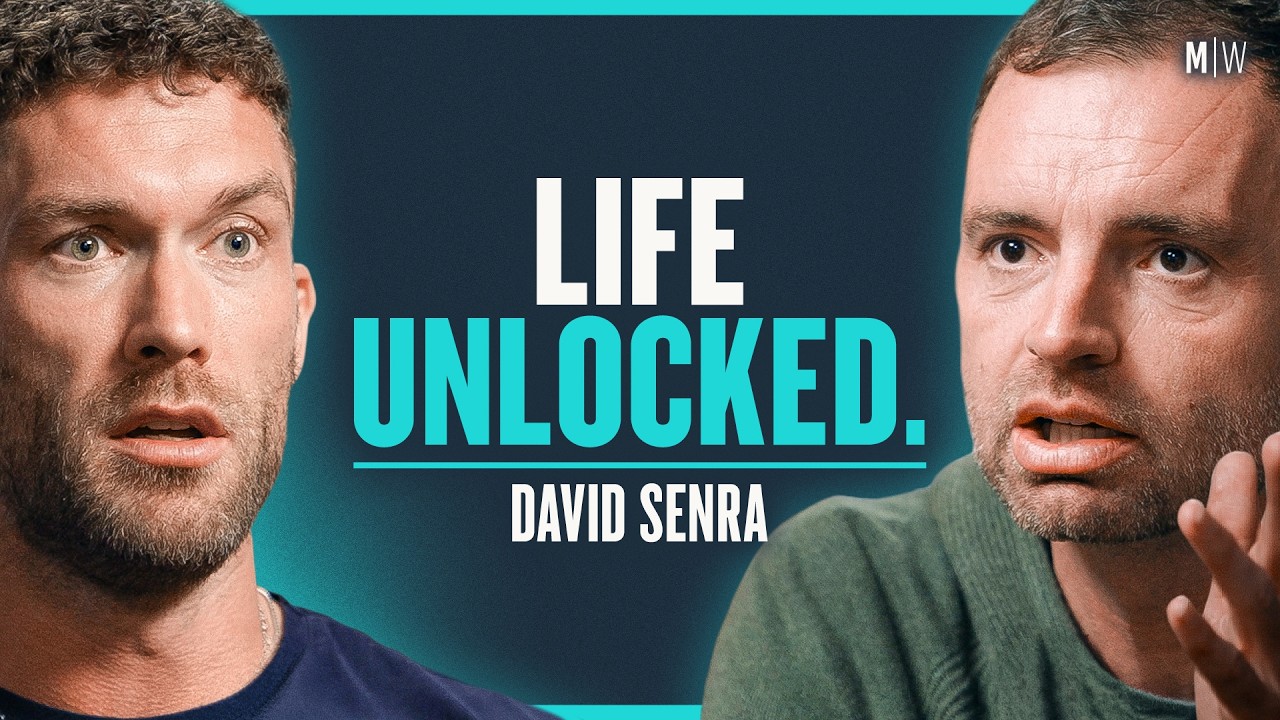
David Senra, host of the Founders podcast, joins Chris Williamson to distill patterns from hundreds of biographies of history’s greatest entrepreneurs and creators. The conversation moves across Rick Rubin’s “lazy workaholic” paradox, the motivational power of a chip on one’s shoulder, the importance of curating one’s information diet and social circle, the winning logic of simple ideas taken seriously, listening as a competitive advantage, wisdom as problem prevention, creating for an audience of one, stepping outside one’s life to audit it (Grand Theft Life), the tension between entrepreneurial drive and romantic relationships, James Dyson’s biography as a masterclass in persistence, and why an internal scorecard — respect from those you admire — beats external metrics.
The “Lazy Workaholic” Paradox
Rick Rubin describes himself as a lazy workaholic: he has to force himself to work every day, does not wake up excited to go to the studio, and would rather be outside naked in the sun.
Despite four decades at the top of music production, the daily grind remains a struggle; he endures it for the “magical act of creation” — the moment a problem solves itself after months of failure.
Rubin’s context window for music history is encyclopedic; he pulls obscure references (e.g., a Beatles technique from 30 years prior) to unblock sessions, and uses random book passages to spark lateral thinking.
Thousands of listeners resonated with this confession: they love having worked, not the work itself, and must override daily resistance to show up.
Chips on Shoulders Put Chips in Pockets
Josh Wolfe’s maxim reappears across entrepreneurial history: a sense of grievance or having something to prove fuels extraordinary effort.
AppLovin founder Adam Foroughi (now ~$170B market cap, ~$6B annual cash flow, 400 employees) was rejected by every top VC when he offered 25% for $1M; competitors got funded instead. He made “drive them out of business” the company goal.
Adam hires “misfit toys” — high-school dropouts, people kicked out of homes, those overlooked by prestige firms. His number two, Raph, started at 17, lived in the office, and is now a multi-billionaire shareholder.
Kanye West’s 2013 Breakfast Club clip: “I’m 10 years ahead mentally and trapped in today’s time.” He practiced Grammy speeches before a single release; belief preceded ability.
Shia LaBeouf: “I had to convince myself my opinion about my life was the most important opinion” and cut out anyone who said he wouldn’t make it.
The “lonely chapter”: moving from an environment where you don’t belong to one where you do, stuck in a messy middle where old peers don’t understand and new ones don’t yet exist. Hope with disappointment hurts more than apathy with acceptance.
Feed Your Mind or Fall Behind
NF lyric: “The mind is a powerful place and what you feed it can affect you in a powerful way.”
Toby Lutke (Shopify founder, ~$200B company) brainwashed himself out of public-speaking fear: wrote “I love public speaking” 100× daily for weeks; now loves it and is phenomenal on stage.
Information diet: read old books, talk to smart interesting people. Cut pessimistic/negative people entirely (“root and stem”).
George Mack’s “sofa friends vs. treadmill friends”: after some people you need to lie down; after others you want to run. Audit content the same way — does it make you feel capable, abundant, energized?
Joseph Pulitzer biography: invented yellow journalism (sensationalism, violence, sex) because it hooks human attention. Reading that history inoculates you against modern algorithmic equivalents on X/Instagram.
Find a Simple Idea and Take It Seriously
Charlie Munger maxim: extreme business success comes from minimizing/maximizing one or a few variables.
Todd Graves (Raising Cane’s): remade In-N-Out’s simplicity for chicken fingers. Menu unchanged for 30 years (3, 4, or 6 fingers; coleslaw, toast, fries). 915 company-owned stores, growing faster in year 30 than ever. Business card: “Fry Cook, Cashier, CEO.” Still works drive-thru and fryer.
Graves owns >90%, rejected multi-billion-dollar offers; believes God put him on earth to be good at chicken fingers, build wealth, then help people.
Joe Hudson’s daughter: “I’ve got an idea I wouldn’t sell for a billion dollars.” Better framing than “billion-dollar idea.”
Senra: not interested in “start, scale, sell.” Wants the last company — the one you couldn’t pay him to stop. Exercise should be death if you love what you do.
Kobe found his path at 13; Henry Leland founded Cadillac at 60, Lincoln at 70. No deadline, but all experiences should funnel toward the infinite game.
Failure Is a Privilege of the Active
Dana White (UFC): “The loudest boos come from the cheapest seats” (from Russ). Critics will always complain; cut the noise.
“Making mistakes is the privilege of the active” — reframing errors as evidence you’re trying. High-trust move: own mistakes instantly.
Dana’s office wall after a public incident: “May God have mercy on my enemies because I won’t.” Clip: “Bet against me. Tell me it’s going to fail. I love every minute of it.”
Dana’s partner: first profitable year, Dana would make $1M. “Wow, that’s incredible. If I just do that, I could do this forever.” Now multi-billionaire.
Todd Graves same energy: needs people to tell him he’ll fail; uses it as fuel.
Why Listening Is the Real Advantage
Michael Jordan (per Roland Lazenby’s 700-page biography): “Successful people listen. Those that don’t listen don’t last long.” Jordan was a sponge for useful information.
Ed Catmull (Pixar founder, worked with Steve Jobs 24 years): Steve fired two Pixar board members because “they never disagree with me. If they never disagree, they add no value.”
No upside in being wrong. Seek disconfirming feedback; don’t confuse ignoring advice with self-belief (that’s local maxima).
Charlie Munger: when convincing someone, state the best counterargument first, then rebut it. Shows depth of thought.
Strong opinions, loosely held > loose opinions, strongly held (most people “slide not decide” into worldviews).
Wisdom Is Prevention — Don’t Solve Problems, Avoid Them
Munger: “Wisdom is prevention.” Problems are inevitable; the wise avoid those under their control.
Munger’s tragedy: divorce, 9-year-old son dying of leukemia (pre-cure), walking Pasadena streets weeping. Yet unshakeable later.
Prescription: surround yourself with a handful (4–5) of great people you’ll do life with; find great work and stay in it. This eliminates most controllable problems.
“Most people are rat poison” — avoid low-quality, evil people.
Dating insight: easier to partner with someone who compensates for your shortcomings than to fix them. Ruthlessly edit who gets access to you.
Daniel Ek (Spotify): “Your life is your relationships.” Ruthlessly edit your circle; high-platform people attract performative behavior — vet via trusted friends.
Senra: small circle, deep relationships. Comfortable alone reading or solo podcasting. No need for constant socialization.
Create for Yourself First — The House on the Mountain Test
Rick Rubin (Creative Act): imagine a house on a remote mountain no one will ever see. Do you still decorate it perfectly? That’s your revealed preference.
Rubin makes music he wants to hear; assumes ~10M others share his taste. Senra and Williamson make podcasts they want to listen to; both listen to their own episodes pre-release.
Rule of thumb: would you consume your own content? If not, don’t post it. (30-second pause = no.)
Raid Your Own Life — Grand Theft Life
Tim Urban (Wait But Why) on Elon: ability to step outside himself like a GTA character. “My character needs money → do jobs. Needs cardio → gym.”
Toby Lutke: views himself as a corporate raider who just took over Shopify. Previous management was crazy; what would the new owner change? Must step outside daily operations to see blind spots.
Hawaii late-night talks: each could see the other’s relationship blind spots instantly; neither could see their own.
George Mack’s “evil mustache twin”: what would a ruthless version of you do to beat you? More decisive, less vacillation, fewer chances for repeat offenders.
Senra’s audit: distractibility is the enemy. Daniel Ek’s advice: “Stay away from the circus. Just sit in a room and make podcasts.” No conferences, no dinners. Life is simple: read, podcast, health, friends.
Are Entrepreneurs Bad at Relationships?
Arnold Schwarzenegger’s girlfriend’s 300-page memoir: “Why is this guy not acting normal?” Because he’s Arnold — driven. Outcome: need a supportive spouse or no spouse at all.
Consultant to 100+ famous people: “expansive personality” — appetite comes with eating (Napoleon). More success → more hunger in every domain except romance, where exclusivity is expected. Infidelity common.
Jimmy Iovine (The Defiant Ones doc, 5 decades music, sold Beats to Apple for $3B): most gifted people cannot handle success. Four buckets of self-destruction: drugs, alcohol, megalomania (80K fans screaming → think you’re a god → stop working → death spiral), wrong partner.
Iovine: “You’re not destroyed by a competitor. You destroy yourself.” Wrong person can literally destroy you.
Andy Stump (Navy SEAL): built identity on “I don’t quit” → amazing SEAL, stayed in bad marriage a decade longer.
Public virtues (resilience, hypervigilance, non-quitting) become private vices. Modern social media blurs public/private; comparing your relationship to others’ highlight reels is destructive.
Senra: don’t be hyper-rational in romance. Be a little irrational. Core filter: “Make sure she’s a good person — not selfish, wants good for you.” Good people are rare.
Senra’s self-lie: “I’m a loner, don’t need people.” Truth: high-quality relationships are his drug of choice. Addicted to the energy of great conversations (treadmill friends).
Workaholism rooted in terror of becoming family losers. Work = independence, control, ability to help family. Realization: relationships now #1 priority, work a close #2. Will forgo some professional success for deep romantic bond — that’s what makes life worth living.
The One Biography Every Ambitious Person Should Read
James Dyson, Against the Odds (first autobiography). If you read one book, read this.
78 now, owns 100% of ~$60–80B private company. Friend’s acquisition flyer returned: “Fuck you. Family heirloom. Not about money.”
Book covers 15 years of failure: 5,126 failed prototypes, #5,127 worked. Worked in carriage house (detached workshop) in Bath, England. Kids grew up watching dad fail (age 4, 7, teenager). Cried himself to sleep.
Senra read it 5×, highlights hundreds of times. Kept him going during 5.5 years of no podcast revenue.
Meeting Dyson: fingers twice as wide as normal — lifetime of tinkering. Organizing principle: “I pick up a product. How can I make it better? I make it better. Put it down. Pick it up later. Repeat for 45 years. Never stopped.”
Antidote to “go to sleep on a win, wake up with a loss” (Conor McGregor quote). Dyson loves the activity itself; everything is a puzzle to improve.
Don’t Let Others Define Your Success
Eminem 1999: “I ain’t in this for the money. I’m in here for the respect. If I had a trillion dollars and fell off, I’d be the most miserable person.”
2003: “A plaque and platinum status is whack if I’m not the baddest.” Peers wanted platinum plaques; he wanted to be the best, not the biggest.
Senra/Williamson: obsess over craft (guest selection, structure). Jeff Bezos: “Build something you can tell your grandkids about — such things are not meant to be easy.”
Senra’s daughter (14): proud when MrBeast (fan of Founders) and Todd Graves tell her dad’s work matters. Worth more than money.
Internal scorecard (Steve Jobs): “Did I make something I’m proud of?” Danger: cutting prep corners (CliffsNotes instead of full book) = failure.
David Ogilvy: “You can’t save souls in an empty church.” If you believe your work helps people, moral obligation to distribute widely.
Entrepreneurship = French entreprendre (has ideas and does them). Podcasters, filmmakers, athletes, Amazon builders — all entrepreneurs.
Positive-Sum Peer Relationships
Early filmmakers (Lucas, Spielberg, Coppola, De Palma): friends, traded secrets, watched each other’s cuts, gave feedback. Spielberg’s Jaws success didn’t hurt Lucas’s Star Wars.
Senra ↔ Williamson: share podcasting data openly. Acquired hosts (David Rosenthal, Ben Gilbert) made $3M from an idea Senra passed from Rob Moore/Andrew Huberman. Senra stole same from Rogan.
John Coogan (TPBN): pushed 5-camera then 7-camera setups; profile shot enables documentary-style pivot framing (minor chord moment).
Rising tide lifts all boats. Journey pointless if not shared with people you respect.