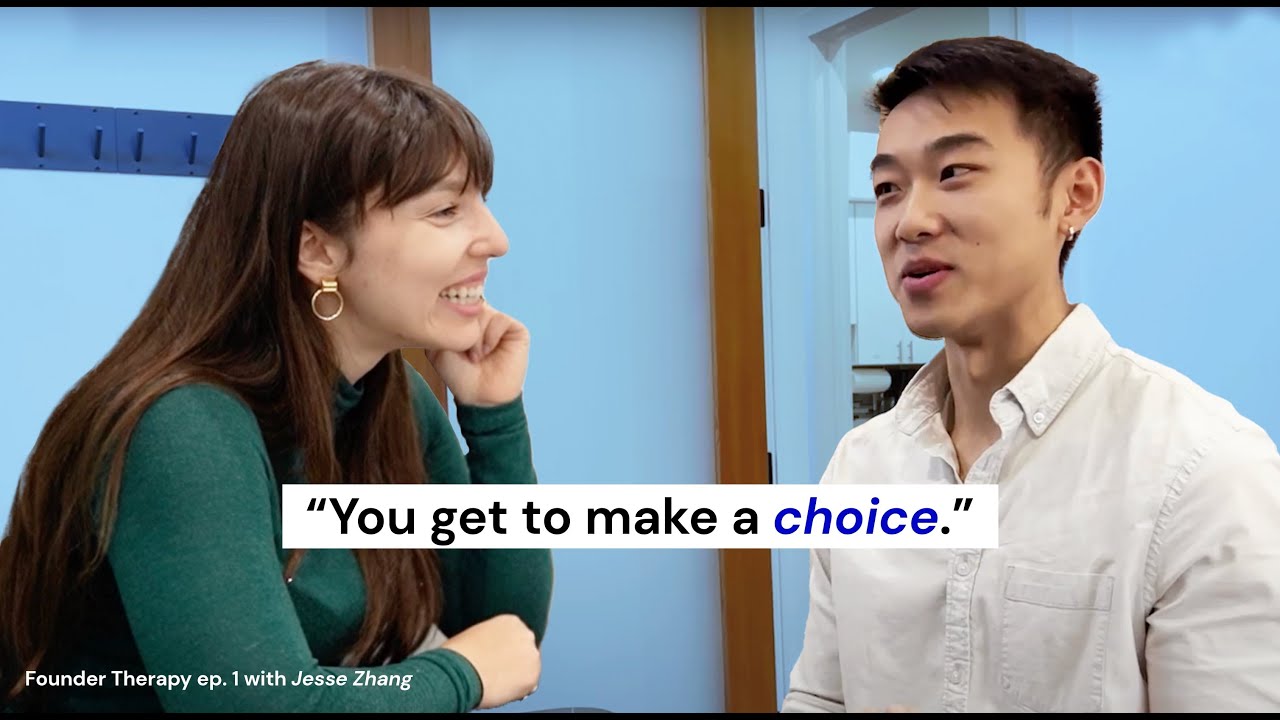
Jesse Zhang is co-founder and Chief Product Officer of beacons.ai, a website builder for creators that has raised over $20 million in Series A funding (backed by a16z and The Chainsmokers), has over a million users, and employs around 35 people. He holds a PhD in electrical engineering from Stanford, where his research applied deep learning to RNA sequencing in genomics. This episode traces his path from a STEM-focused student who never planned to be a founder, through co-founding beacons with two Stanford friends, surviving two brutal years of co-founder conflict, and ultimately building a fast-growing creator economy startup.
The path to founding beacons
Jesse always gravitated toward STEM because it felt logical and concrete, unlike humanities where he struggled to produce good output. He went to Stanford for a PhD partly as a way to get to Silicon Valley, which he saw as the epicenter of cutting-edge engineering and machine learning.
He didn’t plan to finish the PhD and was roughly 50/50 on completing it. He was drawn to the romanticized idea of big tech (free food, cool work) after visiting Facebook’s campus.
His PhD research ended up being interesting enough that he finished it, but he never wanted to go into academia.
His co-founder Neal (CEO) had wanted to do a startup since around 2010, inspired by reading startup literature and YC application essays while working in options trading in Chicago. He went back for a second bachelor’s in engineering specifically to gain technical skills to build things himself, which is why he’s older than the other co-founders.
During their PhDs, Jesse, Neal, and their third co-founder David took business courses together. Near the end of their programs, Neal brought the three of them together and proposed working on a side project, reasoning that their combined machine learning expertise could be packaged into something valuable.
Getting into YC and early pivots
The trio enrolled in YC Startup School, an online program that forced weekly progress. Midway through, YC announced it would select 100 companies from 15,000 to receive $10,000 checks, evaluated using the actual YC application.
They filled out the application to win the grant, then realized they had essentially completed a real YC application and decided to apply to the accelerator itself. They got in.
When they applied in December 2018 (YC’s early decision round for summer 2019), their product was a face ID system for doors—a piece of wood with an August Smart Lock, a Raspberry Pi, and a simple face detection algorithm. The vision was a world with no keys, key cards, or passcodes.
Their YC interview demo involved holding the device up to a partner’s face; the screen showed face detection, drew a green square around recognized faces, and unlocked the door.
Between applying and starting YC, they took Lean Launchpad, which required talking to at least 12 customers per week. This forced them out of the building mindset and into customer discovery.
They quickly realized the face ID for doors product wasn’t working. By the end of the course, they were exploring productivity tools—using machine learning to auto-link tasks and reduce redundant work in organizations.
The problem resonated at a high level, but they struggled to define the actual product, and as non-front-end engineers, they couldn’t deliver the crisp UX a productivity tool required.
Pivoting to the creator space
Halfway through YC, they pivoted to the creator economy, discovering the link-in-bio space. At the time, Linktree was essentially the only product in the market and was growing rapidly.
The pivot was essentially finding a real problem worth solving after searching for places to apply their machine learning expertise. They realized there weren’t strong ML applications for creator problems yet, so they shifted to solving real pain points directly.
The company name beacons survived every pivot because it’s generic with a positive connotation—it could work for a hardware product, a productivity tool, or a creator platform.
Evolution of Jesse’s role
Jesse started as Chief Scientist, a title meant to signal the company’s machine learning focus. As the ML hammer didn’t fit the nails they found, the role shifted.
He moved into general product work, which he describes as filling the space between the business, the user, and the builder. When the team lacked engineers, he coded; when they lacked marketing, he ran social media and growth hacking; when they needed data analysis, he did that.
He describes being “mediocre or less than mediocre” at many of these things, but they had to get done. This naturally evolved into his current role as Chief Product Officer.
The hard years: co-founder conflict
The first one to two and a half years were dominated by co-founder conflict and figuring out how to work together. All three were transitioning from PhD work—arguably the most independent form of work—to a situation where they depended on each other daily.
None of them had real job experience (except Neal, in a completely different industry and era). They had constant misalignments on what to work on, why, what “done” meant, and what “good” meant.
They had what Jesse describes as group therapy sessions every few days—meta-conversations about whether to set goals, what good goals were, how often to change them, and what they were even trying to do.
This period was “really really tough but really rewarding” because they came out the other side having built a genuine working relationship.
Current state and trajectory
Four years in, beacons has raised over $20 million, has over a million users, and employs about 35 people. The company has evolved from a hardware prototype to a productivity tool concept to a creator economy platform.
Jesse’s personal journey has taken him from someone who never planned to be a founder, through a PhD he almost didn’t finish, through brutal co-founder growing pains, to leading product at a well-funded startup. He emphasizes staying flexible with plans and following what draws him rather than rigidly sticking to a predetermined path.