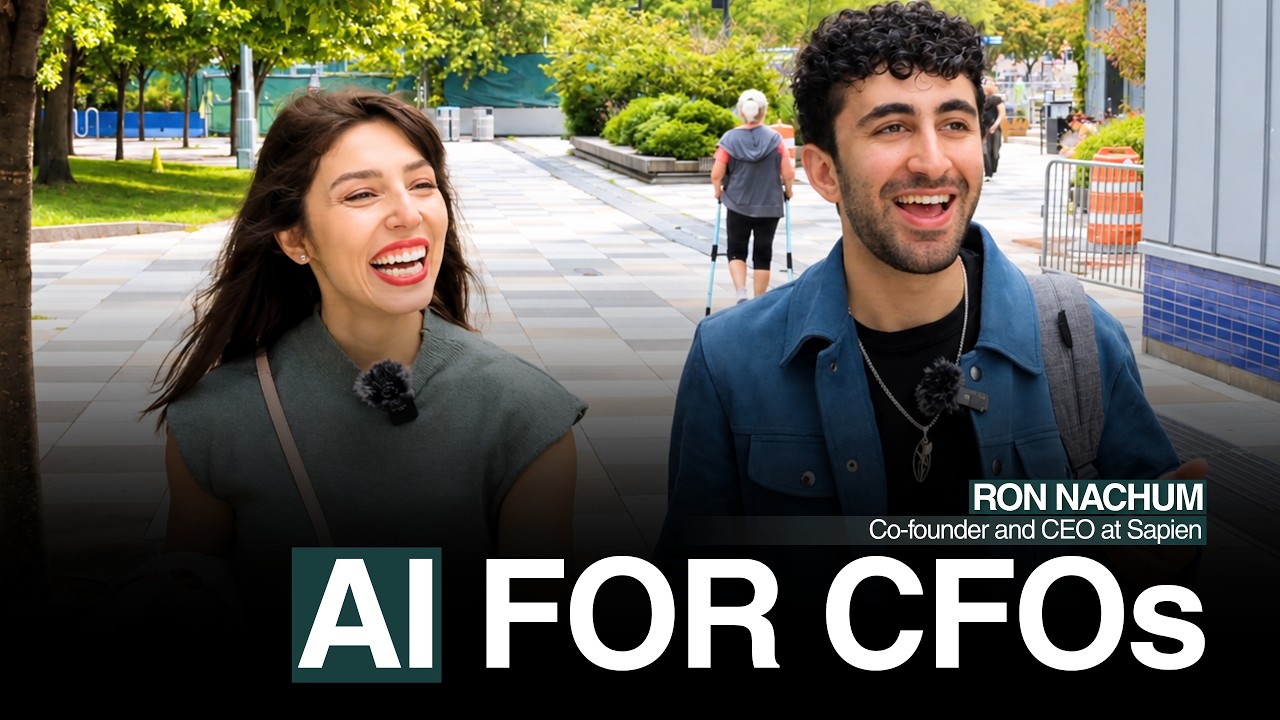
Rom, a 22-year-old Harvard dropout, co-founded Sapient — an AI platform that acts as a “brain” for CFOs by ingesting financial and operational data to uncover hidden profit leaks and run complex businesses better — after cold-emailing his way into enterprise deals and proving the product by finding a $10 million error in a prospective customer’s reporting during a 7 a.m. emergency call.
Early drives and formative experiences
Rom describes himself as “ungovernable” from childhood: he hated being told what to do, got in trouble often, and constantly looked for different ways to do things.
First ventures: selling rubber-band bracelets in third grade (recruiting classmates as labor and giving them a cut), 3D-printing fidget spinners on the school printer in middle school.
A pivotal curiosity trigger: at age three or four, a book page stating “number of moons unknown” for Jupiter refused to let his mother turn the page — he needed to know why humanity didn’t know.
Parents: father in telecom hardware and sales (selling to Verizon, AT&T, T-Mobile); mother most recently in real estate.
Rom strongly favors nurture over nature: he believes the right environment, effort, and support let anyone learn anything; he cites his father making him practice soccer juggling daily until he hit 500 in a row as a template for “you can just go figure things out.”
At 14, he cold-emailed professors for AI/computer-vision research; one replied “You’re 14. Why would you even email me?” — the next day another sent a 30-page paper and asked for notes, which launched his research trajectory.
High-school projects: Alzheimer’s disease research, building a liquid-fueled rocket on a goat farm, joining a satellite club but leaving because it felt too structured (NASA instruction manual).
Two older sisters (7 and 11 years older) became closer mentors once he started the company.
Meeting co-founders and the decision to start
Pranav and Arya: best friends from high school (met at 14 in the cafeteria).
Pranav: hacking since sixth grade, worked for government contractors in middle/high school.
Arya: top-100 junior golfer who chose competitive programming over pro golf; mom has two PhDs; became one of the youngest students in a top UT Austin PhD lab as a freshman.
Winter-break midnight car ride: they knocked on Rom’s door at 1 a.m., drove until 5 a.m. talking about feeling an “itch” to build something together post-ChatGPT.
Applied to accelerators; Rom went on Harvard Startup Trek to NYC, visited Ramp, Graphite (15 people then), others; at a dinner met Ali Partovi (Neo).
Ali’s first interaction: told the story of blowing a pitch to Steve Jobs — vulnerability and genuine relationship-building, not selling — which became a core value for Rom (radical transparency, “talk about everything”).
Neo interview: scheduled 30 minutes, lasted 2.5 hours; Ali and Arya bonded over Persian heritage; Rom felt “why would I want to be anywhere else?”
Choosing between Neo and Y Combinator; decided on Neo because “you should envision if you want them at your wedding” — people first, firm second.
Ali’s explicit permission to explore: “you guys have just started… find whatever you’re excited about” — freed them from the initial recruiting-automation idea.
Pivot path: from recruiting → high finance → corporate finance “AI brain”
First accelerator application: automating recruiting/job search — quickly realized they weren’t excited by it.
Arya’s dad is a wealth manager → exposure to manual spreadsheet finance → built prototypes for high-finance diligence tools (investment banking) → got them into accelerators.
Cold-emailed anyone with “finance” in title: CFOs of small cannabis companies, PE operating partners, former Netflix CFO.
Kept getting nudged toward corporate finance: high finance has few buyers, experimental, capital structure not centered on AI efficiency; corporate finance has millions of dollars locked in unanalyzed data at mid-market manufacturers (5–10 analysts for hundreds of millions in revenue).
Iterative expansion: automate FP&A/reporting → add operational data → add sales data → now “engine that understands how the world’s most complex businesses run from their financial/operational data up.”
Core insight: every company has a version of the weighting error they found — humans can’t process the volume; AI can continuously understand transactions, operations, sales, and drive downstream decisions (manufacture right products, cut costs, target better markets).
The $10 million error — proving the product and earning trust
Early prototype, first customer: automating monthly profitability-driver reporting (customer mix, product mix).
Numbers wouldn’t match; Arya stayed up all night digging through Excel with Sapient + manual review.
Found a weighting error: averaging costs across tens of thousands of products without weighting by manufacturing volume → thought they were making $10M on a product set, actually losing $2M.
7 a.m. call with CFO before board meeting; initially dismissed (“you’re 20, you’ve looked at this for weeks”), but walked through spreadsheet cell-by-cell until they realized “oh my god, this is real.”
Mistake had repeated monthly for years; fixing it recovered millions to bottom line (they were making loss-making products unknowingly).
Rom’s confidence source: thoroughness — they had looked at literally everything; fear was “will they listen?” not “are we wrong?”
Trust-building philosophy: incremental, make it easy to start (anonymized spreadsheet first), prove small job then take bigger bites; now plug directly into data with case studies and references.
Cold-start problem: cold-emailed skeptical middle-America manufacturers; chose hard market deliberately — barriers to entry create stickiness, forces better sales/positioning early.
Leadership, blind spots, and personal operating system
Blind spot 1: intensity and bluntness — gives tough love the way he wants to receive it, but not everyone works that way; learned to adjust delivery per person.
Blind spot 2: over-engineering from first principles — rethought interview process, demo calls, project org, code review; some good (hiring), some wasted effort; learning “you don’t need to do everything better, just the things you’re uniquely equipped to solve.”
Reflection practice: journaling twice daily (5 minutes morning/evening, sometimes one sentence); gives every new hire a signed notebook; writing forces ideas to congeal and creates accountability (can’t rewrite history).
Voice-notes as supplement after writing muscle built; records/transcribes almost every conversation, feeds to AI for daily pattern analysis (how talk tracks change week over week).
Culture at Sapient: “number one thing — be curious, push back on what others say; if you have no other skills, you need that one.”
Executive coach analogy: startup = walking in a dark warehouse smelling for Cinnabons — constant pivoting, not a single event.
Dropping out of Harvard
Asymmetric risk: worst case = 9–12 months learning, then return to school; father encouraged (“decades happen in years” during platform shifts).
Neo check from Ali Partovi gave runway; decision felt “like one of the easiest I’ve ever made.”
SOC 2 in a day (controls)
Accidentally told a customer they had the certification letter; realized letter was dated.
Pranav (infra/security co-founder) had built with SOC 2 in mind; they stayed up all night completing controls; audit followed properly over months.
Vision and what he’s proving to himself
Micro impact: helping people around him become better engineers, leaders, friends — “longest-lasting legacy is people.”
Grandfather was a Holocaust survivor; instilled “overcome impossible things, build a family, create a legacy through people.”
Macro impact: make technology as pervasive as possible — “if Sapient works, we basically make every business in the world run better” (first engineer Eli’s framing).
Anywhere there’s dollars and data: small companies, governments, fire departments, non-profits — “make capitalism the best version it can be.”
Proving to himself: “there isn’t a limit on what you can do… I wake up every morning thinking how do I push that 1 inch further, 1 inch further, because I don’t believe there should be a limit.”