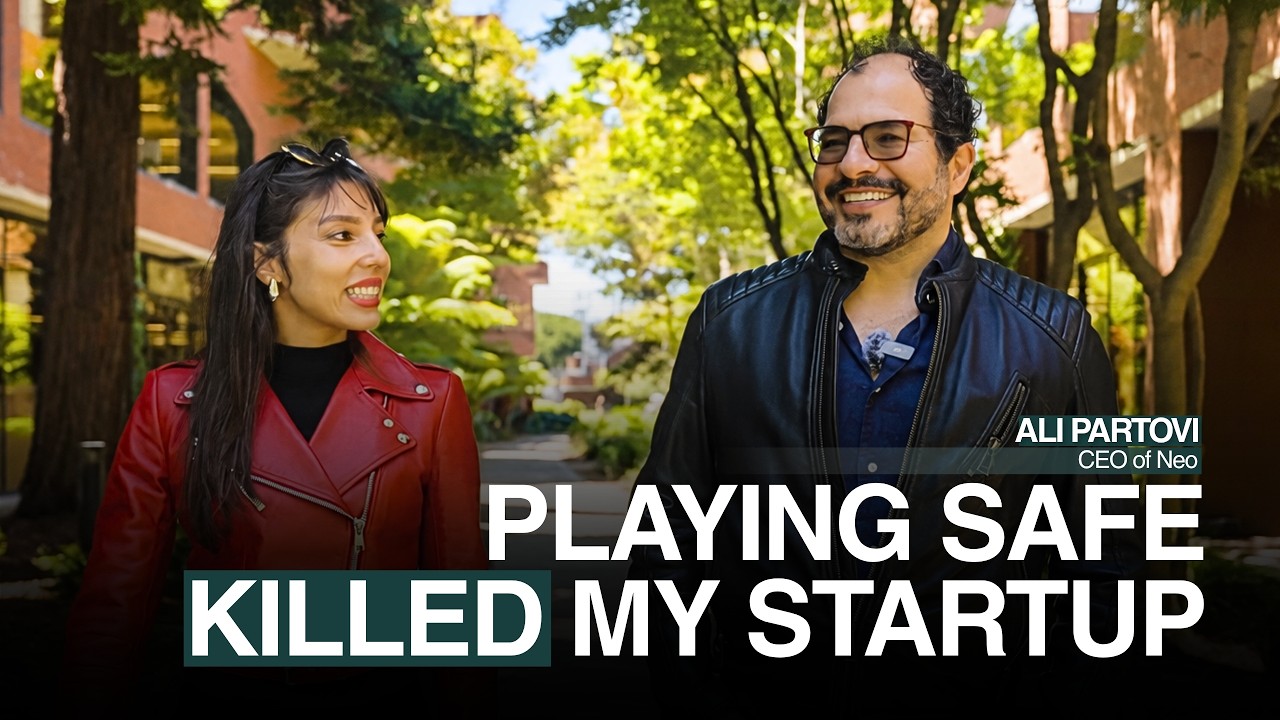
Ali Partovi, co-founder of Neo and early investor in companies like Facebook, Dropbox, Cursor, and Kalshi, shares how a lifelong practice of confronting fear — through rock climbing, startup failures, and talent identification — shaped his philosophy of maximizing reward rather than minimizing risk, and how he built an organization around spotting exceptional people before the world does.
Early life and the pull toward America
Ali grew up in Iran; at age two his family moved to Boston for his mother’s master’s at MIT, where he attended MIT daycare, and the experience of American openness and prosperity left a lasting impression.
After returning to Iran, the 1979 revolution and Iran–Iraq war made life harder, especially for his mother; he sensed her anxiety and read American books (Shakespeare, Dickens, Odyssey) that reinforced a vision of a fairer, freer life.
His father, a physics professor and early computer enthusiast, brought home a Commodore 64 that got stuck in customs for months; once it arrived, Ali and his twin brother Hadi taught themselves to program from the manual, with their father emphasizing design and planning over coding.
The family immigrated to the U.S. when Ali was 11; his parents returned to Iran after about a year, leaving Ali and Hadi with grandparents — a separation that reinforced self-reliance and a future-oriented mindset.
Founding LinkExchange and learning the “people picker” superpower
At 23, Ali co-founded LinkExchange (sold to Microsoft for $265M); none of the three founders wanted to be CEO, so they asked Sequoia’s Mike Moritz to act as interim CEO and sit in on executive interviews.
Moritz could assess a candidate in 10 minutes with high conviction, while the founders had “no signal” after hours of interviews; Ali realized people-picking was a learnable superpower — pattern matching, naming intuitive signals, and calibrating fast.
A parallel lesson came from IDG’s Pat McGovern, who judged GM candidates for Asia in 15 minutes each; Ali committed to practicing this skill deliberately.
Early test: co-founder Tony Hsieh wanted to hire their friend Alfred Lin (then a Stanford stats PhD doing part-time accounting) as CFO; Ali resisted — too young, no experience — but Tony and Sanjay insisted; Alfred became a force multiplier, lifting the whole company’s performance, and later became co-head of Sequoia.
Another signal: Ali evaluated Viaweb (Paul Graham, Trevor Blackwell, Robert Morris) by the elegance of their homepage and the depth of their bios; he recognized “true genius” and tried to acquire them — an early win for betting on raw ability over résumés.
iLike, the Bono story, and the cost of fear-driven decisions
Second startup iLike (music social network) raised $20M, had top artists (Bono/U2, 50 Cent, etc.), but ultimately sold for ~$25M — investors barely got money back.
Universal Music Group (≈50% of music) threatened to pull all content unless iLike took down an exclusive, cleared video of Bono singing a new song about famine in Ethiopia; the board debated, Ali wanted to fight, but they compromised by cutting the video in half — losing its soul and the artists’ trust.
Ali regretted not taking the bold stand: the label might have blinked, and the band would have known iLike had courage; instead they survived but missed the upside.
The failure fused with his identity — “if this fails, I am a failure” — leading to a year+ of rumination, divorce, and the realization that no one else cared nearly as much; he started rock climbing to practice separating fear from danger.
Rock climbing as exposure therapy for fear
Ali took up climbing ~15 years ago partly for fitness, but intentionally to practice feeling fear without danger — one foot off the ground, no real risk, but intense insecurity; he learned to ignore the fear until it dissipated.
The metaphor transfers to startups: founders over-index on downside risk because identity is tied to the company; bold bets (all-in moves) are avoided in favor of survival, often dragging out a slow death.
He now views the scary path as the correct one — in hiring, difficult conversations, strategy — analogous to strength training: growth requires resistance.
Neo: identifying future leaders in college
After selling iLike, Ali raised a fund around the thesis that future leaders can be spotted in college; he personally flew to campuses interviewing hundreds of students, despite insecurity about whether he could still relate to 18-year-olds.
The work turned out to be intrinsically rewarding: he loved the interviews, built a network of thousands of exceptional students, and became a connector — referring even rejected candidates to other startups.
Neo Scholars selection criteria: technical excellence, risk-taking, community-building, and “mischief” — willingness to challenge rules/status quo (e.g., Alfred Lin doing advanced math against teacher’s orders; Michael Truell naming his puzzle-hunt team “The Winning Team” tongue-in-cheek).
Kalshi founders (Tarek Mansour, Luana Lopes Lara) exemplified conviction: 40 law firms rejected them; each refusal cited “no precedent” rather than legal reasoning, which reinforced their belief they were on a valid, novel path.
Ali led Kalshi’s seed, then bridged them in 2019 when VCs wouldn’t fund without regulatory clearance and regulators wouldn’t clear without tech; he trusted Tarek’s integrity and the regulatory path was de-risked.
In 2024, days before the election, Kalshi’s growth exploded (50% day-over-day); they needed $100M in bridge capital to front user deposits. Ali wired personal + fund money on a Monday morning after weekend scrambling failed — unlocking other lenders and saving the launch.
Sharing failures publicly and the “Confession” podcast
Ali’s pinned tweet (Steve Jobs story) was an impulse post that went viral; readers said it helped them overcome their own shame — he realized secrecy gives fear power, confession releases it.
He now hosts a podcast called Confession inviting tech leaders to share unspoken painful lessons, normalizing failure and encouraging risk-taking.
Daily work and philosophy
Most of Ali’s time isn’t traditional investing (pitches, memos) but convincing exceptional people to take leaps — join a startup, turn down Citadel, choose the “red pill” (Neo’s name references The Matrix).
Inherited trait he’s most grateful for: his father’s teaching ability — making complexity feel simple and never making the learner feel stupid.
Life philosophy in one sentence: “Don’t minimize risk, maximize reward.”