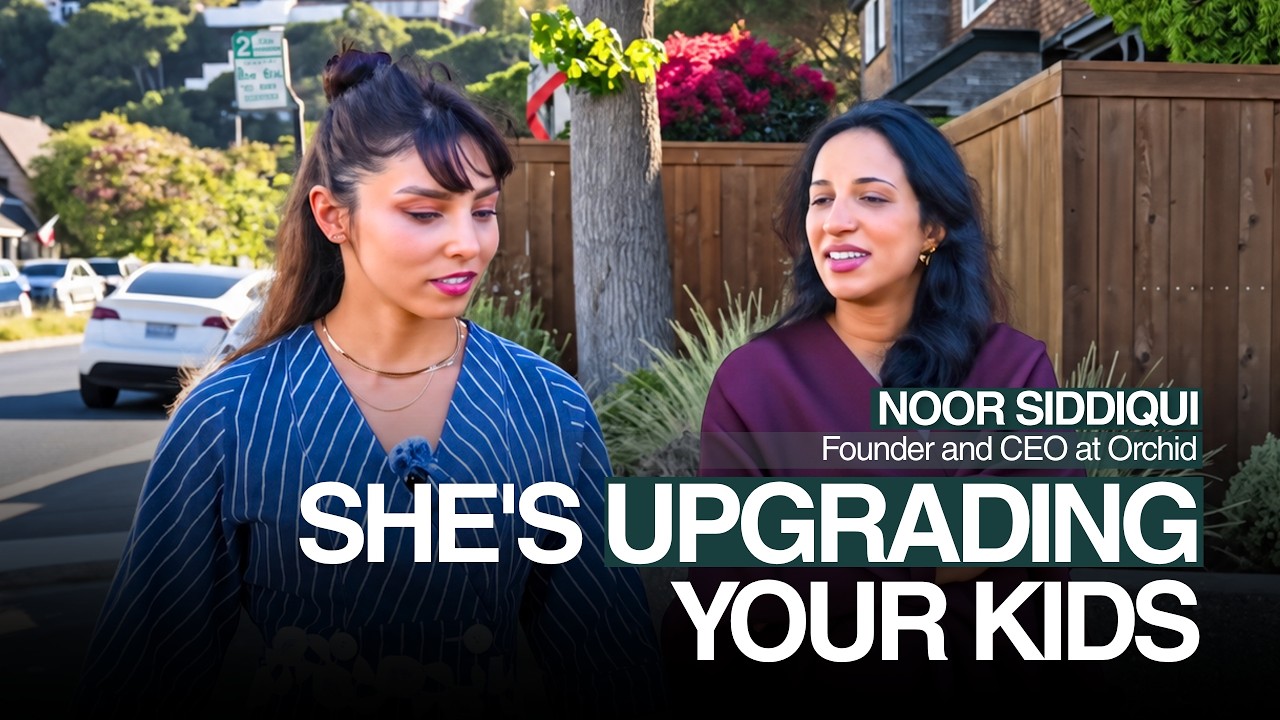
This episode features Noor Siddiqui, founder and CEO of Orchid, a startup that sequences the entire genome of embryos before pregnancy to screen for thousands of genetic diseases; she raised $16.5M from investors including Vitalik Buterin, Brian Armstrong, Naval Ravikant, Elad Gil, and Dylan Field, and the conversation spans her personal journey from Thiel Fellow at 17 to building a company aimed at ending the “genetic lottery” by giving parents radically lower disease odds and higher health odds for their children.
Personal background and the flash mob proposal
Noor has always believed she must be the chooser in life’s most important decisions — who to marry and what kind of child to have — because those choices shape everything.
She proposed to her husband with a custom-choreographed flash mob dance to eight meaningful songs, running toward him at the top of stairs with a “Will you marry me?” sign; he caught her, which she treated as an implicit yes.
Her husband’s later proposal stuck with her more because it revealed his “pure, childlike heart” and enduring curiosity — qualities she values most since many people become jaded and “zombie-like” by their 30s.
She knew he was the one because of his heart: he approaches life with the excitement of a 5-year-old, which energizes her and makes her want to be that way too.
On rekindling childlike enthusiasm: she believes it’s possible through travel, avoiding soul-deadening work, following intuition, and cultivating the muscle of finding wonder in mundane moments — though she admits she’s more black-and-white and feels life drain from her around the wrong people.
Thiel Fellowship at 17 and early lessons
She discovered the Thiel Fellowship on a random online forum at 16 and knew instantly it was what she wanted — the license to work on her own ideas instead of performing for tests.
Her parents (Pakistani immigrants who dreamed of her becoming a doctor/professor) were initially opposed; she didn’t tell them until she won, and their resistance melted when they saw her conviction.
Two major learnings from the fellowship:
Founders make bad friends because they drop everything for their companies; she gained appreciation for less ambitious people who invest more in relationships.
Seeing founders raise $50M, lose $100M, then raise $200M shattered her mental model of failure — people weren’t blacklisted, they just got back on the horse, which expanded her sense of what’s possible.
She cites Arnold Schwarzenegger as a hero for reinventing himself three times (bodybuilding, acting, politics) despite everyone saying he couldn’t — pursuing your dreams matters because “it’s your life that’s expiring.”
Path to founding Orchid
She applied to the Thiel Fellowship at 17 with an idea similar to Orchid but lacked the tools to execute; Stanford was the obvious next step to fill gaps in AI, genomics, single-cell sequencing, embryology, and IVF.
Building a company is so painful it must be your life’s work; she developed thick skin against expert rejection (“can’t be done,” “shouldn’t be done,” “no market”) by asking: “Do you want to be like the person giving this advice?” — e.g., don’t take muscle-building advice from a scrawny genius, take it from the jacked guy.
The acute motivation crystallized when her relationship with her husband made having a child concrete: she didn’t want her future child to suffer like her mother, who went legally blind in her 30s from a spontaneous (de novo) mutation — not inherited, just bad luck.
At Stanford she learned her mother’s condition was mild compared to conditions that prevent walking, speaking, or independent living from birth; she found it shocking that people obsess over wedding details but ignore the genetic lottery that shapes a child’s entire life.
Early fascination with embryos traced to a traumatic sex-ed video of childbirth at 16: “This is not how it’s going to be for me” — she saw birth as under-engineered compared to ad targeting, a pivot point affecting all future generations.
What Orchid does: whole-genome embryo sequencing
A “super baby” (v0) is an embryo scanned pre-pregnancy and pre-birth for radically lower disease odds and higher health odds; future versions may include longevity and enhancement.
Standard PGT-A testing only checks chromosome count (like reading a book’s table of contents); Orchid sequences the entire 3-billion-letter genome (spell-checking every chapter), delivering 100x more data.
This detects risk for thousands of conditions: genetic forms of autism, birth defects, cancer, etc. — most current testing looks at a tiny fraction, so parents think they’re covered when 99% of the “book” is unread.
Even healthy parents produce embryos with de novo mutations (like her mother’s blindness gene); the genetic lottery is “super evil and unfair” — no other domain accepts rolling dice on whether you can walk, see, or speak.
Ethical line: never overstate what you can deliver. Orchid reports monogenic (single-gene) risks definitively and polygenic risk scores probabilistically (e.g., “99th percentile risk” or “2-3x likelihood”), never guaranteeing a child won’t get autism or cancer. They also refuse to report on degraded samples rather than guess.
Technology is moving “insanely fast”: countries and agencies are sequencing populations and pairing with medical records, wearables, and blood tests, enabling better disease models and more precise definitions.
IVF as the new default for conception
Noor’s controversial take: people will stop having sex for babies because sex is already mostly not for reproduction, and having a child is a considered choice — especially as first-time births over 40 now exceed teenage births in the US, while biology hasn’t caught up.
Egg freezing and IVF let people proactively maximize chances on their timeline; Orchid adds the ability to select the healthiest embryo.
Beyond disease prevention (table stakes), she wants to “level the playing field” on traits like Michael Phelps’ swimming build, tetrachromacy (seeing 100M colors vs. 1M), natural blood-doping (Eero Mäntyranta), or needing only a few hours of sleep — these exist naturally in some humans, so distributing them isn’t enhancement but fairness.
Parents already do a “soft version” via mate selection (choosing partners for athleticism, intelligence, compassion); governments will regulate enhancement differently based on cultural values — some prioritize “better” offspring, others enjoyment/relaxation.
Dystopian risks exist (parents shoehorning kids), but the cooler story: humanity escapes the fixed code of the “video game” and writes its own story for the person you’ll be the best steward of — your child.
Personal philosophy and lightning round
On valuing time over money: she grew up with immigrant frugality (dad had Coke once a year; parents wore seven jackets instead of heating the house), which she initially replicated by haggling over every vendor contract — until she saw successful founders pay recruiters’ high fees to close roles fast, realizing open roles cost trajectory. Now she values time as the scarcest resource.
Most inspired by founders on her cap table (Dylan Field/Figma, Brian Armstrong/Coinbase, Elon Musk) and anyone who makes her “light up” — life’s too short for uninspiring interactions; “better to doom scroll.”
She’s “vanilla” in most of life (reliable, calls her mom, values family) to be wild in work — though she overcorrected early by wearing all black to be taken seriously, then reclaimed joy in colors/fabrics. Food is her uniform: same egg burrito daily.
Daily habit that’s “secretly insane”: matcha every morning — the bright green color and smell give her cartoonish, absurd happiness per minute.
Trait most grateful for: not caring what strangers think. In high school it made her an outcast; as an adult it’s a superpower — people call it bravery, but “it’s not bravery if it doesn’t cost you,” like running hot in the cold.
Advice to her 17-year-old self: “Don’t take yourself so seriously.” She took herself extremely seriously then (had so much to prove); after a few cycles of “impossible task → proved it to myself → next impossible task,” she built a muscle of trusted competence — “confidence is about competence.”
What would make her “cool”: upgrading all humans — “once they’re all upgraded, then finally be cool.”
Biggest hope for her future child: not just happiness (which can be mediocre), but following their dreams without fear of failing or disappointing parents/society — even if it requires suffering, reaching full potential matters more.