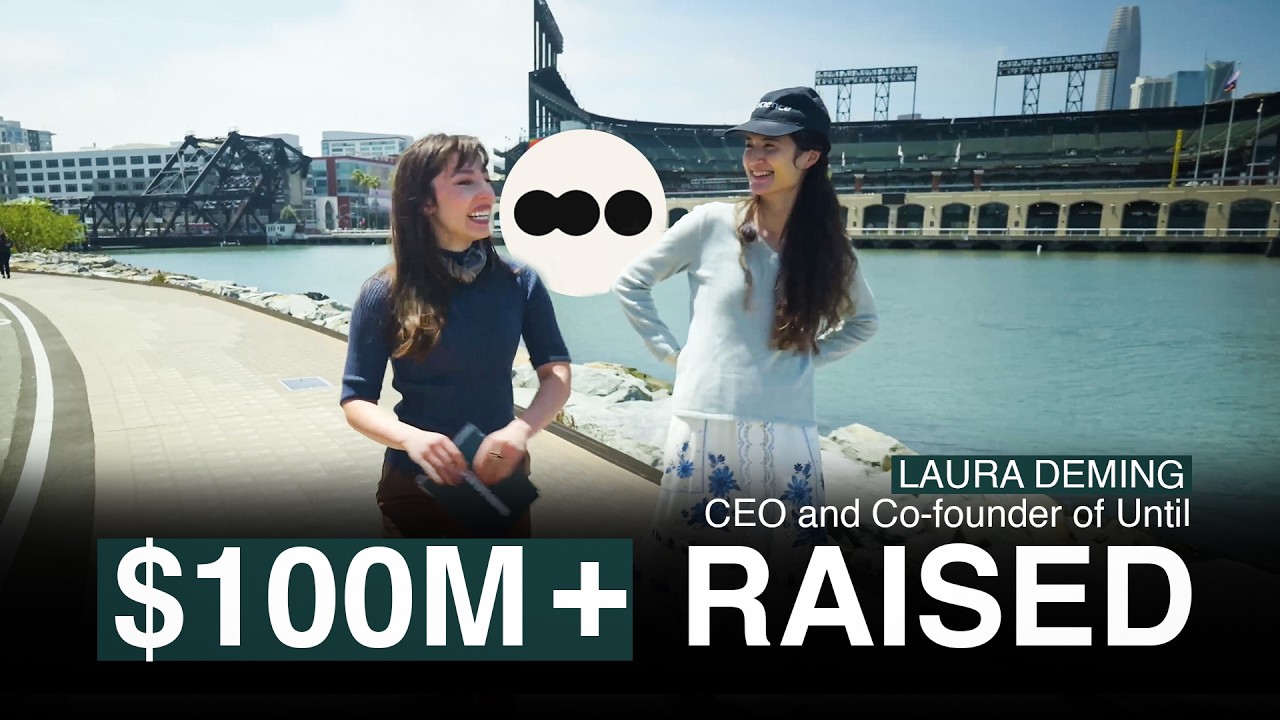
Laura Deming, co-founder of Until (a reverse cryopreservation company in San Francisco), shares her journey from child longevity prodigy to building technology that can pause biology — starting with organ preservation for transplant patients and aiming toward whole-body cryopreservation.
Childhood without rules and early obsession with longevity
Laura grew up homeschooled in New Zealand with near-total autonomy — no formal school, self-directed schedule, and a sense of “normal” that differed radically from most people.
At age 8, she visualized death and ranked it as the worst possible outcome, deciding it was the most important problem to work on.
At 12, she cold-emailed Cynthia Kenyon (pioneer in aging biology at UCSF) with a message of pure devotion — “I worship the ground you work on” — and Kenyon took her seriously, mentoring her as an equal.
Her parents moved the family back to the U.S. to support her lab work; she describes every day in that period as “the best day of my life.”
The social history of aging research and the pivot to cryopreservation
Two decades ago, “aging” was taboo in academia — researchers used “longevity” as a less controversial term; the field has since gained legitimacy and commercial interest.
Laura founded the Longevity Fund (VC) but left after becoming obsessed with cryopreservation — she gave a conference talk on cryo instead of her assigned topic, realized she couldn’t disprove its importance, and committed to founding Until.
The company’s near-term focus emerged from team conversations: organ transplantation has an acute logistical crisis (organs last hours, patients live on pagers within 2-hour radius of transplant centers, surgeries scheduled at 2 a.m., organs lost to weather delays).
Until’s “big magnet” technology can rewarm a cryopreserved organ in about a minute, potentially enabling organ banking and eliminating the time-pressure logistics nightmare.
How cryopreservation works and the physics of the “danger zone”
Core challenge: prevent ice formation, which destroys tissue stochastically between 0°C and -30°C (the “danger zone” where molecular motion allows ice nucleation and growth).
Strategy: perfuse tissue with cryoprotectants that suppress ice nucleation, then cool and rewarm extremely fast to blast through the danger zone.
Small samples (embryos) work today because surface-area-to-volume ratio allows near-instantaneous heat transfer; scaling to organs and whole bodies requires solving heat transfer at scale.
Until’s approach combines cryoprotectant perfusion with rapid, uniform rewarming via magnetic nanoparticles and alternating magnetic fields (the “big magnet”).
Identity, continuity, and what’s worth preserving
Laura is obsessed with the question: when a person dies, what exactly is the thing worth preserving? Continuity of experience? Physical continuity? Causal chain?
She rejects simplistic transhumanist narratives (“make everything better and live like elves”) — a 1,000-year-old consciousness would likely evolve beyond recognition; we lack intuitions for what that looks like.
The Hokusai wave analogy: the artist at 100 said he was just learning to draw; we don’t know what mastery looks like with centuries of time.
Her motivation remains visceral: “if someone I love is on their deathbed with something unfinished, I would do anything to give them that time” — the Satoshi Kon film The Dreaming Machine unfinished due to his death at 46 exemplifies this.
Intuition, beauty in science, and San Francisco as “intuition killer”
Laura describes intuition as a feeling of “the best ice cream + being overwhelmingly loved by the universe” — a pull toward certain ideas (e.g., Galois theory, molecular biology).
She finds deep beauty in science: “10^27 atoms in you, trillions of cells, molecules in clockwork synchrony letting you nod right now — how could you feel more loved by the universe?”
Academic culture suppresses this expression; she had to reclaim permission to feel awe openly.
San Francisco’s strong cultural attractors crushed her intuitive side in her 20s (a breakdown period); she now protects space for “weird” curiosity — reading math in coffee shops, treating obsession as a life-or-death signal.
Company building: clarity, hiring, and decision-making
VC experience made her impatient with complexity — best founders hold a standard of radical simplicity and speed to the next milestone.
She separates “buckets where confusion is allowed” (philosophical questions about 1,000-year consciousness) from “buckets requiring decisions today” (what will a transplant surgeon buy and use?).
Practice for clarity: stare at a wall, say “no” to everything until the single most important thing surfaces; body-awareness practices (somatic therapy, dance, coaching) to detect when regulation is lost.
Philosophical tensions: teleportation, transcendence, and values
Derek Parfit’s teleporter thought experiment (perfect clone on Mars, original destroyed on Earth): Laura would pause — “depends on how attached I am to my identity on Earth.”
She advises against making irreversible philosophical decisions (like cryopreservation signup) in your 20s/30s — “take some time between your philosophical decisions… and possibly life-or-death decisions.”
Current stated value: “transcendence” — but she questions “transcend death of what?” (body? identity? memories?).
Excited about: the team’s execution, understanding Galois theory (the proof that quintic polynomials have no general algebraic solution, linked to symmetry/group theory), and seeing Until’s clinical milestones land.