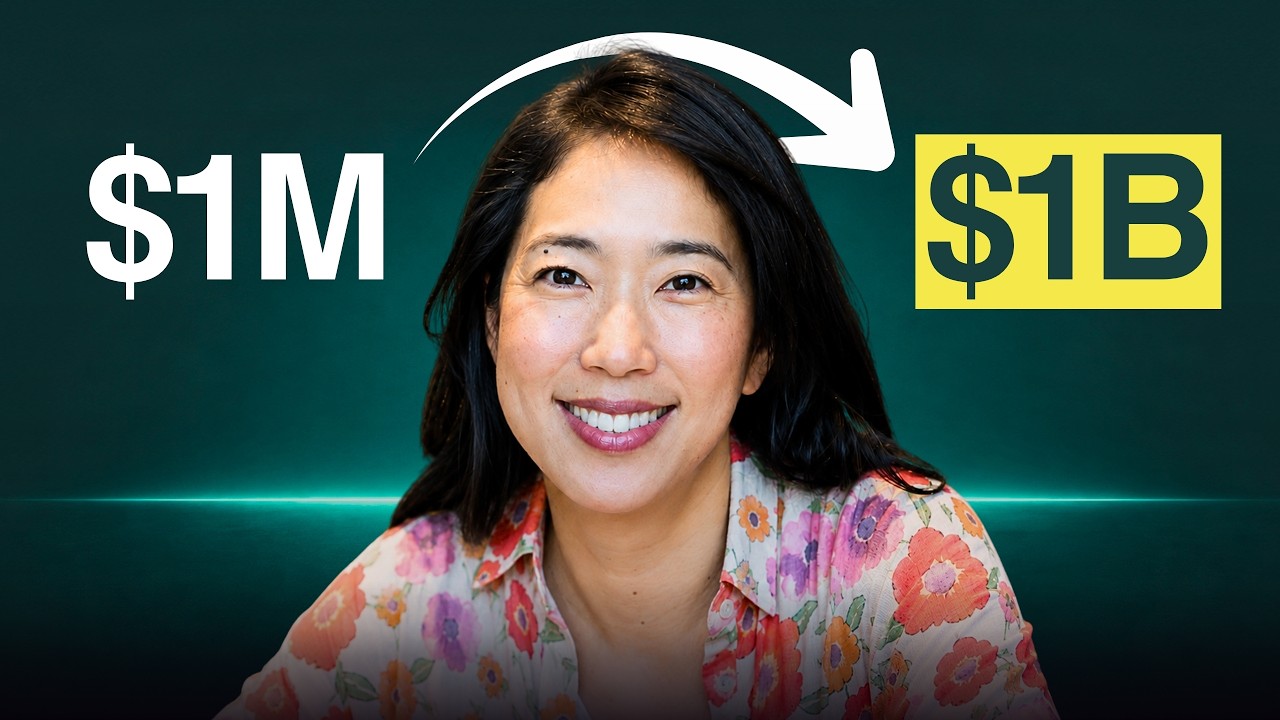
Ann Miura-Ko, co-founding partner of Floodgate and Stanford professor, reflects on 18 years building a seed-stage venture firm that deliberately stayed small, her debate-honed truth-seeking culture, and how AI is rewriting the lean-startup playbook — all framed by a personal philosophy of finding world-class work at the intersection of skill, passion, and value.
Debate as permission to be disagreeable and truth-seeking
Ann’s competitive debate background gave her the first explicit permission to be aggressive and disagreeable, a space where women are often socialized to be agreeable.
Her core strength was pure logic: cornering opponents on contradictions during cross-examination, sometimes making them cry — a skill she now channels into Floodgate’s culture.
At Floodgate, truth-seeking means the best argument wins regardless of title; associates, partners, and outsiders are all expected to challenge each other.
Ego-driven defense (“I am right because my reputation depends on it”) is distinguished from truth-seeking (“the truth exists outside me and elevates my position”).
She actively guards against yes-people by coaching her chief of staff to confront her, and she credits Mike Maples for modeling intellectual equality from day one despite his seniority.
Mike Maples, category design, and the optimism edge
Maples treated Ann as an intellectual peer when she was a PhD student and he was a successful entrepreneur/angel — an unprecedented dynamic that shaped Floodgate’s partnership.
Maples’ storytelling is emotional and possibility-oriented, contrasting with Ann’s logic-and-detail style; he taught her that seed investing requires optimism about what could be, not just analysis of what is.
Category design means creating a new shelf in the store, not just a better product on an existing shelf — exemplified by 5-hour Energy (new form factor, new placement) and Lyft (peer-to-peer rideshare, initially illegal, had to ask for donations).
Floodgate’s early “micro VC” label reflected a category they were defining; being different let them play their own game without comparison traps.
Finding life’s work: the intersection of skill, love, and value
Ann was told she was “average” early on; her mother countered with specific, evidence-based belief (“you’re exceptional at math, piano”) that compounded into confidence.
She tested and rejected medicine (too much memorization/structure), law (too literal/detail-oriented), and academia (saw a peer who was world-class in a way she knew she wouldn’t be).
Her father’s advice: “You have gifts; find where you can be world-class, don’t just try hard at something you’re not great at.”
Venture appeared opportunistically — she’d worked at Charles River before her PhD — and the chance to reinvent venture (seed stage didn’t exist yet) matched her teaching, pattern-recognition, and builder-adjacent strengths.
Luck vs. fortune: fortune is birth circumstance; luck is surface area you expand through manners, value-creation without expectation, hard work, and constant curiosity.
AI rewriting the lean-startup playbook
Floodgate’s original thesis (2006): AWS and open source let startups build on public infrastructure instead of raising $5M for servers/proprietary software — birthing the “lean startup” (talk to customers early, iterate fast).
AI now lets companies ingest real-time data from customers, sales, industry and automatically incorporate it into product, business model, operations — the lean loop compressed and automated.
Example portfolio company: an agent scans all data, validates factual claims, and if impactful, proposes and implements product changes (e.g., caught millions in missed credits; can split shifts).
Hard part isn’t engineering (largely solved); it’s cross-functional orchestration — getting design, eng, product, marketing, sales to feed and act on agent insights together.
First step for AI-first companies: expose data to agents and the whole org via natural-language-to-SQL so anyone can query; this creates a flywheel of new experiments and demand for more agents.
Separator between AI-first and laggard founders: paranoia — not age. CEOs who model curiosity, make the org legible to AI, and use agents personally drive the transformation.
While peers scale fund size after success, Floodgate has kept fund size flat for 3–4 funds.
Thesis: right-sized funds make a $1B outcome meaningful to both founders (life-changing) and LPs (real DPI, not a rounding error).
SmarterDx (Fund IV’s first investment): AI + healthcare revenue-cycle management. Series A investors passed — “market too small,” “boring space.” Exited in 3 years for $1B+, returning more capital than Ann had deployed from the entire fund.
Founder-friendly math: a $100M fund targeting 3–5x needs $300–500M in exits; at 10% ownership that’s $3–5B valuations. A $100M exit is noise to a $1B fund but game-changing for a founder. Founders should check fund size, ownership targets, and talk to portfolio CEOs to decode true incentives.
What Ann brings to the cap table
“Asian tiger mom” brutal honesty on product-market fit: where you are, why you’re not there, what metrics matter, what it takes to get there.
Floodgate partnership adds Mike Maples (category design) and Mike Heler (go-to-market engine).
Investment decision at pre-seed/seed is art over science — minimal traction, so she bets on people:
Have seen excellence somewhere (academic, extracurricular, work).
Super-thinkers: deep curiosity about the world.
Super-builders: love the process of building, excited to scrap and rebuild.
Looks for all three across a 2–3 person founding team; explores via “journey questions” (what did you start with, throw away, why, what will you change, what are you convicted by).
People who bet on her; spotting potential in others
Tom Buyers (Stanford professor) gave her teaching opportunities — 20+ years in the classroom.
Every founder who takes Floodgate’s check is making a bet on them; she credits founders as much as mentors.
Spots potential by asking: have they been in a room where the best work together? (academic or extracurricular). Are they following passion or a script? Passion must mature into obsession to see excellence.
Parenting, sacrifice, and the piano that wasn’t practical
Both parents demanding in different ways: mom vocal (practice 3–4 hrs/day, found best teachers); dad silent enabler (drove her, later taught advanced material).
Dad drove a stripped Toyota Corolla (no radio, AC, power windows) for 25 years to buy her a grand piano — never explained why, just saw her commitment and matched it.
That piano remains irreplaceable: a story, a sacrifice, a family artifact. She doubts her kids will face equivalent manufactured scarcity.
Being the only woman in the room
Electrical engineering at college: zero women. Mom refused sympathy: “Find friends in your dorm, not the classroom.” Lesson: absence of people like you ≠ you don’t belong.
Early venture: almost no female GPs. Mike Maples reframed it: “That’s a superpower.” She used it to get into a founder-only conference by replying, “I can’t imagine people saying they want fewer women in the room.”
Turning 50: the year of saying yes
Habit of saying no (career + kids + family) becomes unnecessary but sticky by 50. Now: default yes to breakfast, trips, new friends — unless a real excuse exists.
Realization: friend-making doesn’t stop at 25; deep connections and learning accelerate later in life. A group of female executive friends (last 3–4 years) expanded into family travel and husband friendships — game-changing.
Happiness = purpose + belonging
Belonging: found in college — friends who knew, loved, accepted, and expected a lot of her. Still grounding.
Purpose: latter half of PhD — loved teaching, saw a new way to build/finance companies with a “secret club” (Steve Blank, Mike Maples, etc.). Renewed by kids (oldest now 19) — different belonging/purpose, new perspective.
On “single until Series B” meme: tells students if you’ve found your person, commit now. Never a good time for kids; younger handles it better. Over-indexing on an uncontrollable future is a dumb reason to delay. If you know after six months they’re not the one, break up — respectfully.
World-class life and what she’s becoming
World-class life: pursue curiosities, constant learning, family + incredible experiences (swimming in warm water, hiking/running with husband, great food), care for both mothers with love and respect.
Still becoming: a more complete human — learning art, science, the world outside tech. References Beethoven’s manifesto on becoming the “complete man.”