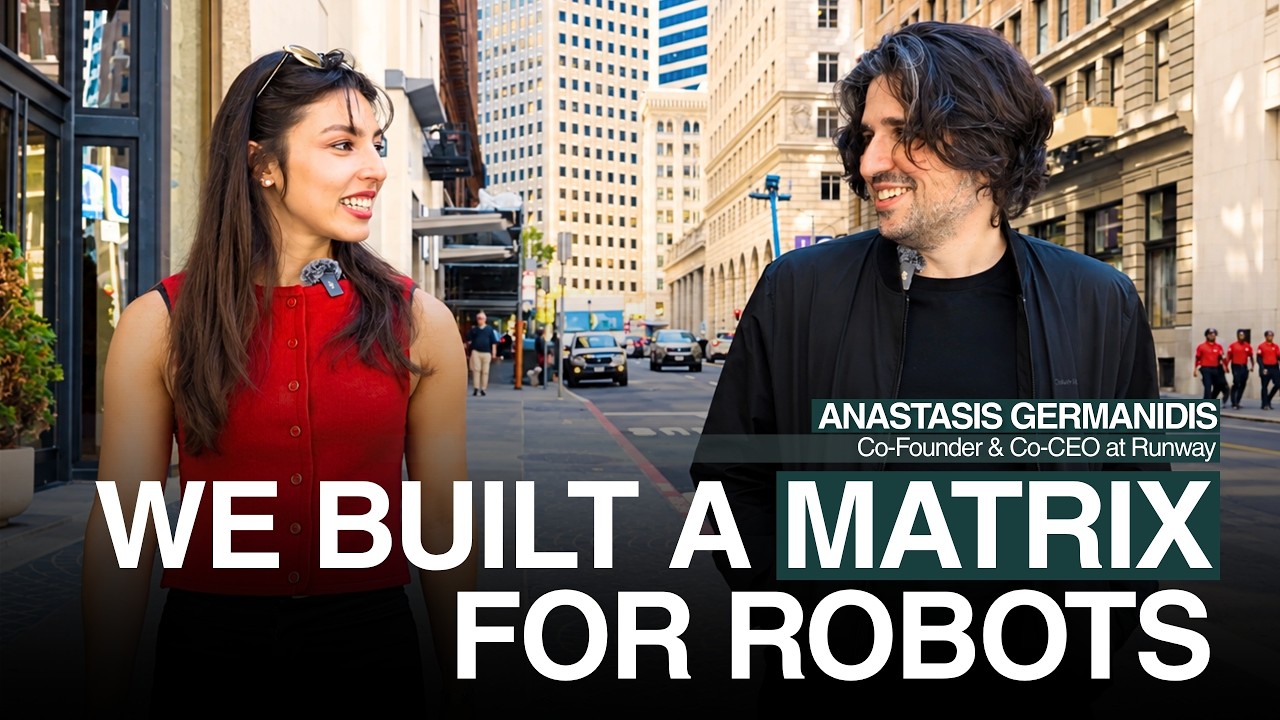
Anastasis Germanidis, co-founder and co-CEO of Runway, traces the company’s evolution from an art-school startup building creative AI tools to a $200M+ ARR company pioneering “world models” — video generation systems that function as general-purpose simulators of physical reality, with applications spanning filmmaking, robotics, self-driving, education, and dynamic software interfaces.
Runway’s Core Insight: Video Models as World Simulators
The central realization: teaching models to predict video pixels forces them to learn physics, object permanence, and how humans move through space — effectively making them world simulators.
The “light bulb moment” came in 2023 when adding camera controls to Gen-1/Gen-2 models; directing a virtual camera felt like navigating a first-person world, revealing that generated video clips were glimpses of persistent, simulated universes.
Analogy: holding a lighter in the dark — the scene exists only in the beam, created and destroyed in seconds, but the underlying model holds a coherent world.
At scale, video models become “indistinguishable simulators” — within five years, Germanidis expects fully interactive worlds navigable in real time, not just watchable clips.
World model definition: a simulator of an environment that understands cause and effect — given an action, it predicts how the world changes, whether the environment is a tabletop, a road network, or a virtual space.
This insight arrived within months of the first video model releases (late 2023), initially confusing to a team whose identity was rooted in filmmaking tools, but quickly adopted as the company’s north star.
The Path to AGI: World Models vs. LLMs
Germanidis rejects the static “AGI achieved” framing; he prefers OpenAI’s original definition — models performing the majority of economically useful tasks — but argues current systems fall far short because they cannot interact meaningfully with the physical world.
Moravec’s paradox: tasks humans find easy (folding clothes, opening doors) are hardest for AI because they rely on subconscious, evolved physical intuition; tasks we consider complex (chess, coding) are solved first because we’re consciously aware of their steps.
His working definition of AGI is asymptotic — never fully reached — because human capability co-evolves with tools; “we’ve discovered 1% of what it means to be human.”
World models, not LLMs, are the path to physical-world AGI: they learn from direct observation of reality (video) rather than human descriptions of it (text), giving them the intuitive physics needed for robotics and real-world tasks.
Synthetic data from world models multiplies rare, hard-to-collect edge cases (accidents, extreme weather) for robotics and self-driving training, making models robust to the long tail of reality.
Anastasis’s Background and Early Influences
Grew up in Greece; quiet, obsessive child who learned to code at 10–11 by convincing his sister’s professor to teach him after her lessons.
Initial driver: video games, especially simulations (The Sims, Airline Tycoon “Arabiz”) — loved rehearsing scenarios and experiencing out-of-reach roles before real life.
At 15, tried building a philosophy game based on Nietzsche’s eternal recurrence (Groundhog Day premise: relive your life, would you make the same choices?).
Read widely in philosophy (epistemology, philosophy of science) — questioned how we acquire knowledge, understand death, construct theories of the world.
Studied computer science and film in college (neuroscience dropped due to memorization load); loved film’s storytelling but hated its latency from idea to output — a gap generative models now close.
Received a neural networks book at 15–16, sparking lasting AI interest; the simulation theme has threaded through his entire life.
Company Building Philosophy
Core belief: identity is constraining; people and organizations can evolve far beyond external expectations — hiring optimizes for learning velocity and end-to-end project ownership over credentials or publications.
“Why Greatness Cannot Be Planned” (Kenneth Stanley) is required reading at Runway: stepping-stone curiosity beats rigid long-term planning; the best discoveries come from following immediate interesting problems.
Early years: no choice but speed — 30-person team, non-traditional background, had to prove existence daily; “longest plan was becoming a mature company in 2020–21, immediately realized that wasn’t us.”
Flexibility maintained through: storytelling (onboarding shows early crude generations vs. today), keeping teams smaller than comfortable, founders interviewing every hire, biasing toward “what’s useful in the next weeks” over multi-year roadmaps.
30 Magic Tools in 30 Days (mid-2022): when image generation quality suddenly jumped (Stable Diffusion, DALL-E 2), the whole company pivoted to a month-long hackathon — daily demos, rapid tool exploration — to discover product-market fit on the new paradigm.
Sora release (early 2024): existential crisis for “an hour or two,” then became “best gift ever” — compressed roadmap, rallied company to beat Sora in 3 months; Gen-3 launched at CVPR, team internalized “we’re more capable than we think.”
Research culture: strong opinions loosely held; stubbornness on direction, flexibility on path; prototypes as vision-setting (e.g., early Solaris demos showed target months ahead).
Key Turning Points in Runway’s History
2018–2020: Art-school origins (NYU ITP), building tools for creative technologists — interactive mirrors, skeletal-tracking painting, early generative art.
2023: Gen-1/Gen-2 release + camera controls + AI Film Festival — birthed “AI video” as a category; world model insight crystallized.
2022: 30 Tools in 30 Days pivot — proved speed and experimentation as competitive advantage.
2024: Sora launch → Gen-3 response — formative “beat the odds” moment, now referenced when entering new fields (robotics, world models).
2024–2025: Kinetics acquisition (Paris robotics team), crossing $200M ARR, scaling to 230 people, formalizing co-CEO structure with Cristóbal Valenzuela.
Solaris: Interface World Models
Solaris = “interface world model”: a system that generates interactive software interfaces in real time via video model, personalized to user intent — no code intermediate, just pixels in, pixels out.
Examples: e-commerce (photo of apartment → add/visualize furniture), virtual try-on (photo of self → try clothes), education (ask about cells → navigable 3D tutorial with mitochondria zoom), games (generate any concept on the fly, multiplayer).
Dual value: human-facing (dynamic, personalized software) and machine-facing (general simulator for training agents to use any software — replaces handcrafted fake environments like “fake Amazon” or “fake Booking.com”).
Cost challenge: video inference ~100x LLM token cost; heavy investment in real-time distillation, on-device inference, efficiency — Sora’s consumer failure partly attributed to cost prohibitivity.
Future: many models run locally on device; real-time generation is prerequisite for consumer adoption.
Personal Reflections on Identity, Ambition, and Growth
Hardest lesson: letting go of hands-on detail control; gradual realization from first hire onward, accelerated by necessity.
Current learning: entering new functions (marketing, robotics) — develop strong hypotheses fast, run small-scale experiments, isolate variables; research and marketing share “art of experimentation” despite different timescales.
Hiring signal: public track record of end-to-end projects > credentials/publications; shows taste, communication, detail orientation, growth trajectory.
Name origin: “runway” = place where models run (original product ran open-source models); fashion/airline double entendre intentional.
Co-CEO with Cristóbal: formalized long-standing collaboration; distinct areas (research/marketing vs. commercial/finance/creative) but decisions made collaboratively after ~decade of “mind meld.”
Full-stack strategy (research + infra + apps) is harder but more defensible: application feedback improves models, cost control, vertical integration.
Personal cost: all-consuming; no personal art/projects; constant problem-finding mindset — “always something broken to fix” — exhausting but optimal for curiosity-driven builders.
Stress regulation: self-critical obsessiveness is double-edged — harmful personally, beneficial for founder role; no tools to suppress it because it’s functional.
On missed lives: simulation/art already let us live vicariously — stories are low-fidelity simulations of others’ lives; the gap between living and simulating is smaller than we think.
Eternal recurrence test: would choose this life again; parallel universes exist (artist path, engineer path) but this one feels right.
“Always becoming someone else” — identity limits are artificial; self-invention is continuous; others’ models of you are just suggestions.