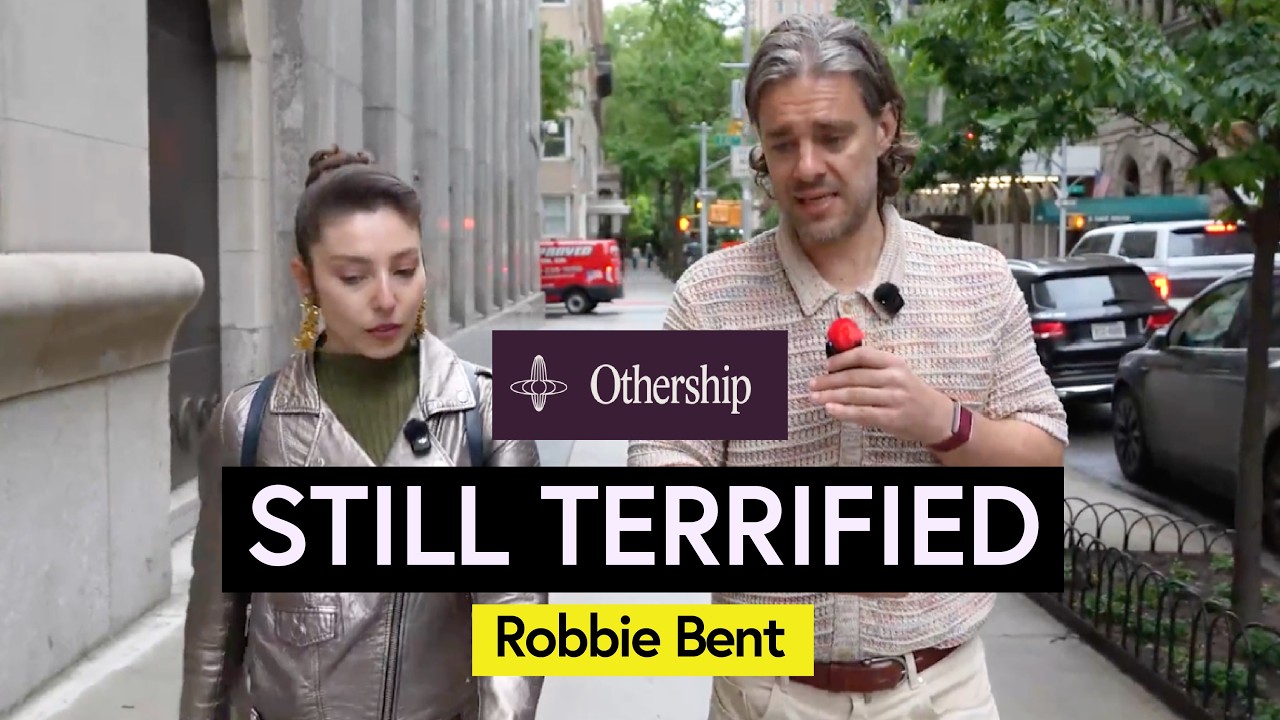
Robbie Bent is the CEO and co-founder of Othership, a wellness brand that grew from a DIY ice bath in a Toronto backyard into a multi-location “social spa” business in New York and Toronto, with a devoted community and a reputation as one of the most talked-about wellness brands in North America.
The company’s core product is a guided group experience combining sauna, cold plunge, breathwork, and emotional sharing — designed to help people process emotions and make friends without alcohol, functioning as what Robbie calls a “Trojan horse” for emotional health disguised as a physical wellness practice.
Othership now has 250 employees, multiple sold-out locations, a breathwork app, and plans for a large retreat center and a new “social spa” concept on New York’s Upper East Side that will offer spa treatments done in groups rather than one-on-one.
The conversation covers Robbie’s past as a drug addict, the near-death experiences that led him to sobriety and emotional healing work, the terrifying financial crisis during the New York expansion when he and his co-founders mortgaged their houses to keep the business alive, his ongoing relationship with fear, the dynamics of building a company with four co-founders (including his wife and two other couples), how fatherhood changed him, and the philosophy of obsessive detail and world-building that drives the brand.
The 20-year vision: from sauna to community living
Robbie’s long-term vision for Othership unfolds in stages over roughly 20 years, starting with the sauna-and-ice-bath experience as a “Trojan horse” and eventually building toward communal living spaces.
Stage 1 (current): Build profitable physical “hot-cold” spaces in urban cities — the sauna and ice bath serve as the entry point that gets people in the door for physical health, but the real value is emotional processing and friendship formation.
Stage 2 (current): A daily-use app for breathwork, modeled on how prayer functions in religion — giving people a ritual they can practice every day at home.
Stage 3 (next): A mega retreat center 1–2 hours outside a major city, 100,000–200,000 square feet, with farm-to-table food, a hotel, and mini-retreats — making deep wellness experiences more accessible than flying to a Tony Robbins event.
Stage 4 (long-term): A community living space, though Robbie acknowledges this requires the brand and capital to be much bigger first, and the audience needs to be primed through the earlier stages.
He is inspired by founders who work on one thing for 30–50 years and believes long time horizons make success more likely.
Horse trough to $2 million: the origin story
In 2019, Robbie and his wife built an ice bath from an actual horse trough in their Toronto backyard, buying $60 worth of ice daily, hosting friends around a fire — a free, informal gathering during a period when Robbie was newly sober and avoiding nightlife.
When winter came, they converted a woodworking garage attached to their rental house into an underground sauna-and-ice-bath space, which grew to 1,000 visitors over about a year, still not a business but a community project.
During COVID, the garage operated as a self-serve space via an app, becoming a safe socialization hub — and Robbie witnessed life-changing outcomes: people getting sober, relationships forming, deep friendships blossoming.
In February 2022, after nearly three years of side-project experimentation, Robbie and his co-founders self-funded a $2 million purpose-built space in Toronto using crypto earnings, despite skepticism from landlords and press who said group saunas were “disgusting” and illegal.
The Toronto location had multi-week waitlists from day one, was immediately profitable, and proved two novel concepts: emotional classes inside a sauna, and alcohol-free socializing in a bathing space.
Building with four co-founders: two couples and a best friend
Othership has five co-founders: Robbie and his wife, another couple (Harry and Amanda), and Robbie’s best friend from university (Miles) — a structure Robbie believes is essentially unprecedented among successful companies.
Each co-founder found a natural role: Robbie handles strategy, financing, and brand storytelling; his wife leads creative, marketing, and the app (managing a team of 10); Miles runs construction and operations; Harry and Amanda, trained sauna masters with a decade of experience in Europe, created all the programming and classes — the “soul of the brand.”
The co-founder dynamic works because the project started as a fun side project with no business pressure, roles emerged organically, and everyone shares the same long-term vision of building over decades rather than flipping for an exit.
The five co-founder energy has been a “secret weapon” — their presence across spaces inspires the team, and their combined skill set (product, marketing, construction, programming) has eliminated the need for senior hires in those areas for seven years.
Robbie attributes their success to three near-zero-probability alignments: doing something you love, doing it with your best friends, and having it succeed — plus luck from mega-tailwinds like post-COVID health awareness, the mental health crisis, and the sober-curious movement.
The New York crisis: mortgaging everything
After the Toronto success, Robbie raised $8 million to build two New York locations in parallel, while also building a second, larger Toronto unit — a massive overextension based on naive budgeting from Toronto costs.
The New York project went catastrophically over budget (projected at $7.5 million for one location) because the original space was too small for New York’s legal requirements around changing rooms, requiring Robbie to rent and dig out a basement to suspend pools.
An accounting error by a third-party team missed a $2 million invoice, and Robbie was told the company would run out of cash in 20 days — with two signed leases, no permits, and construction workers on-site he couldn’t pay.
Robbie mortgaged his house, his co-founders mortgaged theirs, and his mother mortgaged hers to lend the company several million dollars personally, still guaranteeing those loans today.
He was smoking a vape all day, going to city hall to beg for temporary permits, waking up in cold sweats every few days, and seriously believing he would go personally bankrupt — all while his newborn son was at home.
The New York location opened to 18,000 people in the queue before launch, was profitable in month one, and exceeded projections by month two — validating the bet but leaving lasting trauma around financial scarcity.
Fear never disappears
Despite the success, Robbie says fear has not diminished — it is the same intensity as before, just managed differently.
Fear of competition: When a new bathhouse opens, his instinct is to worry they’ll be better; he studies competitors obsessively (inspired by Sam Walton visiting Kmart for ideas), though his co-founder Harry is the opposite — ultra-confident they’re already the best.
Financial scarcity: A previous company bankruptcy in his 30s left him with $60 in his bank account, living with his parents — a visceral fear he “can’t get out of his body” even when things are going well.
He distinguishes between anticipation (which is almost always worse than the reality) and the experience itself, comparing it to cold plunging: you never want to get in, but you always feel amazing after.
His toolkit includes going to the Othership experience itself for inspiration, using a treadmill desk and Peloton for zone 2 cardio during calls, a GLP-1 microdose for impulse control (which improved his diet and sleep), and food tracking via the Alma app — small health changes that dramatically reduce baseline anxiety.
He believes 90% of entrepreneurship is managing your psychology — meditation, emotional regulation, holding boundaries — and that many companies fail because the founder’s psychology breaks.
The social spa: Othership’s next evolution
The upcoming Upper East Side location has evolved from a standard Othership into something more ambitious: a “social spa” where expensive spa treatments are done in group class formats.
The concept was inspired by European and Canadian experiences Robbie studied, including a “Veni” (honey and salt scrub in a steam room) and a one-on-one sauna experience in Minnesota with a man named Dan who built a wood-fired hot tub with copper cables in the woods.
Example treatment: a guided group scrub in a steam room where participants exfoliate, apply clay, do breathwork or sound baths while the steam bakes the clay, then rinse — delivering a spa-quality body treatment at a fraction of the one-on-one cost.
The space will also introduce 1-to-4 and 1-to-1 programming, a departure from Othership’s standard 1-to-64 guide-to-journeyer ratio, made possible by the Upper East Side location’s smaller, more compartmentalized layout.
The build cost has ballooned well beyond the initial $5–6 million estimate, representing what Robbie calls “a huge bet that only a founder can make.”
Product creates community (not the other way around)
Robbie challenges the popular notion that Othership is a “community business” — he believes true community cannot be built at scale; only products that enable community can.
Communities are small, decentralized groups of close friends that form organically; anything that scales works against that dynamic. The business must build an excellent, ritualistic product that brings like-minded people together, and community forms as a byproduct.
He cites fantasy football as an example: the product (the game) creates a weekly ritual that deepens friendships over years, but the company didn’t “build community” — it built a product that enabled it.
Othership’s two missions are reducing loneliness (helping people make friends and feel seen) and providing accessible emotional processing (a lighter-lift alternative to therapy or psychedelic retreats).
The company is developing a small-group class format (six people) designed around research showing that feeling heard and feeling safe are the core components of social connection — essentially a structured “loneliness class.”
They’re also building digital matching tools in the app to let members meet and connect online before meeting in person, reducing the friction and rejection risk of approaching strangers in a sauna.
From addiction to healing: Robbie’s personal roots
Robbie’s obsession with emotional health work comes from his own history of severe drug addiction, near-death experiences, and a long recovery process involving multiple modalities.
He discovered Vipassana meditation in Israel, which was the first practice that made him aware of his own emotions — realizing he’d been insecure, frustrated, and people-pleasing without knowing it.
He went through 15 therapists (at $250/session), psychedelic medicine, the Hoffman process, and darkness retreats — and wanted to make the benefits of these experiences accessible to more people with less friction and cost.
He believes retreats are valuable on an annual or quarterly basis but warns against “over-retreating” — using them as avoidance rather than doing the integration work of actually changing your life and relationships.
His tagline for Othership: “spaces to be yourself with others” — the idea that people can show up as they truly are.
How his wife changed him
Robbie met his wife at a wedding where they talked for four hours; he was doing drugs at the time and developed an immediate crush. After a period of no contact (she briefly dated one of his friends), he messaged her on Instagram while posting about his Vipassana trip in Israel, and they connected over his sobriety journey.
Their first date was lunch with his mom and grandmother — his grandmother predicted he would marry her. Their second date was a cold plunge (her idea, inspired by Rhonda Patrick). They got engaged inside their garage sauna with a ring hidden in an ice ball.
Robbie credits the relationship with helping him stay sober and describes the “Michelangelo effect” — her seeing him as a good person made him become one, giving him confidence he’d never had.
She has grown from a shy hospital worker with a science master’s into a fierce leader managing marketing, paid ads, design, and an engineering team — a transformation Robbie attributes to pushing smart people to grow.
He finds her more attractive now than ever, particularly watching her as a mother and as a confident professional.
Fatherhood: from absent to present
Robbie has a three-and-a-half-year-old son and was honest about finding the first two years difficult — he has ADHD, found the early stage boring, and was consumed with work anxiety even when physically present.
The shift happened around age two-and-a-half: his son started asking for him, and Robbie began walking him to and from school daily, carrying him on his shoulders — moments that ground him and pull him out of his neurotic work focus.
He feels regret about the first two years of his son’s life, looking at old photos and crying, recognizing he wasn’t emotionally present despite being in the house.
He and his wife are experiencing fertility challenges trying for a second child, which has intensified his feelings about time and presence.
He rates his current life balance as: health 9/10, work 9/10, relationship 9/10, fatherhood improving, and friends 0/10 — he has essentially no social life outside his co-founders, who double as friends.
Culture, values, and world-building
Othership’s three core values are: inspiring awe (feeling like a child), cellular commitment (growth requires hard work), and building belonging (helping people become friends and feel like themselves).
The single most important hiring criterion is that candidates use and love the product — Robbie will never hire someone who isn’t a cold plunge enthusiast. Employees are tracked on class attendance and celebrated for participation.
The company has a 200-hour training program for all staff (front desk through guides) and uses an elaborate internal language system: customers are “journeyers,” front desk staff are “stewards,” managers are “ship captains,” and the spaces are designed as immersive worlds.
They manufacture all their own products (essential oils, incense, signature scents, body care) and never sell third-party brands — controlling every sensory element to create a cohesive world.
Robbie learned the importance of obsessive detail from studying Steve Jobs (the customer feels when you care), Walt Disney (real leather on horse carriages), Danny Meyer’s hospitality philosophy, and brick-and-mortar operators like Todd Graves of Raising Cane’s who hand-selects every ingredient after 40 years.
He believes the level of care is only sustainable when you genuinely love the work — he and his co-founders brainstorm ideas like custom tea ceremonies with the same excitement as people planning vacations.
Learning from founder stories and global inspiration
Robbie has consumed nearly every episode of founder biography podcasts, with particular inspiration from deep dives on Steve Jobs, Elon Musk, Jensen Huang, Walt Disney, Danny Meyer, and Todd Graves.
He has visited over 100 bathhouses across 20 countries. His favorites include Balnea near Montreal (for its view of a private lake and farm-to-table food, which convinced him outdoor components matter) and Dan the Banya Man’s one-on-one sauna experience in Minnesota (for its intensity and intimacy).
The company holds creative retreats that sometimes involve psilocybin, breathwork, and drum circles to unlock design ideas — one such retreat directly shaped the New York location’s look and feel.
He believes obsession can only be sustained when you genuinely care about the problem — not necessarily the product itself, but the mission behind it.
Acceptance
Robbie’s life philosophy, in one word: acceptance — accepting fear, accepting imperfection, accepting that you can’t optimize every area of life simultaneously, and accepting the emotions that come with building something meaningful.