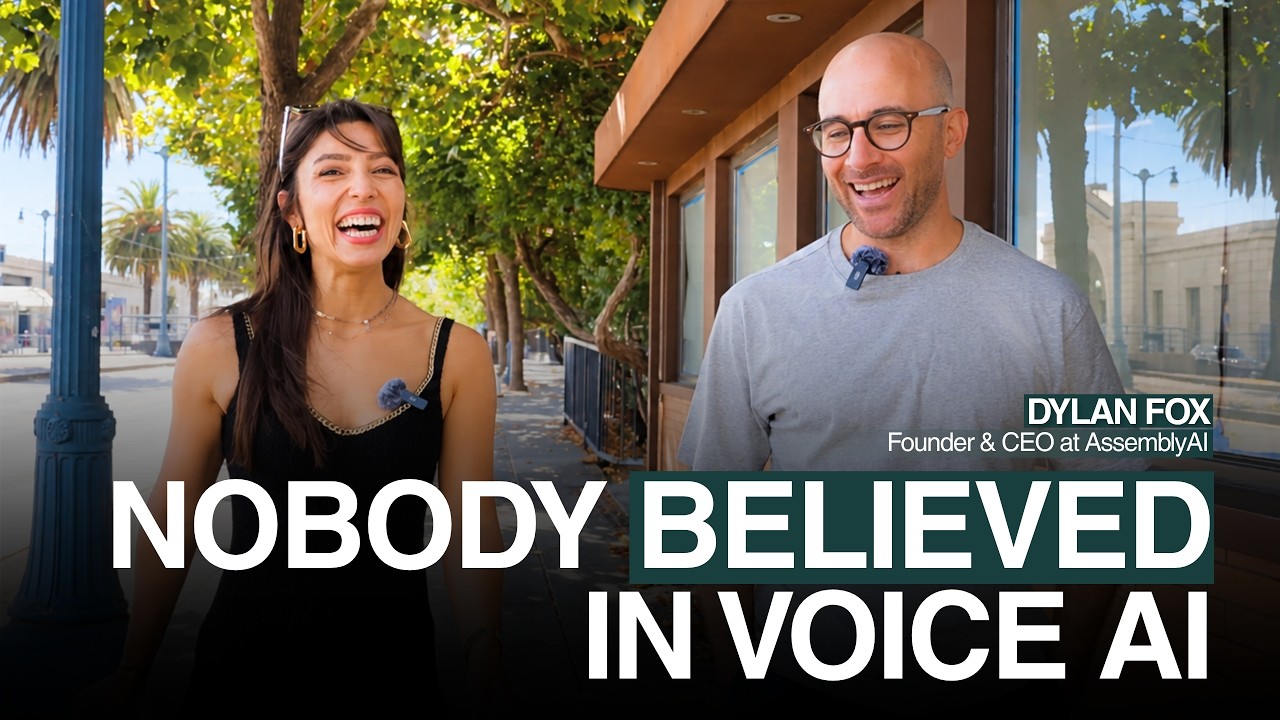
Dylan Fox founded Assembly AI in 2017 as a self-taught engineer with a vision to build voice AI infrastructure for developers, long before the market existed; after a slow first chapter (five years to Series A), the company exploded post-COVID and post-ChatGPT, now serving over 1 million developers, 100 million API calls daily, 3 million hours of audio daily, with ~180% net dollar retention and $130M raised from Excel, Insight, and Y Combinator.
Origin story and early conviction
Fox grew up in New Jersey playing video games and building websites for gaming clans; his older brother built computers, sparking his interest in tech.
He studied economics at George Washington University because “you’re 17, they ask you what to major in, you don’t know,” but barely attended classes senior year while working on startups (a DoorDash precursor for campus toiletries, a textbook marketplace).
He taught himself PHP, Python, and machine learning from books because he needed to build apps for those startups and found the fast feedback loop addictive.
After college, he took a machine learning engineer role at Cisco (2015–2017) rather than founding immediately, wanting to learn more and not force a startup without a 5-year commitment.
At Cisco, he worked on an internal incubator adding natural language interfaces to video conferencing hardware; buying an Amazon Echo blew him away — it was the first voice product that worked well enough to build habits around.
He realized no developer platform existed for voice AI, quit after ~6 months, and started Assembly AI with a small friends-and-family/angel round ($50–100K).
Y Combinator and the first chapter (2017–2022)
Applied to YC a month late, expecting rejection; got in because partner Daniel Gross (ex-Apple, AI investor) believed in the voice infrastructure vision.
Solo founder during YC (wife is also a founder; they were in Denmark when the interview call came); chose to push through the 12 weeks alone rather than recruit a co-founder.
YC was “a whirlwind” — hard to prioritize between training better models (30-day cycles) and finding customers in a tiny market; focus shifted week to week.
Early customers included fellow YC companies like VoiceOps (still a customer today, though they churned once and returned).
First 3–4 person team (Fox, Guru, Michael) built in a “fun but stressful” period with no clear market; Fox never doubted the direction, only the pacing between tech depth and market pull.
Macro tailwinds needed to align: COVID moved collaboration online (audio data surge), podcasts boomed, then LLMs + vector DBs + coding agents created an AI infrastructure ecosystem — only in the last ~2.5 years did demand explode.
Product vision and differentiation
Assembly AI builds voice AI infrastructure: models, inference stack, APIs, and platform so any builder can create voice agents and apps (ambient scribes for healthcare, consumer toys, field-sales copilots, meeting notetakers like Granola, Fireflies).
Differentiation: “It’s easy to get 90% of the way there with an AI product, but the last 10% creates product-market fit” — e.g., accurately transcribing short utterances (“yes,” “mhm”) that break agent experiences if missed; low-latency inference at massive scale; pay-as-you-go usage pricing (no committed contracts).
Net dollar retention ~180% is all real usage expansion, not contract upsells; 40% of 1M+ developers signed up in the last year.
Customers range from consumer apps (Tolan, sticker-printing toys, talking stuffed animals) to enterprise (Athelas/Kimera AI scribes for doctors, Cero AI for field sales techs earning ~$20K more commission/year).
Leadership evolution and scaling lessons
Early scaling mistakes: hired ahead of product-market fit after raising capital, applied traditional sales motions to AI infrastructure (too early in 2023); had to reset go-to-market and rebuild customer journey around self-serve usage-based buying.
Now ~85–90 people, intentionally lean; hybrid/remote-friendly to support parents (Fox has two young kids, prioritizes dinner/bedtime).
Rejects “best practice” stereotypes: 100% usage-based pricing, flat hierarchy, no executive coach — prefers advice from operator peers (Victor at Synthesia, Edo at Pinecone, investors) via informal WhatsApp/text.
Stress management: “desensitized” after 9 years; early YC period was peak stress; now relies on peer founder network (“group therapy”) and investor support (weekly calls with Excel, Insight, Smith Point).
Current challenge: managing hypergrowth — scaling team, supporting existing customers, capturing massive tailwinds from AI application explosion (accelerated by coding agents enabling non-engineers to build).
Personal reflections
Voice will become a primary interface for all hardware/software (TVs, coffee machines, cars, toys), not replacing keyboards/touch but augmenting; edge deployment and low cost critical for consumer adoption.
Fox deleted X/Twitter apps and blocked the site because it was too distracting; may return for company presence.
Still motivated by the unfulfilled product vision: “there’s this really clear in my head product vision that we have yet to achieve.”
Sees himself as a builder, not status-driven: “I really think we can build something awesome here that can help other people innovate and be creative and build really cool things for the world.”