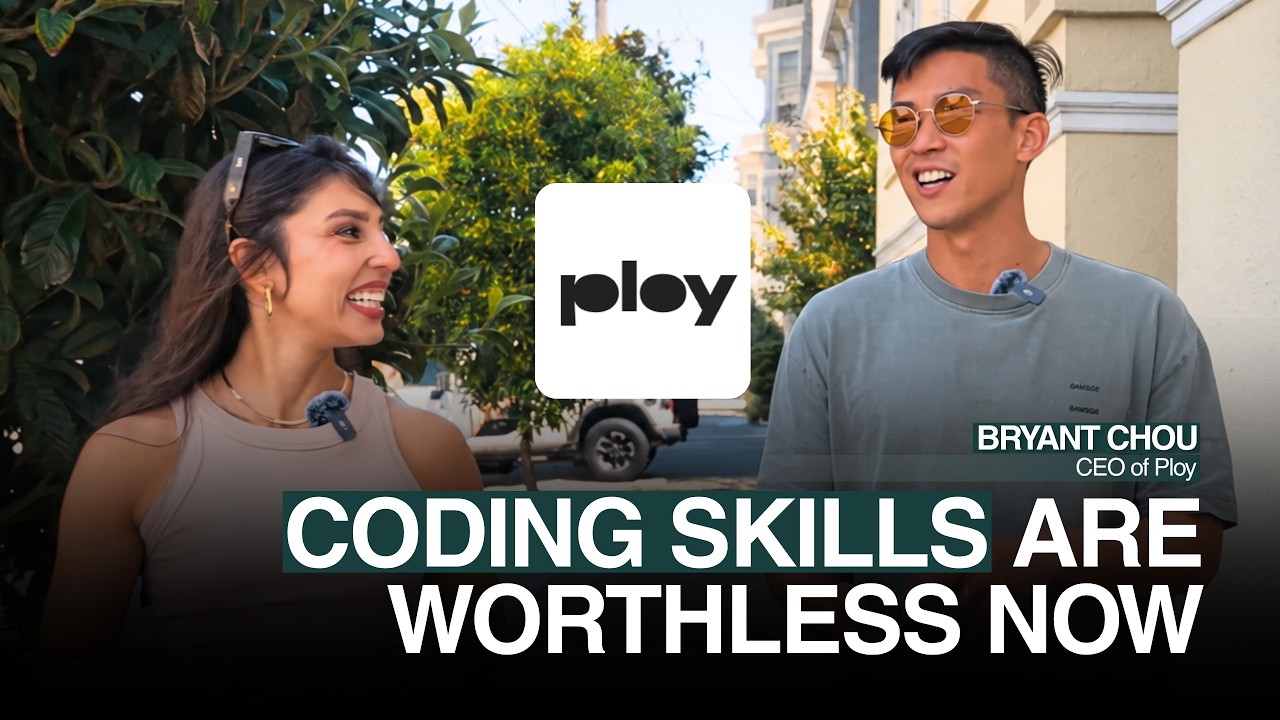
Brian Cho, co-founder and 13-year CTO of Webflow (platform powering roughly 1 in 100 websites), left an 800-person company at age 40 to start Ploy, an AI-native marketing platform, and went through Y Combinator a second time to relearn how to build in the AI era.
Webflow journey and the decision to leave
After 13 years as CTO, Cho also built and led Webflow’s growth and marketing teams, which revealed how chaotic and underserved marketing operations are compared to engineering’s structured rituals.
He realized AI agents could fundamentally change how marketing is done by turning the website into an automated growth engine — the core thesis behind Ploy.
The decision to leave crystallized in a single day: he was running Webflow Labs (innovation division) but felt misaligned with the company’s enterprise trajectory and wanted to build AI-native products for startups.
Webflow’s next phase required enterprise focus; Cho’s passion remained with early-stage founders and the “spirit of entrepreneurship.”
He trusted his instinct that if anyone would build this specific vision — website as intelligent, self-reinforcing growth asset — it had to be him.
Ploy: product and differentiation
Ploy “slurps” a company’s existing website to automatically generate a brand design system and visual understanding, then uses that to create new pages for SEO, CRO, demand generation, and account-based marketing.
It includes analytics, memory, database, and instrumentation out of the box so campaigns can be measured and optimized autonomously.
Differentiation: the AI agent lives in the website, not as an external tool stitched to analytics; it turns the website into a “hardest working employee” that operates while the founder sleeps.
Target customers: tech-enabled startups, solopreneurs, agencies, and non-tech businesses (e.g., home services, private jet brokers) — the 99% of websites not on Webflow.
Why Y Combinator again at 40
Initially declined YC, assuming fundraising would be easy; Gary Tan persuaded him that building in 2026 requires a different playbook than 2013.
In 2013, success required a dense founding team covering every discipline (technical, design, product, commercial); now intelligence is commoditized, and the edge comes from audacious vision, execution, and sharp one-way vs. two-way door decision-making.
YC provided immersion in the “school of innovation”: living 2–3 years in the future alongside founders rethinking AI-native company building, growth, and agent-first products.
Learned from a 17-year-old founder (Raspire.ai) who never signs up for SaaS — everything is agentic via MCP, Claude Code, Codex — forcing rethinking of business models, pricing, and product architecture.
Cold-demoed Ploy at a YC launch event straight from his son’s baseball game; received constructive feedback and experienced the high-trust, mutual-help culture.
Personal history shaping mindset
Grandfather’s story: at 8, sent alone from Taiwan to Japan for schooling; endured discrimination, became judo/kendo expert; at ~20, led student rebellion against Nationalist army takeover, became fugitive in mountains for a year, captured after threat to mother, tortured for 3 days, left for dead in morgue, survived by grabbing a soldier’s pant leg, released after mother forfeited family gold and land.
Grandfather spent rest of life rebuilding family; tracked Cho’s company growth (20 → 40 → 100 → 800 people) with pride; died two weeks after hearing 800.
Family history of lost wealth created complicated relationship with money; Cho’s younger brother is disabled (works at TJ Maxx, won’t drive/marry/have kids), instilling acute awareness that opportunity is a gift not everyone has.
“Scarcity mindset” manifests as healthy fear of death and finite time — maximizing every hour (e.g., wing foiling after 14-hour days) — not financial anxiety.
Unhealthy side: sometimes wishes he could slow down, work out more, see friends more; actively designing Ploy for longevity (refresh days, 60-hour weeks not 996, employee health).
Leadership philosophy and team building
“Founder mode” = trusting instincts, being a beacon of stability, zero tolerance for misalignment (“if you’re not rowing in the same direction, get off the boat”).
Sunday night ritual: posts Monday-morning Slack message reiterating business state, green shoots, worries, and the 1–2 P0 priorities.
Hires for agency: asks “what have you built end-to-end that you’re proud of?” and “what’s the hardest thing you’ve worked on?”; needs engineers to be “many CTOs of their domain.”
Started solo for ~4 months, then brought on two co-founders: Ben (childhood friend, smartest person he knew, wanted to build similar idea) and Will (head of growth, referral, high-energy alignment).
Communication evolution: from “cloak of assuredness” (impostor syndrome armor) to welcoming feedback; credits Webflow co-founders Vlad (kindness as leadership) and Sergiy, plus wife and friends.
Reflections on success, mortality, and what’s next
Success definition shifted: early years = survive zero-to-one, constant “washing machine” of doubt; now = stoic passion, building something worth carrying to deathbed.
Driven by redemption: wanted Webflow to evolve into Ploy-like platform; now building it himself to positively inflect millions of businesses.
Sees himself in founders taking enormous risk; Ploy frees them from marketing grind to focus on their core mission.
At 40 with two kids (6 and 8), wife in climate investing, he’s in a “finite window” of shared interests (bikes, tennis, swimming); prioritizes family time, gets away once or twice a year (aims for quarterly).
No bucket list — “great family, great friends, health, happiness”; Ploy succeeding would be “cherry on top.”
Still becoming: “unwritten chapters I can’t even think about what to come.”