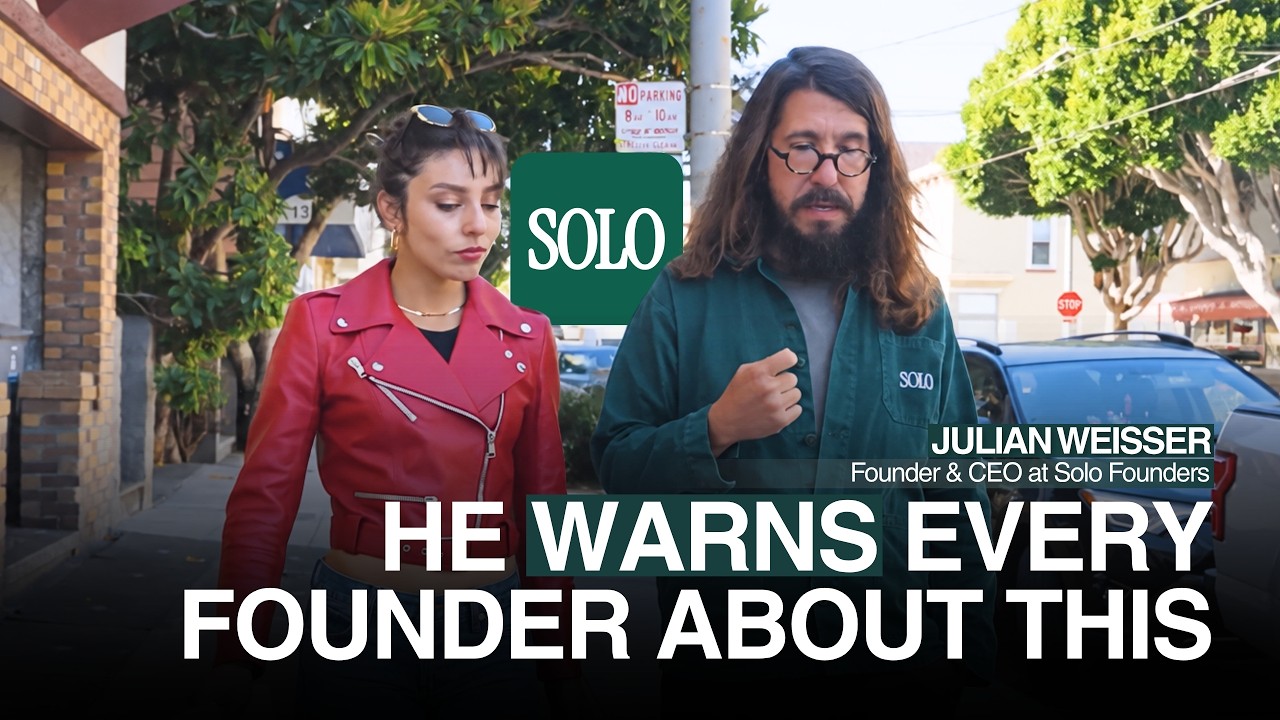
Julian Weisser, founder of Solo Founders and co-founder of On Deck (ODF), reflects on his journey from music school to building founder communities, explaining why he now believes solo founding is an underrated path and how his background in performance shapes his approach to communication, teaching, and company building.
Music, improv, and the roots of a communication philosophy
Julian grew up in a small Connecticut town and chose Berklee College of Music in Boston to immerse himself in a bigger world, not because he had a fixed career plan.
He joined a student-run label, Jazz Revelation Records, initially to meet people; working on a jazz album he didn’t yet appreciate became a “revelation” that taught him to listen across cultures and challenge his own assumptions.
Improv comedy, which he started in middle school, became the single biggest force for breaking out of his comfort zone — teaching him to think on his feet, say “yes, and,” and treat the audience as a partner.
He views performance as advocacy for the audience: on stage you rise to the room’s energy; one-on-one you meet the person where they are (e.g., making a tired, disengaged partner laugh before pitching).
The “mask” metaphor: it’s not about being inauthentic, but about bringing the part of yourself that fits the context — like a teacher adapting to each student, a principle he traces to his parents and to Keith Rabois’s idea that every direct report should describe their manager differently.
From Boston to San Francisco: discovering startups as self-expression
A cross-campus forum linking Berklee, MIT, MassArt, and Emerson let him collaborate with technical founders who needed help with everything except code; he jumped in to learn, not to lead.
He saw software as the digital equivalent of recorded music: once duplication costs hit zero, a product can reach anyone, anywhere — a form of self-expression that scales like a song on Spotify.
His first real startup artifact, Bundio (a Dropbox-API layer for artists to share exclusive content with fans), flopped on Hacker News but caught the eye of Dropbox employee #1, Aston, who became a friend and his entry point to the Bay Area.
He moved to San Francisco for the tech scene and the geography — Golden Gate Park’s transformation from sand dunes to a living, evolving masterpiece mirrors what he loves about building: you can create a world people inhabit.
Building On Deck: 27 cohorts, 1,000+ founders, $2B+ raised
ODF began as Eric’s community for people secretly exploring founding while employed; Julian, Eric, and David turned it into a business focused on the exploration phase, not just co-founder matching.
The early magic: celebrating quitting a job to explore, not announcing a company — creating a space where people saw others a few steps ahead and realized they weren’t alone.
Julian’s role was founder-facing: he ran admissions, events, and 1-on-1s across 27 cohorts, getting “reps” no VC or operator role could provide — seeing what works and doesn’t across co-founder dynamics, idea validation, MVPs, fundraising.
Those reps forced him to communicate the same concept in different ways until it landed; he internalized Feynman’s idea that if you truly understand something you can explain it to a four-year-old or an 84-year-old — and if they don’t get it, it’s your fault.
Why Solo Founders: the constraint shifted from “no co-founder” to “belief you need one”
By 2024 the bottleneck wasn’t finding a co-founder; it was the widespread, often unexamined belief that you must have one — a belief Julian saw holding back founders who already had momentum.
He noticed “oddballs” in ODF — solo founders like Selene (Loyal) and John Andrew (Wander) — who built ambitious companies without co-founders, often because they had a strong supporter or simply decided to start.
AI and tools like Replit lowered the technical bar, making the “co-founder as technical necessity” argument feel like a car phone in the smartphone era: once useful, now often optional.
Co-founders can be great if there’s deep alignment (shared cult-like belief or clear vision/support split), but most are “co-founders of convenience” — driven by fear of loneliness or investor expectations — and the downside (deadlock, misaligned exits, equity disputes) is catastrophic.
Solo founders don’t automatically own 100%; they should strategically give more equity to early employees because they have a larger pool to allocate — equity as a creative canvas, not just a scoreboard.
Solo Founders as a jazz ensemble: structure for improvisation
Julian sees Solo Founders (the program) as a song he wrote — core melody and harmony — where the team and the founders are the band members improvising within the form.
Jazz, not orchestral music, is the model: a standard like “Stella by Starlight” sounds radically different depending on who’s playing bass, drums, or horns; the leader sets the tune, but everyone’s voice shapes the performance.
This applies to the internal team (each person plays their instrument their way) and to the founders in the program (solo founders have decision freedom — hiring, fundraising, exits — that co-founders split 2-3 ways constrains).
Selene exemplifies the solo-founder storyteller: at 22-24 she pitched dog longevity with such practical conviction it sounded inevitable, not fantastical — her personality became the company’s strategy.
Personal operating system: keep going, don’t box yourself in
Morning ritual: cold plunge in the Bay (biking there daily when possible) to reset the nervous system.
Re-reads books that change meaning with age — A Christmas Carol annually, To Kill a Mockingbird every decade — because characters at different life stages become new mirrors.
Life philosophy in two words: “Keep going.” He resists single-sentence credos because they feel like boxes; the only constant is continuing to learn, help, and contribute.
Optimizing for: how many people he can help work on something that feels like a true expression of who they are.