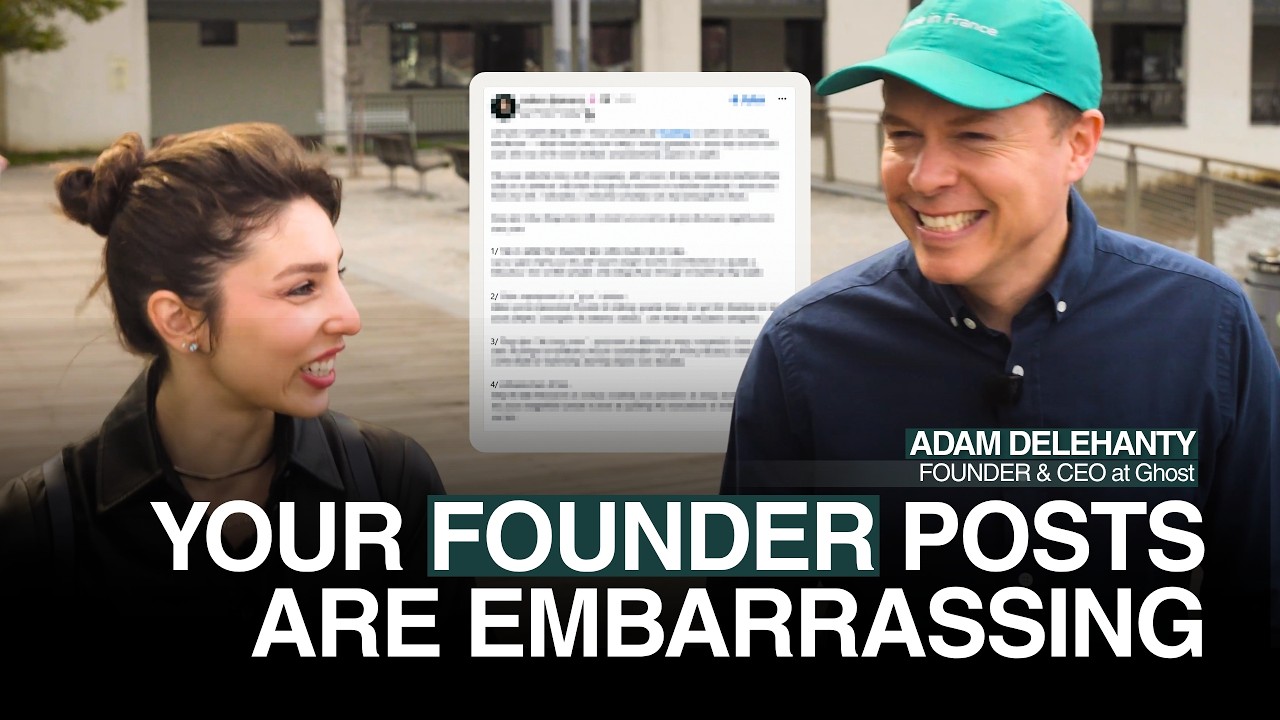
Adam Delehanty, founder and CEO of Ghost, runs a ghostwriting agency that writes culture books for companies like Hinge, Duolingo, and DocuSign, and helps founders and VCs tell their stories; the episode explores how he distills messy internal documents into a single compelling narrative, why culture breaks between 200 and 1,000 employees, how he cuts sprawling value lists down to the few that are actually true, and why he treats ghostwriting as “journalism times therapy” — plus his human–Claude–human writing workflow, his nightly writing ritual, a four-day phone-free retreat, and his obsession with precise language.
What Ghost does and why companies hire them
Ghost writes “culture bibles” — single, tight, compelling artifacts that replace a mess of Slack threads, Confluence pages, and Notion docs with one story the company can orient toward.
The before state: companies drowning in scattered documents, internal confusion, and no shared lore; the after state: one compass that aligns the team and acts as a talent magnet by signaling “this is how we think.”
Two main drivers: internal alignment (especially when culture starts dissipating across Slack, Zoom, and international offices) and external recruiting (a public manifesto attracts people who say “I love the way these people think”).
The work is not invention but curation: picking the decisive product and strategic moments the company is proud of and wants to repeat, then editing them into a coherent narrative.
When culture breaks and why it matters
Culture holds naturally up to ~150–200 people (Dunbar’s number); between 200 and 1,000–2,000 it starts to dissipate across tools, time zones, and lack of shared space — that is the sweet spot to write a culture book.
Culture is the shared identity and the “big why” — the reason people choose this company over every other option, especially when AI handles more execution and human motivation becomes the differentiator.
A culture book fails when it is written by committee: executives produce 10–12 values because no one says no, yielding a list no one can remember, follow, or care about.
Cutting 12 values down to the 4 that are real
The method: interview dozens of employees to surface actual behaviors, then cross-reference with strategy — keep only the ideas that are both true (people already do them) and directional (they nudge the company the right way).
Example: a stated principle that nobody actually practices gets cut; the remaining few become the spine of the book.
The goal is not aspiration but accuracy — a culture book that describes the real operating system so it can be reinforced and scaled.
Founder storytelling: motivations, process, and the “journalism times therapy” frame
Delehanty looks for founders with a personal connection to the problem — a void of motivation (pure market opportunism) makes it hard to recruit people to devote their careers; the strongest stories come from lived experience that the founding team shares.
His process: act as an “internal journalist” — ingest the founder’s idiosyncratic mental models (how they think about life, business, talent, product) and get them on paper.
Ghostwriting = journalism (telling the story) + therapy (creating space to become a new person by diving into what drives you); when it works, it can be transformational for the founder’s life and business.
Delehanty’s own path: wanted to be a long-form investigative journalist; those jobs were scarce, so he became a journalist for clients — extracting narratives that never get told from the inside.
Personal branding, LinkedIn, and “don’t talk about your product at a bar”
Founders should lean into their native medium (podcast, long-form writing, short posts) — stretching outside your fluency zone reads as cringe.
The bar test: if you met someone at a bar and they only pitched their B2B features, you’d run; online, mix in personal anecdotes, worldview, reactions to news — people follow people, not feature lists.
LinkedIn advice: ignore viral-formula articles (hooks, one-sentence paragraphs, engagement-bait questions); the only rubric — is this interesting? would I read it? would I share it? am I proud of it? — then post less often but only when the bar is met.
Ghost’s founder content engine: ingest past content, do one 60–90 minute conversation per month, generate multiple posts from that — founder gets better output for far less time.
The human–Claude–human writing workflow
Sandwich model: human at the beginning (interview, co-create, generate the story), Claude in the middle (first draft, programmed via Claude Code to write in a specific voice), human at the end (eliminate every ounce of slop, make it idiosyncratic, funky, funny, weird).
For DIYers: dump your expertise, intentions, reading, and thinking into Claude; ask it to interview you with 10 questions; go on a walk and talk through answers verbally (often better than writing cold); writing need not be solo — riff with a friend, record it, transcribe.
Training Claude as an editor: feed it examples of writing you like/dislike, show track-changes edits, teach it to self-rate and recursively improve — but Delehanty still does a final human pass on every piece.
He is not worried about AI replacing the high-touch advisor role: the co-creative journey, the mirror he holds up (“this story is worth publishing / this is a dead end”), and his decades-on-the-internet taste are hard to automate.
Writing as thinking and self-actualization
“Writing is how we figure out what we think” — the process itself makes you smarter and arrives at new places; skipping it (as students now do with AI) weakens human prospects.
At the deepest level, writing is self-actualization: you write your new story and it becomes who you are.
Private vs. public writing: private (nightly 10-minute handwritten journal — recap day, plan tomorrow, stray observations, clears the deck for sleep); public (announce projects, hold yourself accountable, invite dialogue with the internet).
Delehanty has hosted a weekly writing group in his sunroom for 100+ weeks.
Digital detox, retreat, and curating original inputs
After a heavy travel/social summer, he did a four-day solo retreat in the woods: phone and laptop locked in car, keys hidden; a coach opened the container, left, returned for dinner the last night.
Without the phone, unresolved relationships surfaced repeatedly; he wrote seven or eight handwritten letters to people he needed to address — patterns from the subconscious that constant distraction had buried.
He plans an 8-day Vipassana retreat next; believes such offline space will become rarer and more necessary.
On originality: Williamsburg (and NYC) has lost its fringe artists due to cost — fewer weird, original people can afford to enter; originality now lives online (Reels, Substack, art/film worlds) and in primary sources.
Practical tips: get off the scroll, go to the primary source (read Ted Sorensen’s actual speeches, not TikToks about them), talk to people no one else interviews, go places influencers haven’t bombarded — nudge toward the weird, hard, unusual thing.
Language precision: word choice as truth-telling
“Partner” obscures — business partner? spouse? boyfriend of a decade? — “spouse” is clearer; if “boyfriend/girlfriend” feels awkward after years, the real conversation is why marriage hasn’t happened.
“Dude” from a woman to a man often quenches romantic/sexual tension — once noticed, seen everywhere.
Tech title inflation: adding “engineer” to non-engineering roles (GTM engineer, growth engineer, copy engineer) to seem closer to code and more deserving of money — deceitful; just call yourself a writer, marketer, etc.
“Member of technical staff” — a flat, trendy title that obscures more than it reveals.
Becoming a student of language: don’t force it if it’s not your zone; but anyone can practice simplifying, being more concise, clarifying communication — it refines thinking.
Life philosophy and what’s next
Mantra: “Everyone should use the language that their ideas deserve.” — brilliant people stay silent from embarrassment while shameless people flood the zone with subpar ideas; that is a disservice to the internet.
Finding that language: write your thesis on life, share with friends, get feedback, iterate — baby steps toward expression that matches genius.
Still becoming: happy with business and social life; compass pointed toward traditional domesticity — marriage and family — ready for the next chapter.