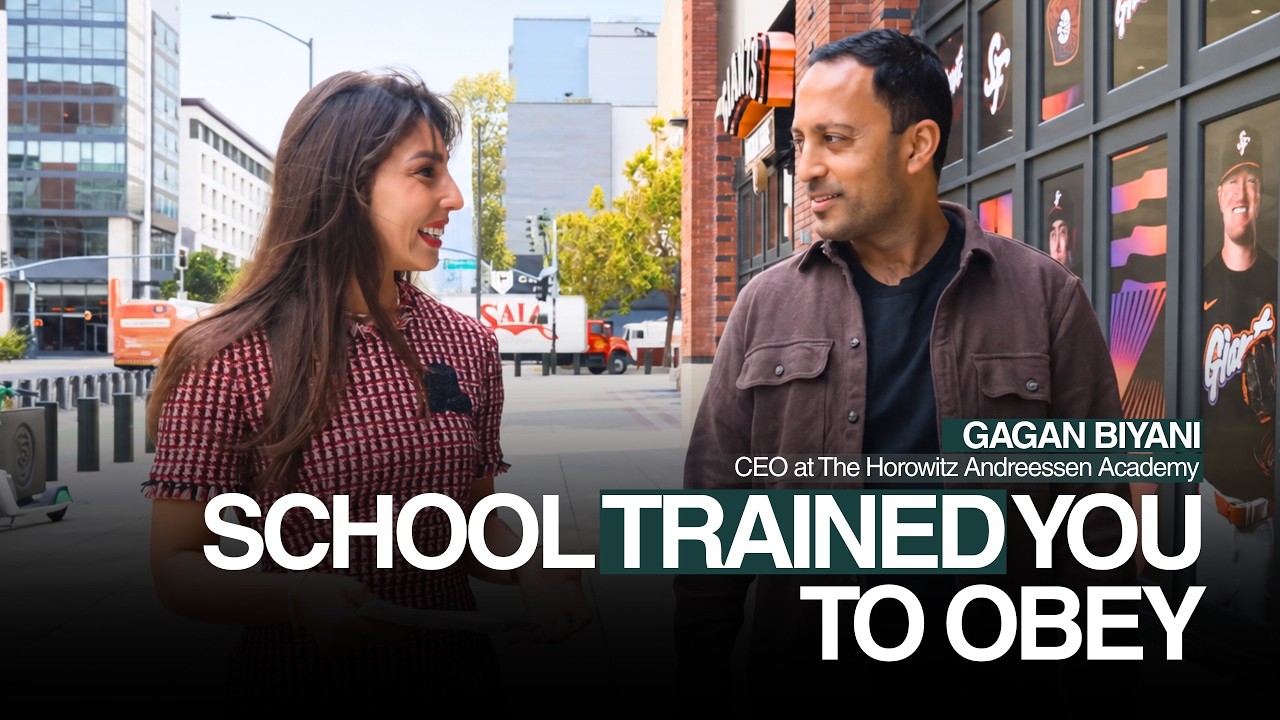
Gagan Biyani, co-founder of Udemy ($2B public company) and Maven, is now founder and CEO of the Horowitz Andreessen Academy, a new school backed by a16z with $42M and founding partners Anthropic, OpenAI, Google, and Nvidia; Mark Andreessen sits on the board, and the first class of 50 students pays no tuition.
The academy: a one-year fellowship built around building, not class
The academy is a school designed specifically for young builders straight out of high school, starting with a 12-month “founder class fellowship” and eventually expanding to a two-year program.
The model flips traditional college: students spend the vast majority of time creating real projects rather than attending classes, though top practitioners still teach skills like product sense, AI-native architecture, and new media.
The goal is to develop humans with three core characteristics: AI-native building (systems thinking using today’s tools), high agency (ownership over one’s impact rather than rule-following), and people skills (conversation, storytelling, rallying others — skills that are “AI-proof”).
The environment is built for self-starters and autodidacts who are bored by standard pacing; it is explicitly not for people who want to be told what to do.
Why schools suppress agency and how the academy differs
Schools reduce student agency to minimize liability and create predictability, but this trains rule-following over ownership — a mismatch with what makes great employees and entrepreneurs.
The academy’s culture aims to distinguish good rules from bad ones: students can challenge norms if they have a good reason and engage in conversation, rather than facing automatic suppression.
Peer network is central: the academy recruits the top 1% of young builders so they can feed off each other, replicating the “best network” value proposition of elite colleges but focused on makers.
The broader network includes a16z’s ecosystem of CEOs, VCs, and mentors — a structural advantage over traditional universities.
Gagan’s path: from Rajasthan grandparents to Udemy, Sprig, Maven, and the academy
Two generations back, none of his four grandparents finished high school in Rajasthan, India; his father became a software engineer in the US, and his mother made education the singular family priority.
At 13, he co-founded a speech and debate camp teaching younger kids, reaching 50–100 students per summer with ~50% EBITDA margins funding the school program — but faced constant resistance from administrators worried about liability, not support.
At UC Berkeley, he graduated in three years, held seven jobs, rarely attended class, and loved only the great professors (e.g., Econ 1); most professors prioritized research over teaching and lacked practical experience.
Udemy democratized education via a marketplace model (courses $10–20), becoming one of the largest education sites globally; he left after 3.5–4 years due to a co-founder falling out, a hard lesson in interpersonal skills that later shaped the academy’s emphasis on people skills.
Sprig raised $60M building full kitchens and delivery in SF (1,300 employees at peak) but shut down; notably, many Sprig investors reinvested in Maven — a “fail upward” dynamic Gagan calls unique to Silicon Valley.
Maven became an AI training platform for mid-career professionals with practitioners from OpenAI, Anthropic, etc., teaching function-specific AI skills plus leadership; after six years, it’s pivoting to B2B enterprise training under new CEO Rish (former VP of product).
Why partner with a16z instead of going solo again
Great ideas are rare; raising VC at 18–19 is a 10-year commitment most young people aren’t ready for — the academy gives them a peer network and time to mature before that leap.
The idea originated inside a16z (originally “a16z Academy”); Andrew Chen (Maven board member) brought it to Gagan, who immediately wanted in. After ~10 meetings with Ben Horowitz, Mark Andreessen, Jason Rosenthal, and Eric Torenberg, the partnership formed.
a16z provides two networks: the peer cohort of elite builders, and the mentor/VC/CEO network only a top venture firm can convene. Mark Andreessen and Eric Torenberg joined the academy’s board.
The academy will eventually spin out with its own brand but launches with a16z’s network fully activated — dozens of “legends” involved as investors, faculty, speakers, and mentors from day one.
Leadership challenges and personal growth
Gagan retains founder/CEO latitude; a16z’s culture (e.g., Eric Torenberg’s “I leave that to you”) reinforces trust while offering access to world-class advisors.
Biggest worry: recruiting the absolute best students globally, then preventing entitlement (“I got into a16z Academy”) and pressure — he wants high ambition with high support, low pressure, and a culture of humility where what matters is what students build after.
He’s learning to be more patient and to keep “breaking rules” thoughtfully: the academy will have few but good rules, and students must discuss rule-breaking with staff rather than act unilaterally.
Key mentors: Andrew Chen (strategic, patient, marketing/go-to-market mastery) and Russ (seven-time entrepreneur, multiple IPOs, brutally direct yet warm — taught tactical VC negotiation and compensation conversations).
The north star: build the greatest school on the planet
Gagan wants to prove an alternative to traditional college can work at scale, inspiring existing institutions to evolve — especially as AI reshapes what education should deliver.
The vision is not anti-college but pro-better: create the next great institution where the most ambitious young builders get the freedom, peers, mentors, and practical skills to shape the future.