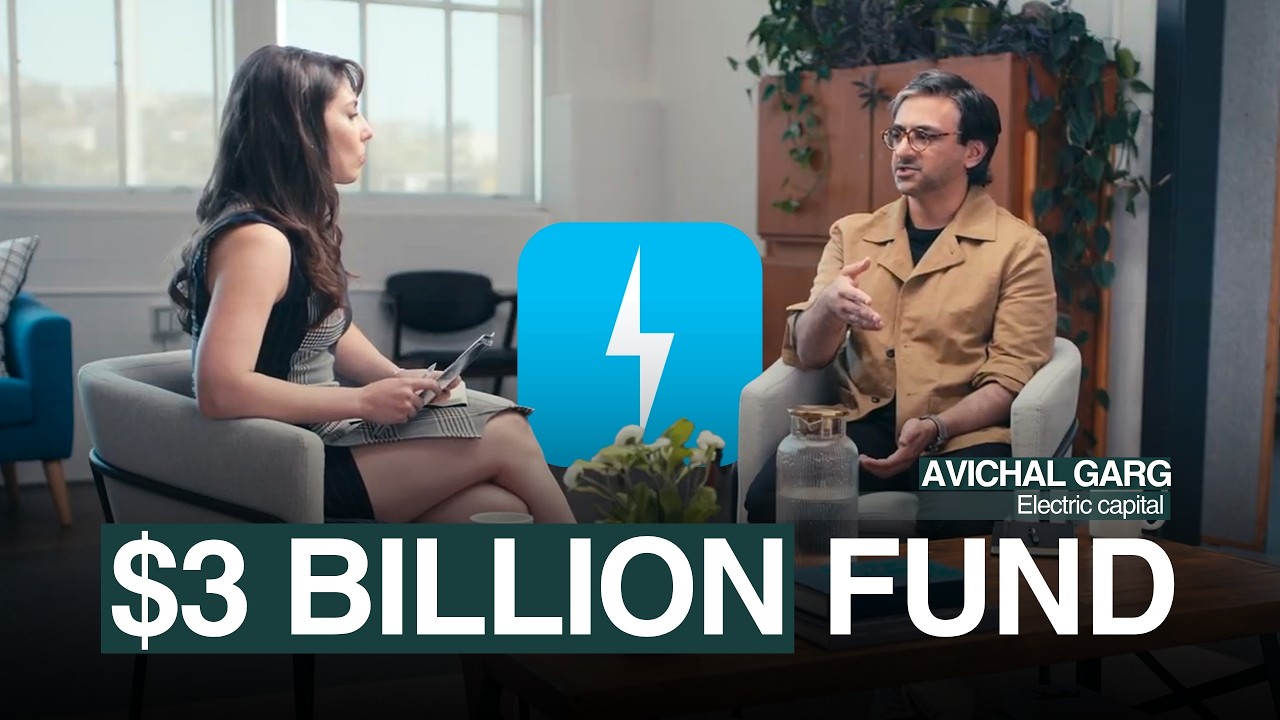
Avichal Garg, co-founder and General Partner at Electric Capital, shares his philosophy on investing, founder psychology, and building a venture firm that operates more like an artist collective than a traditional financial institution — rooted in the belief that progress comes from identifying outliers and giving them disproportionate resources.
Watches, luxury markets, and the AI parallel
Mechanical watches survived the quartz crisis by recasting themselves as luxury goods whose value comes from “proof of work” — hundreds of hours of human craftsmanship that machines cannot replicate.
Garg sees a parallel with AI: as utilitarian tasks get commoditized, things that provably require human effort (craftsmanship, relationships, physical-world skills) may become more valuable, not less.
Industries with regulatory moats (defense, healthcare), deep physical/biological constraints, and human-mediated decision-making will likely remain defensible and even see margin expansion as AI handles the commoditized work.
”Opportunity is a luxury” as a guiding principle
Garg’s early realization: being in Silicon Valley with access to capital, talent, and information is a form of privilege greater than money itself.
The best products are extensions of their founders’ uniqueness — their values, beliefs, and worldview — not just utilitarian problem-solving.
This insight reframes venture capital as closer to Rick Rubin (nurturing artistic expression) than Warren Buffett (allocating capital based on financial metrics).
Founders as artists, not operators
Great founders (Ivan Zhao at Notion, Dylan Field at Figma, Zuckerberg, Larry/Sergey) express a distinct, opinionated worldview through code; the company is the medium.
Founder-market fit, founder-product fit, and founder-culture fit are all manifestations of this authenticity — Google’s PhD-culture made it great at research but bad at commodity network-effect businesses like social.
Authenticity cuts through market noise because humans have a primal ability to detect it; markets (collections of humans) reward it, giving authentic founders a shot at distribution.
Authenticity requires intrinsic work
Extrinsic factors (market size, CAC, LTV) matter, but the intrinsic exercise — “what can only you say?” — is what makes a founder distinctive.
Garg processes the world through talking and writing (like Eminem writing lyrics vs. Jay-Z internalizing); long-term trusted relationships (Curtis, 20+ years) serve as sounding boards that sharpen thinking.
The Buddha parable: you must experience success first to credibly say “money doesn’t matter” — scarcity mindset forces founders to chase every opportunity; financial safety enables deliberate choice.
Betting on outliers as a life philosophy
Garg’s through-line: civilization advances through small numbers of outliers (Einstein, Elon, Lee Kuan Yew) who catalyze disproportionate change; society should identify them and give them 10-100x resources.
Great universities (Oxford, Harvard, Stanford) historically served this function — brand attracts talent, provides ground truth, peer networks, capital, and validation — and are among the most durable institutions in history.
Electric Capital replicates this formula: brand so outliers find them, ground truth from domain expertise, peer networks, capital (though small relative to GPU costs), and validation (“you’re in the same category as Zuck/Elon at 22”).
Spotting talent and the Elad Gil catalyst
Garg realized circa 2017-2018 (after angel investing since ~2014 with ~10/30 companies becoming unicorns) that he was better at finding entrepreneurs than being one.
Elad Gil catalyzed Electric: owned the domain, helped structure the thesis, flew to NYC to pitch LPs, iterated on the deck — “we wouldn’t have gotten off the ground without him.”
YC visiting partner experience (2016-2018) reinforced reverence for founders: Paul Graham and Jessica Livingston’s genuine love for founders, listening intently to alumni at dinners, embodying the “sand the inside of the drawer” care.
Why crypto was the wedge for Electric
Startup strategy: pick a beachhead incumbents ignore, bet the market is underestimated, use advantages to expand — crypto was that beachhead (legacy firms except a16z avoided it).
Thesis: Ethereum created a new platform; “software eating money” — programmable money → stablecoins → on-chain capital markets → venture capital itself moves on-chain.
Corollary: when software eats an industry, software engineers win (Amazon vs. Walmart, Tesla vs. legacy auto, NYT vs. other newspapers) because critical levers become software-enabled; professional CEOs can’t reorganize power structures the way founders can.
AI’s impact on power dynamics
Software engineers and founders become more empowered as software commoditizes — branding, culture, orchestration, problem definition matter more.
Historical pattern: those who go 1-2 levels deeper in the stack (designers understanding frontend/APIs, backend engineers understanding infrastructure/chips) retain leverage; CS fundamentals remain critical even as the leverage point shifts.
Market corrections and conviction
Garg prefers bear markets: bull markets encourage overconfidence, “drinking the Kool-Aid”; corrections disconnect price from reality, creating opportunities to buy conviction cheaply.
Human biases (poor intuition for large numbers, exponentials, low-probability events) make startup investing counterintuitive — when something works at 50M users, it likely reaches 1B.
Failures: being too early (Cruise/self-driving regulatory complexity) or backing phenomenal technologists who can’t make the CEO transition (technology later commercialized by others).
Checking convictions and the firms Electric modeled after
Surround yourself with smart, first-principles thinkers who’ve built enough trust to disagree comfortably (Curtis, Steve, long-term colleagues) — disagreement resolves through surfacing different assumptions/data/reasoning.
Five explicit models: YC (founder reverence), Founders Fund/Peter Thiel (no boxes, willing to be misunderstood), a16z/Andreessen-Horowitz (founder as artist, build framework around them), Reid Hoffman (blend access/capital/info creatively), Elad Gil (market selection + unmatched helpfulness).
Sequoia/Don Valentine admired for market selection and “good is not good enough” durability, but harder to directly model.
Honesty as the core operating principle
“Not putting yourself in a box,” “willing to be misunderstood,” “first-principles thinking” all flow from radical honesty — with yourself and others.
Most people are dishonest not from malice but because truth has social/professional cost (accountant can’t admit they’re overbooked); honest people assume others are honest and get burned.
Electric’s struggle: hiring engineers who build great product (internal tooling like “Quest” agent system replacing junior analysts) but are bad at talking about it — brand as proxy for trust, built durably through product excellence not noise.
Over-committing resources to founders
Electric’s product: founders know “we’ll do the right thing for you” across a 10-year journey, not just one company.
Demonstrated by over-committing: Garg and Curtis are lowest-paid; GP cash comp redirected to hire full-time operating partners (ex-WhatsApp/Instagram/Facebook HR head Baz, etc.) who embed in portfolio companies 3 days/week.
Founder summits, dinners, deck editing, customer calls — “do whatever it takes” — but the core is caring more than makes rational sense, which founders sense intuitively.
Dodging SBF and reading fake authenticity
Passed on SBF twice: fundraising behavior/language didn’t match actions, math on FTX/Alameda money flows didn’t add up, bright-line rule against “saying one thing, doing another.”
Acknowledges luck: if CZ hadn’t triggered FTT collapse, SBF’s Anthropic stake would have papered over the hole — “we may never have found out.”
Best founders are ridiculously honest, intrinsic storytellers, unboxable; worst founders lack these traits — lessons continuously compiled from “no” decisions that were wrong.
Personal life and life philosophy
Married to a founder 16+ years; no work-life separation — careers are the things they’d do for fun anyway, friends are founders/engineers, “product-market fit trumps everything” (if it clicks, run with it).
Most proud/grateful for: people who supported him at right moments, and having made good on paying it forward.
Life philosophy in one sentence: “Everybody really cares about something and is an outlier at something — society should find those people and give them disproportionate resources to pursue exactly those things.”