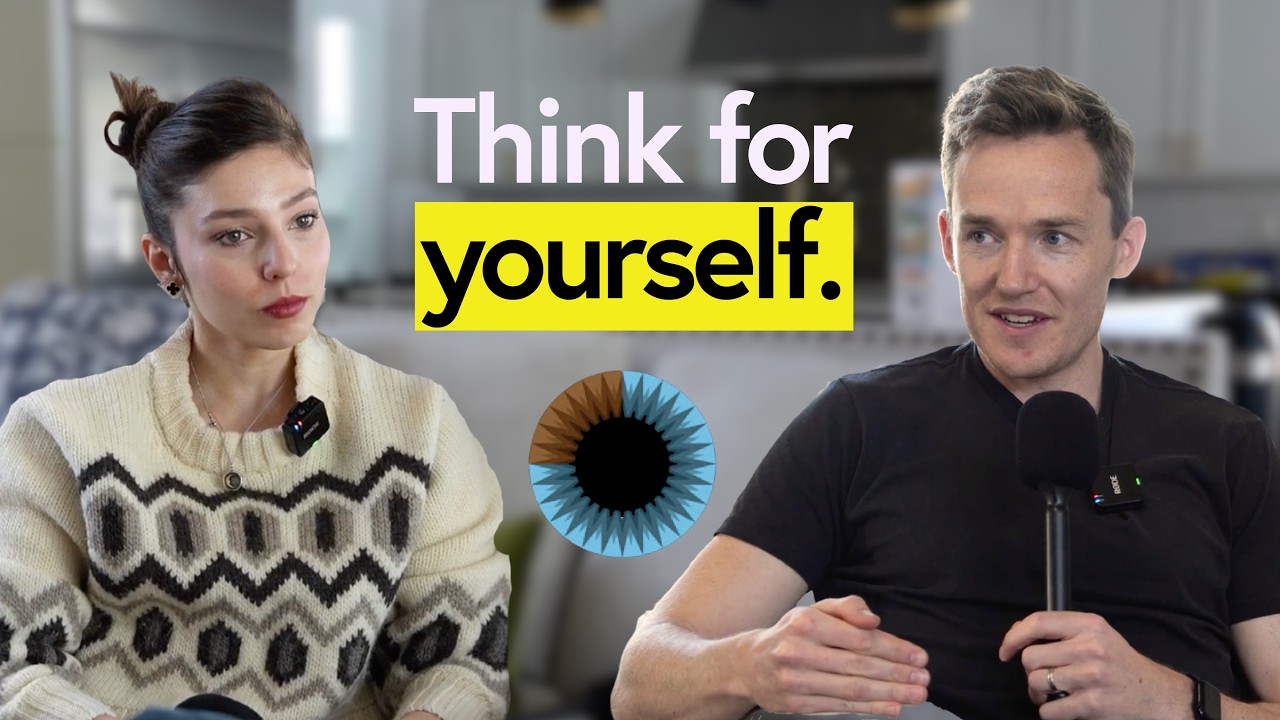
Grant Sanderson (3Blue1Brown) joins Luba to reflect on a decade of creating math YouTube videos, his creative process, and how he’s planning to evolve his channel with a small team and a new business model. The conversation moves between practical craft (speechwriting, pauses, animation), deeper philosophy (beauty in math, motivation vs. explanation, personal growth vs. service to others), and concrete next steps for the channel.
How He Writes a Wedding Speech
Grant was asked the day before a mutual friend’s wedding to give a toast, and delivered what many guests called the best wedding speech they’d ever heard.
The speech wove together nuclear fusion equations, detailed personal observations about the bride and groom, emotional vulnerability, and a romantic quote in a foreign language — all without notes.
His process: He started by figuring out the ending first, asking an LLM for romantic sayings in the couple’s language (it hallucinated a beautiful fake quote, which he used anyway). He then worked backward, knowing he wanted to open with a science joke and close by landing on that quote.
Key speech principles:
Never use notes — it kills the liveliness. Memorize it or speak from the heart, but don’t read from a phone.
Know exactly how you’ll start and especially how you’ll end. A strong ending is what people remember and tells them when to clap.
Use deliberate pauses. Instead of “um” or “so where were we?”, look meaningfully at someone in the audience as if the pause is intentional. Internally you’re thinking “where am I?”, but externally it looks confident.
Lower expectations by appearing casual, then exceed them by being well-prepared. The gap between “this seems off-the-cuff” and “this was clearly structured” is where the magic lives.
He traces this skill partly to a stern Hungarian violin teacher who taught him to never show the audience when you’ve made a mistake — just keep going with confidence.
Going Full-Time on YouTube
Grant didn’t set out to be a YouTuber. He started making videos near the end of his Stanford undergrad, initially not even understanding what a “subscriber” was.
Early mentors included Henry Reich (MinutePhysics), who offered encouragement before Grant had any real output, and connections at Khan Academy, where he did a fellowship after winning their talent search.
Growth was steady — roughly 10% subscriber growth per month over multiple years — not explosive. A notable spike came when Vsauce (Michael Stevens) mentioned one of his videos, adding ~30,000 subscribers overnight, a kind of cross-promotion that was more common in that era.
He eventually left Khan Academy to focus on the channel full-time, partly because of conflicts of interest, but also because he loved the work: building his own animation tool, making educational content that felt genuinely valuable, and the creative fulfillment of coding something from scratch.
He originally envisioned becoming an academic mathematician with outreach as a side channel. He let go of that identity not because he stopped loving math, but because he realized what he actually loved — teaching, outreach, finding the “right” perspective on known results — didn’t require academia. The cost: some entities don’t respect his lack of a PhD. The benefit: math is objective, so people judge the ideas on their own merits.
Explain It vs. Discover It
Grant describes himself as someone motivated by deeply understanding things that already exist, not by being the first to discover something. He’s drawn to ideas that have already proven their significance, then asks: “Why is this true? What’s the cleanest way to see it?”
He compares this to software: the first version of an idea is often awkward and tied to a specific use case. The cleanest expression emerges only after it’s been used, taught, and refined. He sees a role in finding that cleanest expression.
Over the years, he’s shifted from prioritizing novelty (a proof or perspective no one has seen before) to prioritizing clarity and usefulness. His most impactful series — Essence of Linear Algebra — contained no novel insights, just aggressive visualization and motivated formulas. Students at universities still thank him for it.
He still loves novel, surprising content (like pi appearing in unexpected places), but recognizes that the topics people most want to understand are often the standard ones. Being a smaller channel rewards niche novelty; being a larger one lets you add value to well-trodden topics through superior delivery.
Be a Source, Not a Relay
Grant distinguishes between sources (creators who digest ideas and present them with a distinct perspective) and relays (creators who simply pass along what a book or paper already said).
At the macro level (topic choice), he’s fine covering standard material. But at the micro level (how exactly you describe something), he’s ruthless about finding something distinctively his own — a way of framing, visualizing, or motivating an idea that couldn’t have come from anyone else.
Loyal followings come from creators who are sources. Audiences can sense when someone is genuinely thinking on screen vs. translating someone else’s thinking. The goal is that someone thinks, “I never would have watched a video about X, but Grant made it, so it must be worth my time.”
His Creative Process: Mulling, Not Researching
Grant doesn’t have a discrete “research phase” for videos. Instead, he maintains a long list of topics he wants to understand and ambiently mulls them over months or years — reading, playing with code, thinking about what would make the idea click.
A video idea only moves to active production when he feels confident he has a clear vision for how to explain it, including core visuals and motivation. This is why his explanations feel deep rather than journalistic: by the time he makes the video, he’s been living with the idea for a long time.
He never reverse-engineers content to fit a schedule. He uploads when something is good, not when a calendar says so. This is partly why he hasn’t experienced the burnout many creators describe — he’s never been on a treadmill.
Why He Isn’t Burned Out (and Why Others Are)
At creator conferences, Grant notices that many peers who’ve been doing this for 10 years are exhausted and want to stop. He introspected on why he feels the opposite — energized and wanting to continue for at least another decade.
Key factors:
No team (until now): He works largely solo, so there’s no payroll pressure, no organizational engine that must keep running. Many creators need teams to maintain their cadence, which creates minimum revenue requirements and stress.
Evergreen over topical: He optimizes for content that will be watched 10 years from now, not for hitting a trending moment. This removes the anxiety of “did I catch the wave?”
He loves the craft: Animating is his happy place, not a chore. Many creators outsource animation because they hate it; for him, it’s how he thinks through the content.
Privilege: He acknowledges this setup is a privilege. Not everyone can afford to work solo or skip sponsorships.
Metrics and the Algorithm
Grant’s guilty pleasure is watching real-time view counts in YouTube Studio — a dopamine hit he admits is useless for decision-making.
He thinks most creator anxiety about “the algorithm” is really anxiety about the audience. When people say “the algorithm wants good thumbnails,” they really mean “people only click on compelling thumbnails.” Replacing “the algorithm” with “the audience” in almost any creator complaint makes it more accurate.
The algorithm does diverge from audience interests in some cases (e.g., YouTube wants you to stay on the platform; you might close YouTube to go apply what you learned). But 90% of the time, optimizing for what the audience wants and what the algorithm rewards are the same thing.
His north star metric: Not total views, but how many people are watching right now (watch time per month, normalized). He wants videos that are being actively watched years later, not videos that spiked and faded.
Fun Work vs. Strategic Work
Once he’s 20% into a project, the process is about craft and is genuinely fun — thinking about how to animate a proof, how to make a concept click. The strategic layer (what to make, what to optimize for) feels more like work.
He plans content for the year but doesn’t follow the plans rigidly. Projects expand, new ideas hijack his attention, and half the planned goals get met. He wants to be more disciplined about completing curricular series (like Essence of Probability, which has been stalled for years with unpublished drafts) because he knows they’d have lasting impact.
The tension: curricular series are high long-term value but lower short-term reach. One-off videos on trending topics reach more people sooner. He wants to do both without it being a trade-off.
Mental Hygiene and Decision-Making
Grant processes decisions by writing daily notes — not to publish or revisit, but to externalize thoughts and turn vague rumination into actual thinking. The act of writing forces clarity.
He journals about questions like: Should I hire? Should I focus on curricular content or one-offs? Should I do more ML content or stick to pure math? The notes are redundant and messy, but the process helps.
He uses Apple Notes for life organization (partly because he shares things with family who don’t use Obsidian), though he’s intrigued by Obsidian and may switch.
The Inflection Point: Building a Team
Six months ago, Grant would have said solo creation was ideal. Now, with a 7-month-old child and less time, he’s rethinking everything.
The problem: He’s not learning as much as he wants. His process depends on ambient mulling time, and that’s drying up. In a few years, the content will reflect that gap.
The plan: Hire a small, trusted team:
Animators who can take his vision and run with it (his animation tool is open source and others know how to use it).
An illustrator for non-math visuals — history of a topic, narrative elements — things he currently avoids because he doesn’t know what to put on screen.
An editor to make post-production more efficient.
He’ll still animate some himself because he loves it and feels it’s where he has comparative advantage, but he doesn’t need to do every frame.
He acknowledges this means passing through a local minimum — less learning and creating in the short term during hiring and onboarding — but expects a higher local peak afterward.
New Business Model
Grant has never done sponsorships and wrote a manifesto about why. He felt that a monetization structure centered on 3-month view incentives didn’t align with his goal of making content valuable for decades. Patreon support has been sufficient.
New model: A virtual career fair on his site — a curated set of partner companies that value mathematical/technical talent. The audience (many of whom are highly skilled engineers and scientists) get access to vetted employers. Companies get access to a concentrated pool of math-interested talent.
This aligns with his audience’s needs, doesn’t require him to interrupt videos with ads, and creates a revenue stream tied to the body of content over time rather than any single video’s performance.
He contrasts this with title sponsorships (logo on every video, no host mention), which work well for some tech channels but don’t feel like the right fit for his content.
Loneliness and Collaboration
Grant enjoys the solitary craft moment-to-moment but values collaboration for scoping ideas and rubber-ducking. He’s excited to work with people more formally.
His social circle spans YouTubers, academics, and tech people. He stays in touch with creator friends beyond conferences and has thought about running his own conference that bridges math academics and the creator community.
Ego, Topic Selection, and the Beauty of Math
Grant only starts a video when he has a clear vision of how to make it good. Many topics stay on his list for years (e.g., Transformers/attention mechanisms took ~4 years of mulling before he felt ready).
He distinguishes between two types of videos:
“Wow, that’s so clever” videos — where the beauty is in the surprise and elegance of a proof (e.g., volumes of high-dimensional spheres, pi appearing in block collisions).
“How does this work?” videos — where the goal is clarity on a useful topic (e.g., neural networks, reinforcement learning), and beauty comes from clear motivation rather than surprise.
The beauty of math he describes as a specific emotion: tension from feeling like something is hard or intractable, followed by release when the right perspective makes it fall apart cleanly. He compares it to dissonance resolving to harmony in music.
He believes the beauty is discoverable by almost anyone if they have the right teacher and the space to find it themselves — not poured in, but grown from within. His own early experience playing with factorials on a calculator and discovering e felt “his own” in a way a lecture never could.
His advice for finding beauty in math: pick a topic known to be beautiful (like linear algebra), learn it through whatever method you enjoy, and whenever something gives a hint of surprise or elegance, pause and try to work it out yourself before someone else tells you the answer.
Will LLMs Kill Motivation to Learn?
Grant’s view: The fundamental problem with education has never been explanation — it’s motivation. Every new medium (film, radio, TV, MOOCs) was predicted to revolutionize education. LLMs are better than all of them, but they still don’t solve motivation.
His tongue-in-cheek solution to education: Hire attractive actors, assign each one a student as their “mark,” and have them charismatically befriend or flirt with the mark while showing genuine interest in the subject you want the mark to learn. It’s neither scalable nor ethical, but it illustrates the point: the most powerful form of motivation is social, and the most powerful social motivation comes from peers.
LLMs make the explanation side even more solved (from 90% to 99%), but that last percent isn’t what matters. What matters is: do you make the student care?
For content creators, this reframes the value proposition: the lasting impact isn’t whether you clearly explained a formula, but whether you made someone care about it. The social role — showing your own genuine interest, being engaging — is what creates lasting change.
He’s skeptical LLMs will be a trivial game-changer for education unless someone finds a creative way to solve the motivation problem.
Don’t Niche Down Too Early
On alternative schools that let kids focus early on their interests: Grant worries about pigeonholing too young. A child’s early interests are arbitrary. Exposure to a broad range of subjects should come first.
His approach with his own child: Leverage existing interests to bridge into new ones (e.g., if a kid likes coloring, use color in math lessons), but don’t narrow too early. Let them run with strengths while maintaining influx of novel experiences.
Happiness vs. Fulfillment
Happiness is easier to achieve — play music, exercise, have a child, meet basic needs. It’s available and renewable.
Fulfillment is harder and more important for how you spend your life. It requires strategy and self-reflection. You can’t just “generate” fulfillment the way you can generate a dopamine hit.
He doesn’t have a single definition of success. It involves: basic needs met, health, financial security (above a threshold where it stops mattering), fulfillment from the work itself, and generational thinking (will his child have a happy life 20 years from now?).
Growth vs. Serving Your Audience
Luba suggests that focusing on personal growth naturally leads to value for others as a byproduct. Grant agrees this often happens but sees a risk: inertia toward self-focused growth can persist too long, especially in academia, where the feedback loop (citations, peer recognition) is indirect and disconnected from real-world impact.
He worries about talented people in their 20s spending years optimizing for personal growth or intellectual interest without ever asking: “What do I actually want to want? Where can my effort matter most to others?”
A good litmus test: if someone with financial freedom spends all their free time on personal enrichment (hiring physics tutors, getting good at chess) without any outward-facing purpose, that may be the inertia he’s warning about.
He gave a commencement address on this theme, arguing that the education system bakes in an individualistic definition of success, and that a deliberate shift toward others-focused fulfillment earlier in life could redirect a lot of talented brain cycles toward meaningful impact.
Teaching Empathy to Kids
Grant thinks about empathy development as a curriculum with stages:
Ages 2–5: Simply becoming aware that other people have inner lives as vivid as your own. Stories, reflection, asking “what do you think she’s thinking right now?”
Ages 5–10: Recognizing that you can play a role in someone else’s story — doing things for others, being other-centered.
He intends to spend as much time on this as on teaching reading or math, and thinks the structured approach of academic education and the intuitive approach of social norms should be more blended.
Lightning Round
What he hopes 80-year-old Grant will be proud of: Having instilled genuine mathematical intuition in a meaningful number of people — through the channel, tutoring, and personal life.
Life philosophy in one sentence: “It’s okay not to have a single guiding philosophy.”
Best advice he’s ever received: “Action precedes motivation” — you don’t wait to feel motivated before acting; action creates the motivation.
Trait he’s genuinely grateful for: Emotional steadiness. He doesn’t get heated under stress (though he may freeze). He sees this as baked-in disposition, not something he earned.
What he’s excited to learn next: How to run a small team effectively — turning his vision into something others can execute. He has philosophies about how to do it well and is excited to have them corrected by reality.