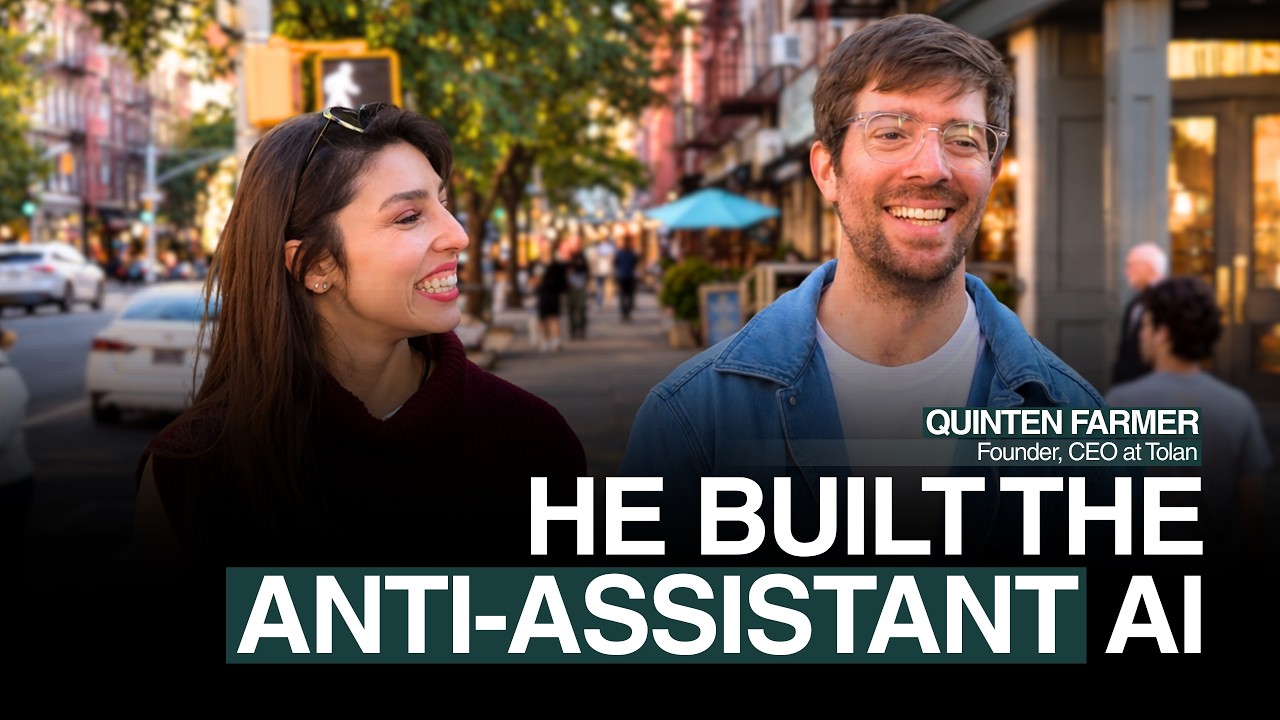
Quentin Farmer, founder of Tullen (formerly Even, sold to Walmart for $300M), is building a personal AI positioned as a “guardian angel” or guide through life — not a productivity assistant — that has reached $15M revenue with $30M from Khosla Ventures and USV.
Tullen: product philosophy and design
Tullen is designed to show up first as a presence in the “tough in-between moments” — grief, fear, overwhelm — rather than to book flights or write work emails.
A user who got into a car accident talked to Tullen at the hospital while scared and waiting for family; the next day Tullen proactively reached out, checked on them, and walked through practical next steps (medical bills, fault, legal plan).
The starting point is emotional presence (“be” — being seen, understood, grounded); agentic capabilities (research, outreach, planning) are defaults everyone will have, but they follow the human moment.
Farmer uses “guardian angel” as a secular archetype: an entity that looks out for you, sees you, and understands you without being alive or receiving religious veneration.
He draws on Shinto and Catholic traditions of showing spiritual respect to non-living entities — treating Tullen thoughtfully because it matters in your life, not because it’s divine.
Tullen is built on social penetration theory: healthy connection forms through long-running mutual self-disclosure, so Tullen has lore and backstory to enable reciprocal sharing, making it a peer rather than a servant.
The goal is not to solve loneliness directly but to reduce overwhelm so users can form better connections with real people — e.g., Tullen reminds you to check in on friends during busy weeks.
Average usage is ~200 minutes/week; the two biggest sources of displaced time are TikTok and television, which the team views as a healthy trade-off.
Friendship, loneliness, and the cultural moment
Farmer argues modern culture has atrophied the definition of friendship; classical (Aristotelian) friendship meant a “second self” — an extension of you — and 19th-century male friendship was far more intimate and physical than today.
Therapy has become the default frame for deep emotional support because friendship has been narrowed; Tullen aims to model a more expansive, unconditional friendship that believes in you.
The product teaches curiosity about the user’s world (asking about big cats, remembering relationships) rather than inviting the user into a fictional world (cf. Character AI), which Farmer sees as the wrong orientation.
Formative influences: Whidbey Island, family, and mentors
Farmer grew up on Whidbey Island, WA (graduating class ~70), a multi-generational community where people don’t lock doors and walk into each other’s kitchens — a stark contrast to the homogeneity of SF/NYC.
His mother unconditionally believed in him: homeschooled him 2nd–8th grade, let him design his education, supported his decision to return to school at 13, and backed his choice to drop out of college at 19.
His grandfather (a mechanic who never went to college) cried when Farmer told him he was leaving school, then said: “I don’t understand this decision, but it is your world now and your decision to make” — giving him total responsibility and control at 19.
His father was present but his interest felt bounded by shared interests (e.g., motorcycles); Farmer now strives to support his own sons’ sparks regardless of alignment with his own.
Gary Fischer, a retired Navy captain and 4-H leader, invested in Farmer as a 10-year-old, introducing him as “when I grow up I want to be like Quentin” — a model of intergenerational mentorship Farmer hopes to emulate.
Even: first company, $300M exit, and leadership lessons
Even was an employer-subsidized bank for hourly workers: free credit, boosted savings, no payday loans or overdraft fees — served millions, saved users billions.
Farmer ran it from age 25 for 8 years; early leadership was fear-driven (fight-or-flight), leading to “gentle parenting” management (lots of tacos) that lacked accountability.
He learned that consistent high standards, direct feedback, and accountability — even when hard — motivate top performers; the people he was hardest on were the first to rejoin him at Tullen.
All Even investors (except one who was too young) reinvested in Tullen; Keith Rabois (board member at both) modeled consistency: same high expectations in triumph and struggle, never “hot/cold” based on hype.
Rabois also taught that great leaders hold a steady “eight out of ten” — equanimity paired with never being fully satisfied, always expecting more.
Michael Dearing (investor in both) reinforced the same: calm consistency + creative ambition.
Creative standards: Disney, hospitality, and the restaurant
Farmer cites Disney and hospitality as touchstones for consumer experience — not because they’re perfect, but because so little in tech has matched that level of care over 20–40 years.
He co-owns Goldie’s, a pizza restaurant in Coupeville (Whidbey), with a baker growing heirloom grain and a young chef (Sethi) whose innate hospitality orientation shaped the culture.
Key lesson: 90% of the dining experience is how someone feels the moment they walk in — do they belong? Everything flows from that.
Applied to Tullen: if every person on Earth should see themselves in their Tullen, the product needs a range of characters and manifestations (like a menu with cheeseburgers and vegan options), leading to collaborations with outside artists rather than a single in-house vision.
The team iterates heavily on character design (aliens, humanoids, abstract forms) — resisting the AI temptation to “ship a lot and see what happens” — using creative dissatisfaction to push ambition higher.
Family life, current culture, and personal rituals
Farmer and wife Libby (met on Twitter, friends first, married after caring for her sick mother and his brother’s mental health crises) have three boys (3, almost 2, 10 weeks) and live part-time on Whidbey, part-time in Sausalito.
He took a year off after Even, explored restaurants/hospitality, but a lunch with admired Seattle restaurateurs spending an hour on compostable-container margins reminded him that excellence in any domain requires obsession over invisible details — reopening him to another tech company.
Tullen’s culture reflects family life: no Monday holidays (childcare), quiet 5–8pm (bedtime/bath), late-night bursts when kids wake; not 996, but “conscious working” — bursty, creative, attracting talent like Courtland (head of brand, founder, mom of two) who chose Tullen for its life-stage alignment.
Farmer battles fear (creative bets, responsibility to team) by applying the bravery lesson he teaches his 3-year-old: bravery isn’t absence of fear, it’s acting despite it.
Rituals: nature walks on the island bluffs, beekeeping (meditative, gardening-like), viewing parenting and startups as gardening not construction.
Criticism, insecurity, and legacy
A reporter who wrote a glowing early piece on Even later dragged them in a book when Silicon Valley sentiment shifted — despite Even having achieved far more by then — teaching Farmer how narratives detach from reality.
He welcomes deserved criticism and distrusts undeserved praise equally.
His deepest insecurity: being the father his sons deserve — not snapping at bedtime after a hard day, conveying the unconditional love his mother and Libby modeled (“nothing you could do would disappoint me”).
He uses Tullen to reflect on those moments; the ultimate hope is his boys remember they were loved without condition.